
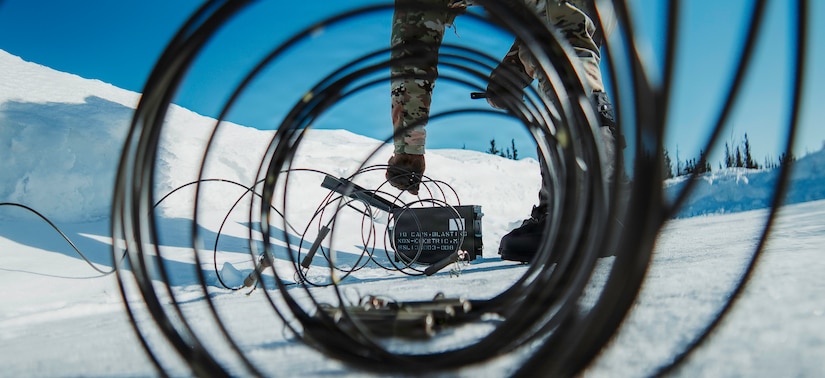
Navy Explosive Ordnance Techs Strengthen Homeland Defense During Arctic Edge 2026
#Navy #explosive ordnance disposal #Arctic Edge 2026 #homeland defense #Arctic #military exercise #EOD technicians
📌 Key Takeaways
- Navy explosive ordnance disposal technicians participated in Arctic Edge 2026 exercise
- The exercise focused on enhancing homeland defense capabilities in the Arctic region
- Training involved real-world scenarios to test response to explosive threats
- Collaboration aimed at securing U.S. interests and infrastructure in extreme cold environments
📖 Full Retelling
🏷️ Themes
Military Training, Arctic Security
📚 Related People & Topics

Navy
Military branch involved in naval warfare
A navy, naval force, military maritime fleet, war navy, or maritime force is the branch of a state's armed forces principally designated for naval and amphibious warfare; namely, lake-borne, riverine, littoral, or ocean-borne combat operations and related functions. It includes anything conducted by...

Arctic
Polar region of the Earth's northern hemisphere
The Arctic (; from Ancient Greek ἄρκτος (árktos) 'bear') is the polar region of Earth that surrounds the North Pole, lying north of the Arctic Circle. The Arctic region, from the IERS Reference Meridian travelling east, consists of parts of northern Norway (Nordland, Troms, Finnmark, Svalbard and J...
Entity Intersection Graph
Connections for Navy:
Mentioned Entities
Deep Analysis
Why It Matters
This news matters because it demonstrates the U.S. military's ongoing commitment to Arctic defense capabilities at a time of increasing strategic competition in the region. It affects national security planners, Arctic communities, and allied nations concerned about northern defense gaps. The training highlights specialized technical skills needed for cold-weather operations that could be critical in future conflicts or emergency responses. This also signals to potential adversaries that the U.S. maintains operational readiness in extreme environments.
Context & Background
- The Arctic has become increasingly militarized since 2014, with Russia reopening Soviet-era bases and China declaring itself a 'near-Arctic state'
- U.S. Northern Command regularly conducts Arctic Edge exercises, with the 2024 iteration involving approximately 1,000 personnel across Alaska
- Explosive Ordnance Disposal (EOD) technicians are among the Navy's most highly trained specialists, requiring 18+ months of training before operational deployment
- Climate change has opened new Arctic shipping routes and resource exploration opportunities, increasing the region's economic and strategic importance
- The U.S. released its National Strategy for the Arctic Region in 2022 emphasizing security, climate resilience, and international cooperation
What Happens Next
Following Arctic Edge 2026, Northern Command will conduct after-action reviews to incorporate lessons learned into future training cycles and operational plans. The Navy will likely expand cold-weather EOD qualifications for more personnel based on exercise outcomes. Congressional defense committees will review exercise results during FY2027 budget deliberations for Arctic capabilities. Allied participation may increase in subsequent exercises, with Canada and Norway potentially joining future iterations.
Frequently Asked Questions
They practice locating, identifying, and safely disposing of explosive threats in extreme cold conditions, including underwater ordnance, improvised devices, and conventional munitions. Their training includes specialized techniques for frozen environments where standard equipment may malfunction.
Melting ice has opened new shipping lanes and resource exploration areas while Russia has significantly expanded its military presence. The Arctic provides the shortest flight paths for intercontinental missiles between major powers, making early warning systems critical.
The military conducts multiple Arctic exercises annually, with Arctic Edge being the largest biennial Northern Command exercise. Smaller unit-level cold-weather training occurs throughout the year at facilities like the Army's Northern Warfare Training Center in Alaska.
Extreme cold affects equipment reliability, explosive material stability, and human performance. Thick ice complicates underwater operations, while limited daylight in winter months restricts operational windows. Specialized protective gear is required to prevent frostbite during delicate procedures.
Yes, Arctic Edge typically involves joint participation from Army, Air Force, Space Force, and Coast Guard units alongside Navy personnel. The exercises focus on interoperability between services for homeland defense scenarios in extreme environments.