
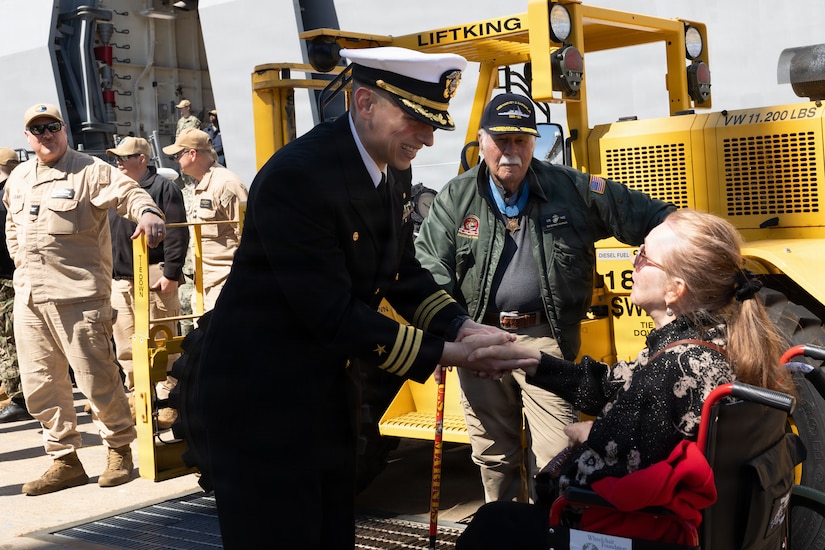
Navy's Newest Destroyer Arrives at Naval Station Norfolk Ahead of Commissioning
📖 Full Retelling
📚 Related People & Topics

Naval Station Norfolk
United States Navy base in Virginia
Naval Station Norfolk is a United States Navy base in Norfolk, Virginia, that is the headquarters and home port of the U.S. Navy's Fleet Forces Command. The installation occupies about 4 miles (6.4 km) of waterfront space and 11 miles (18 km) of pier and wharf space of the Hampton Roads peninsula kn...

Navy
Military branch involved in naval warfare
A navy, naval force, military maritime fleet, war navy, or maritime force is the branch of a state's armed forces principally designated for naval and amphibious warfare; namely, lake-borne, riverine, littoral, or ocean-borne combat operations and related functions. It includes anything conducted by...

USS Zumwalt
Guided missile destroyer of the United States Navy
USS Zumwalt (DDG-1000) is a guided missile destroyer of the United States Navy. She is the lead ship of the Zumwalt class and the first ship to be named after Admiral Elmo Zumwalt. Zumwalt has stealth capabilities, having a radar cross-section similar to a fishing boat despite her large size.
Entity Intersection Graph
No entity connections available yet for this article.
Mentioned Entities
Deep Analysis
Why It Matters
The arrival of the Navy's newest destroyer at Naval Station Norfolk represents a significant enhancement of U.S. naval capabilities, particularly for the Atlantic Fleet. This matters because modern destroyers serve as multi-mission platforms capable of air defense, anti-submarine warfare, and surface combat, directly impacting national security and maritime dominance. The commissioning of new vessels strengthens the Navy's ability to project power globally and respond to emerging threats. This development affects military strategists, defense contractors, and international allies who rely on U.S. naval presence for security and stability.
Context & Background
- The U.S. Navy has been modernizing its surface fleet with Arleigh Burke-class Flight III destroyers, which feature advanced radar systems and enhanced combat capabilities.
- Naval Station Norfolk is the world's largest naval base and serves as homeport for the U.S. Atlantic Fleet, making it a strategic location for new vessel arrivals and commissioning ceremonies.
- Destroyer commissioning ceremonies are traditional naval events where ships are officially placed into active service, often involving military dignitaries and public celebrations.
- The U.S. Navy operates approximately 70 active destroyers, with ongoing efforts to maintain a fleet of 355 battle force ships as mandated by Congressional requirements.
- Recent geopolitical tensions in regions like the South China Sea and Eastern Mediterranean have increased demand for advanced naval assets with multi-domain warfare capabilities.
What Happens Next
The destroyer will undergo final preparations and crew training ahead of its formal commissioning ceremony, typically scheduled within weeks of arrival. Following commissioning, the ship will begin initial sea trials and operational testing before being deployed for its first mission. The Navy will likely announce deployment schedules and homeport assignments within 3-6 months, with the vessel expected to join carrier strike groups or operate independently in strategic regions.
Frequently Asked Questions
This is likely an Arleigh Burke-class Flight III destroyer, featuring the AN/SPY-6 air and missile defense radar, enhanced electronic warfare systems, and improved anti-submarine capabilities. These ships can engage multiple threats simultaneously and serve as key components of carrier strike groups.
Naval Station Norfolk is the largest naval base in the world and serves as the primary East Coast homeport for the U.S. Atlantic Fleet. Its strategic location provides immediate access to the Atlantic Ocean and supports extensive maintenance, training, and logistical facilities essential for new vessel integration.
Typically, a new destroyer requires 6-12 months after commissioning to achieve full operational capability. This period includes crew certification, weapons system testing, and integration exercises with other fleet assets before the vessel is ready for deployment.
The new destroyer will enhance the Navy's ability to conduct air defense, anti-submarine warfare, and surface combat operations. It will strengthen maritime presence in key regions and provide additional capacity for protecting sea lanes and supporting allied forces during international operations.
This arrival supports the Navy's ongoing fleet expansion and modernization goals, particularly the transition to more advanced Flight III destroyers. These ships represent critical steps toward maintaining technological superiority and meeting Congressional mandates for a larger, more capable naval force.