
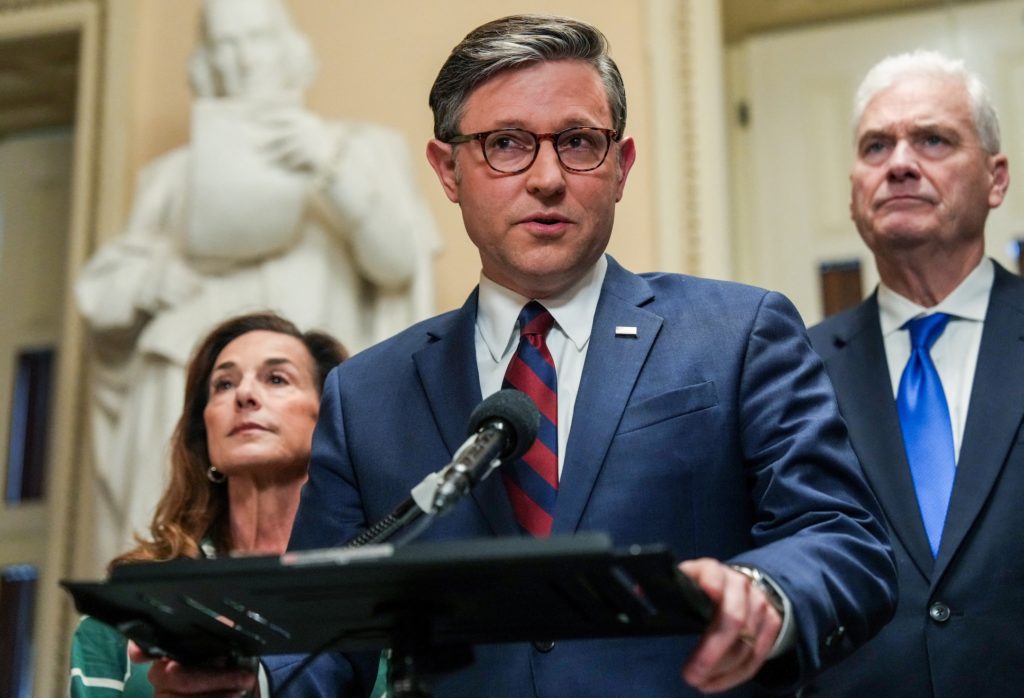
News Wrap: Johnson, Thune agree on path to fund DHS through September
📖 Full Retelling
📚 Related People & Topics

United States Department of Homeland Security
United States federal executive department
The United States Department of Homeland Security (DHS) is the U.S. federal executive department responsible for public security, roughly comparable to the interior, home, or public security ministries in other countries. Its missions involve anti-terrorism, civil defense, immigration and customs, b...

Mike Johnson
Speaker of the US House of Representatives since 2023
James Michael Johnson (born January 30, 1972) is an American lawyer and politician serving as the 56th speaker of the United States House of Representatives since 2023. A member of the Republican Party, he is in his fifth House term, having represented Louisiana's 4th congressional district since 20...

John Thune
American politician (born 1961)
John Randolph Thune ( THOON; born January 7, 1961) is an American politician serving as the senior United States senator from South Dakota, a seat he has held since 2005. From 1997 to 2003, he was the U.S. representative for South Dakota's at-large congressional district. A Republican, Thune has bee...
Entity Intersection Graph
Connections for United States Department of Homeland Security:
Mentioned Entities
Deep Analysis
Why It Matters
This agreement prevents a partial government shutdown of the Department of Homeland Security, which would have disrupted border security, immigration enforcement, and disaster response operations. It affects federal employees who would face furloughs, travelers who depend on TSA screening, and communities relying on FEMA assistance. The bipartisan compromise demonstrates Congress can still reach critical funding deals despite deep political divisions, maintaining essential national security functions.
Context & Background
- The Department of Homeland Security was created in 2002 following the 9/11 attacks to consolidate various security agencies
- Congress has frequently struggled with DHS funding due to political disagreements over immigration and border policies
- Government shutdowns have occurred multiple times in recent decades, most recently in 2018-2019 lasting 35 days
- DHS employs approximately 240,000 people across agencies including TSA, CBP, ICE, FEMA, and Coast Guard
What Happens Next
The funding agreement will move through congressional committees before full House and Senate votes, likely within the next two weeks. If passed, President Biden will sign the legislation before the current funding expires on September 30. Congressional leaders will then turn to other appropriations bills for the remaining federal agencies.
Frequently Asked Questions
DHS includes TSA (airport security), CBP (border protection), ICE (immigration enforcement), FEMA (emergency management), Coast Guard, Secret Service, and cybersecurity agencies. These agencies protect borders, manage disasters, and secure transportation systems.
Without funding, DHS would undergo a partial shutdown where non-essential employees would be furloughed. Essential personnel like border agents and TSA officers would work without pay until funding is restored, potentially causing operational delays and security vulnerabilities.
Funding debates frequently center on immigration enforcement levels, border wall construction, and detention policies. These issues reflect deep partisan divides, with Republicans emphasizing border security while Democrats focus on humanitarian concerns and immigration reform.
The funding agreement maintains current immigration enforcement operations but doesn't change underlying policies. It provides resources for border patrol, detention facilities, and asylum processing without altering the legal framework governing immigration.