
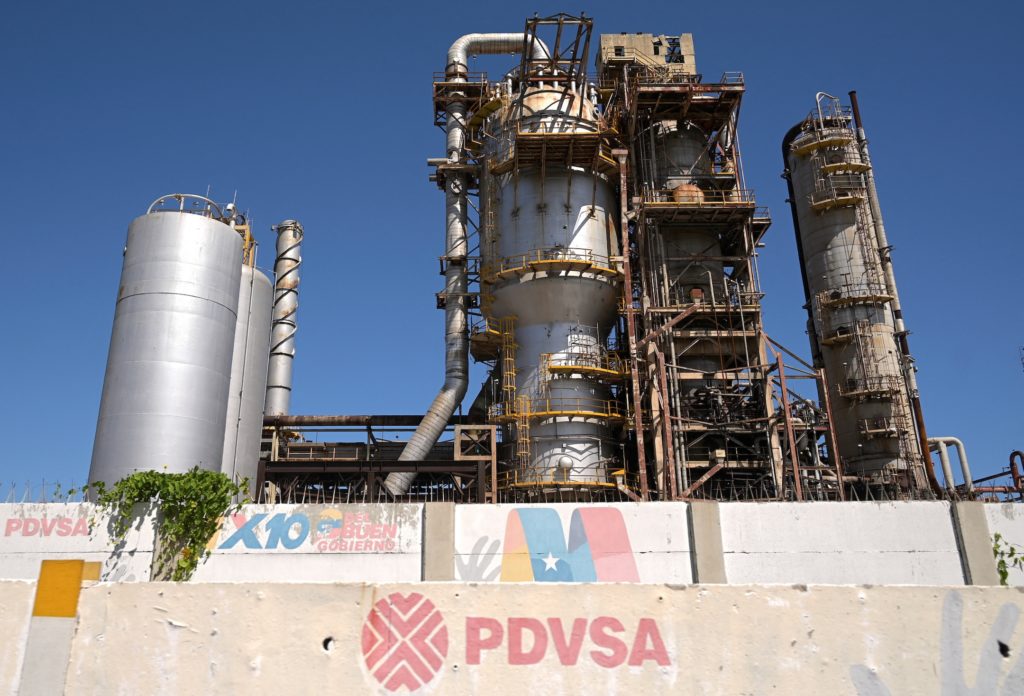
News Wrap: U.S. eases sanctions on Venezuela's state-owned oil company
#sanctions #Venezuela #oil #PDVSA #United States #energy #diplomacy #exports
📌 Key Takeaways
- The U.S. has eased sanctions on Venezuela's state-owned oil company PDVSA.
- This move allows for increased oil production and exports from Venezuela.
- The decision is part of diplomatic efforts to support political negotiations in Venezuela.
- It aims to address global energy market pressures and inflation concerns.
📖 Full Retelling
🏷️ Themes
International Relations, Energy Policy
📚 Related People & Topics

PDVSA
Venezuelan state-owned oil and gas company
Petróleos de Venezuela, S.A. (PDVSA, Spanish pronunciation: [peðeˈβesa]; English: Petroleum of Venezuela) is the state-owned oil and gas company of Venezuela. It has activities in exploration, production, refining and exporting of oil, as well as exploration and production of natural gas. Since its ...

Venezuela
Venezuela, officially the Bolivarian Republic of Venezuela, is a country on the northern coast of South America, consisting of a continental landmass and various islands and islets in the Caribbean Sea. It comprises an area of 912,050 km2 (352,140 sq mi), with a population estimated at 31.8 million ...

United States
Country primarily in North America
The United States of America (USA), also known as the United States (U.S.) or America, is a country primarily located in North America. It is a federal republic of 50 states and a federal capital district, Washington, D.C. The 48 contiguous states border Canada to the north and Mexico to the south, ...
Entity Intersection Graph
Connections for PDVSA:
Mentioned Entities
Deep Analysis
Why It Matters
This development matters because it signals a significant shift in U.S.-Venezuela relations after years of maximum pressure sanctions. It directly affects global oil markets by potentially increasing supply from Venezuela's substantial reserves, which could help stabilize prices. The move impacts Venezuelan citizens who may see economic relief, U.S. energy companies seeking new opportunities, and geopolitical dynamics in Latin America where Venezuela has been increasingly isolated.
Context & Background
- The U.S. imposed comprehensive sanctions on Venezuela's state-owned PDVSA oil company in 2019, cutting off its primary revenue source
- Venezuela has the world's largest proven oil reserves but production has collapsed from 3 million barrels per day in the 1990s to under 700,000 barrels per day currently
- The sanctions were part of a 'maximum pressure' campaign to force political change following disputed 2018 elections that many countries deemed illegitimate
- Previous sanctions relief in 2022 was temporary and conditional on political negotiations between the government and opposition
- Venezuela's economy has contracted by over 75% since 2014, creating a humanitarian crisis with mass migration throughout the region
What Happens Next
Venezuela will likely begin increasing oil exports to the U.S. and other markets within weeks, though infrastructure limitations may cap initial production gains. The Biden administration will monitor compliance with election commitments ahead of Venezuela's 2024 presidential vote. International oil companies like Chevron and European firms may seek expanded operations, while OPEC+ will watch how additional Venezuelan supply affects their production quotas.
Frequently Asked Questions
The Biden administration is responding to global energy market pressures from the Ukraine war and seeking to encourage democratic progress ahead of Venezuela's 2024 elections. The move also addresses regional migration concerns by potentially improving Venezuela's economic conditions.
Increased Venezuelan production could modestly lower global oil prices by adding supply, but the impact may be limited initially due to Venezuela's deteriorated infrastructure. The psychological effect on markets may be more significant than immediate volume increases.
The relief is conditional on Venezuela allowing monitored presidential elections in 2024 and continuing negotiations with opposition parties. The U.S. can reverse the decision if Venezuela backtracks on democratic commitments or engages in human rights abuses.
Initial increases could occur within months using existing infrastructure, but returning to pre-sanction levels would require billions in investment and years of work. Most analysts project Venezuela might add 200,000-400,000 barrels per day within the first year.
This represents a shift away from the U.S. policy of recognizing Guaidó as interim president, instead focusing on electoral conditions. The opposition will need to regroup around electoral strategies rather than relying on international pressure alone.