
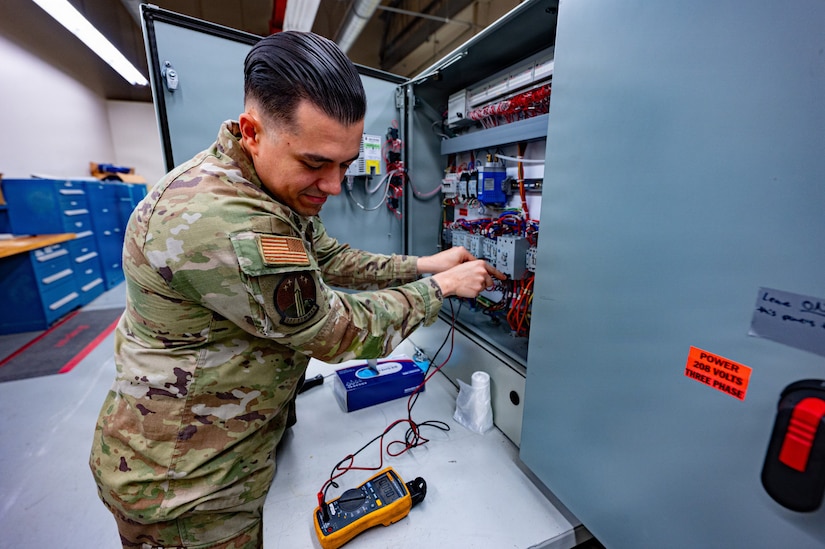
Next Generation of Airmen Sustain Deterrence Mission
#Airmen #Deterrence #B-21 Raider #Sentinel ICBM #Strategic Defense #Modernization #Training
📌 Key Takeaways
- The U.S. Air Force is training a new generation of airmen to maintain nuclear deterrence capabilities.
- These airmen are being prepared to operate and support advanced systems like the B-21 Raider and Sentinel ICBM.
- The mission emphasizes the importance of readiness and reliability in strategic defense.
- Continuous modernization and skill development are critical to sustaining long-term deterrence.
📖 Full Retelling
🏷️ Themes
Military Readiness, Nuclear Deterrence
📚 Related People & Topics

Airman
Member of a national armed force relating to aviation
An airman is a member of an air force or air arm of a nation's military. In some services it can refer to any service member, equivalent to the term soldier or sailor, and in some it is also a specific enlisted rank. Both men and women with this rank are called airmen.
Modernization theory
Explanation for the process of modernization within societies
Modernization theory or modernisation theory holds that as societies become more economically modernized, wealthier, and more educated, their political institutions become increasingly liberal democratic and rationalist. The "classical" theories of modernization of the 1950s and 1960s, most influent...

LGM-35 Sentinel
Intercontinental ballistic missile
The LGM-35 Sentinel, initially known as the Ground Based Strategic Deterrent (GBSD), is a land-based intercontinental ballistic missile (ICBM) system under development for the United States Air Force. It was intended to replace all 450 Minuteman III missiles beginning in 2029, with service expected ...
Entity Intersection Graph
Connections for Airman:
View full profileMentioned Entities
Deep Analysis
Why It Matters
This news highlights the critical transition of nuclear deterrence responsibilities to younger military personnel, ensuring the continuity of national security strategies that prevent catastrophic conflicts. It affects global geopolitical stability by maintaining credible nuclear capabilities that deter adversaries from aggression. The development impacts military families, defense contractors, and international allies who rely on consistent U.S. strategic posture. Successful transition is essential for maintaining confidence in nuclear command systems during evolving global threats.
Context & Background
- The U.S. nuclear triad (land-based missiles, submarine-launched missiles, strategic bombers) has been maintained since the Cold War era
- Recent modernization programs include the B-21 Raider bomber, Columbia-class submarines, and Sentinel ICBM replacements
- Previous generations of nuclear personnel trained during periods of heightened tensions with specific adversaries like the Soviet Union
- Nuclear deterrence doctrine relies on credible second-strike capability and clear communication of red lines
- The New START treaty limitations have shaped current force structures and deployment patterns
What Happens Next
Expect increased training exercises and certification events for new nuclear personnel throughout 2024-2025. Defense contractors will accelerate delivery of next-generation systems requiring operator training. Congressional oversight hearings will likely review transition effectiveness in upcoming defense authorization debates. International partners will monitor readiness levels during upcoming NATO exercises and strategic dialogues.
Frequently Asked Questions
They operate and maintain nuclear delivery systems including bombers, missiles, and command-control infrastructure. Their responsibilities range from direct weapons handling to intelligence analysis supporting targeting decisions and readiness verification procedures.
New personnel undergo rigorous training on updated safety procedures while maintaining established safeguards. The transition incorporates lessons from past incidents and technological improvements to enhance security during handover periods between generations.
Potential challenges include knowledge transfer gaps from retiring experts, adapting to new technologies while maintaining legacy systems, and sustaining morale during demanding certification processes. Cybersecurity threats to newer digital systems also present evolving risks.
The transition occurs amid renewed great power competition, requiring personnel to understand contemporary threat landscapes while maintaining foundational deterrence principles. This affects strategic calculations with nuclear-armed adversaries and non-proliferation efforts globally.
Nuclear personnel receive specialized education in weapons effects, fail-safe procedures, and unique security protocols. Their training emphasizes extreme reliability standards, two-person rules, and psychological screening for high-stress decision-making environments.