
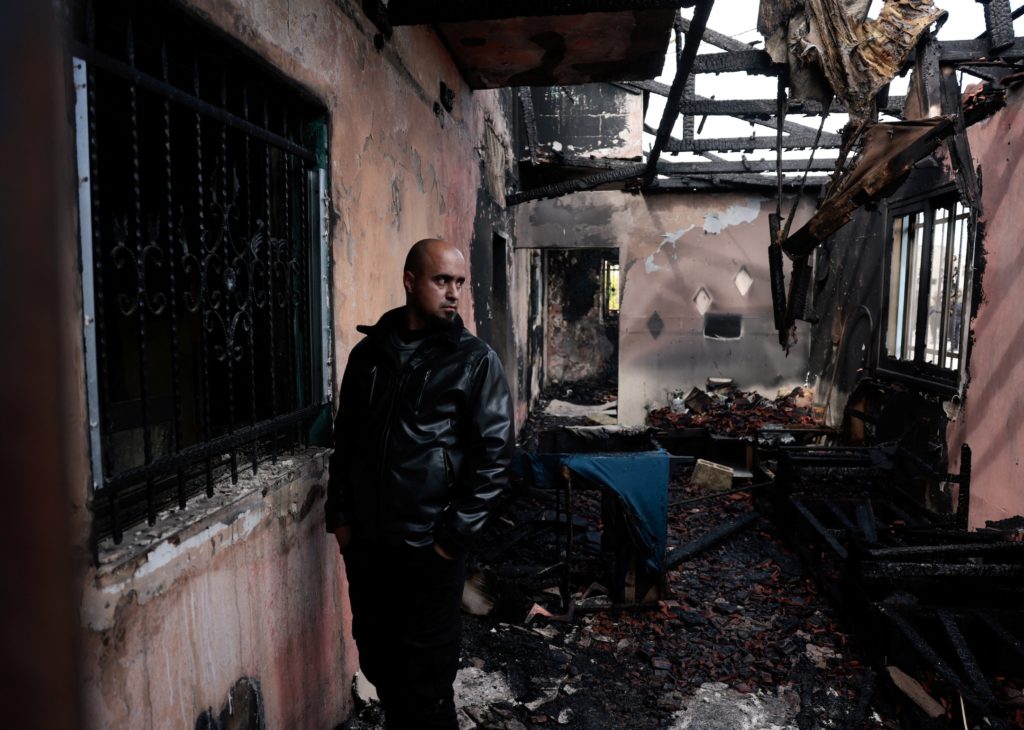
Palestinians in occupied West Bank face growing violence from Israeli settlers
📖 Full Retelling
📚 Related People & Topics

Palestinians
Arab ethnonational group of the Levant
Palestinians (Arabic: الفلسطينيون, romanized: al-Filasṭīniyyūn) are an Arab ethnonational group native to the Levantine region of Palestine. They represent a highly homogeneous community who share a cultural and ethnic identity, speak Palestinian Arabic and share close religious, linguistic, and cul...

West Bank
Palestinian territory occupied by Israel
The West Bank is on the western bank of the Jordan River and is the larger of the two Palestinian territories (the other being the Gaza Strip) that make up the State of Palestine. A landlocked territory near the coast of the Mediterranean Sea in West Asia's Levant region, it is bordered by Jordan an...

Israeli settlement
Israeli communities built on land occupied in the 1967 Six-Day War
Israeli settlements, also called Israeli colonies, are the civilian communities built by Israel throughout the Israeli-occupied territories. They are populated by Israeli citizens, almost exclusively of Jewish identity or ethnicity, and have been constructed on lands that Israel has militarily occup...
Entity Intersection Graph
Connections for Palestinians:
Mentioned Entities
Deep Analysis
Why It Matters
This escalating violence threatens to destabilize the already fragile security situation in the West Bank, potentially triggering broader regional conflict. It directly affects Palestinian civilians who face displacement, injury, and loss of livelihood from settler attacks, while also impacting Israeli security forces who must respond to increased tensions. The violence complicates diplomatic efforts toward a two-state solution and undermines Palestinian Authority governance in areas meant to be under its control. International observers warn this could lead to further radicalization and cycles of retaliation.
Context & Background
- The West Bank has been under Israeli military occupation since the 1967 Six-Day War, with Palestinian Authority administering limited self-rule in parts since the 1990s Oslo Accords
- Israeli settlements in the West Bank are considered illegal under international law by most countries, though Israel disputes this characterization
- Settler violence against Palestinians has been documented for decades, often following Palestinian attacks against Israelis or during periods of heightened political tension
- The UN recorded over 1,200 settler attacks against Palestinians in 2023, the highest annual number since record-keeping began
- Many settlements are protected by the Israeli military, creating friction between settlers, Palestinians, and security forces
What Happens Next
International pressure on Israel to curb settler violence will likely intensify, with potential for US sanctions against individual settlers. Palestinian leadership may seek UN Security Council action or International Criminal Court investigations. The Israeli military will probably increase deployments in flashpoint areas, but may face challenges balancing settler protection with Palestinian safety. Localized clashes could escalate into broader confrontations, especially around religious sites during upcoming holidays.
Frequently Asked Questions
Motivations vary but often include ideological beliefs about Jewish rights to the land, retaliation for Palestinian attacks against Israelis, or attempts to pressure Palestinians to leave areas settlers wish to control. Some attacks are coordinated while others are spontaneous reactions to tensions.
Palestinians in the West Bank fall under Israeli military law rather than civilian law, creating different legal standards than those applied to Israeli settlers. The Palestinian Authority has limited jurisdiction in Areas A and B but cannot protect residents from settler attacks occurring in Area C or near settlement boundaries.
Settler violence undermines trust in negotiations by demonstrating Israel's limited control over extremist elements and creating facts on the ground that complicate territorial compromises. It strengthens Palestinian arguments that Israel isn't serious about a viable Palestinian state alongside Israel.
The US and EU have condemned settler violence and imposed some sanctions on individual settlers. The UN regularly documents abuses but has limited enforcement power. International humanitarian organizations provide aid and monitoring but cannot offer physical protection to vulnerable communities.
No, most settlers are not directly involved in violence, with attacks typically carried out by a minority of ideological extremists. However, the broader settlement project creates structural conditions that enable violence, and many mainstream settlers benefit from or tacitly support the displacement of Palestinians.