
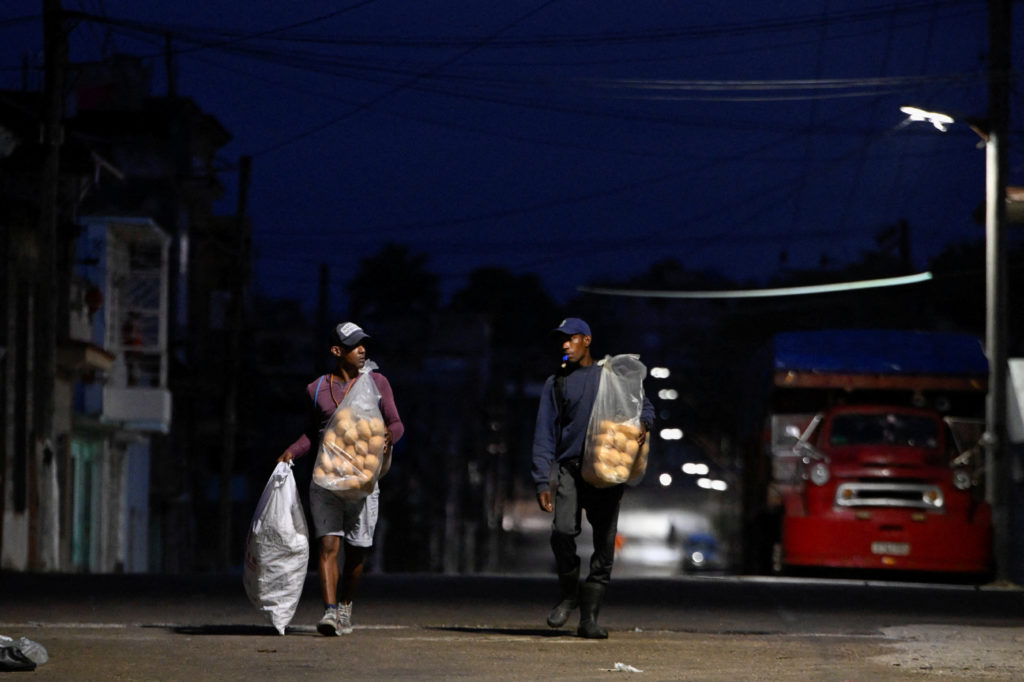
Rubio calls for new Cuban leaders as blackout underscores economic crisis
#Cuba #Marco Rubio #blackout #economic crisis #leadership change #infrastructure #U.S.-Cuba relations
📌 Key Takeaways
- Senator Marco Rubio demands leadership change in Cuba amid ongoing economic turmoil.
- A nationwide blackout highlights Cuba's severe infrastructure and economic challenges.
- The power outage exacerbates existing hardships for Cuban citizens, including shortages of essentials.
- Rubio's statement reflects U.S. political pressure on Cuba's government to address systemic issues.
📖 Full Retelling
🏷️ Themes
Political Pressure, Economic Crisis
📚 Related People & Topics

Cuba
Country in the Caribbean
Cuba, officially the Republic of Cuba, is an island country in the Caribbean. It comprises the eponymous main island as well as 4,195 islands, islets, and cays. Situated at the convergence of the Caribbean Sea, Gulf of Mexico, and Atlantic Ocean, Cuba is located east of the Yucatán Peninsula, south ...

Marco Rubio
American politician and diplomat (born 1971)
Marco Antonio Rubio (, ROO-bee-oh; born May 28, 1971) is an American politician, attorney, and diplomat serving as the 72nd United States secretary of state since 2025. A member of the Republican Party, he represented Florida in the U.S. Senate from 2011 to 2025. Rubio is also the acting national se...
Entity Intersection Graph
Connections for Cuba:
Mentioned Entities
Deep Analysis
Why It Matters
This news matters because it highlights Cuba's deepening economic crisis and infrastructure failures that directly impact 11 million Cuban citizens facing daily hardships. It reveals ongoing U.S. political pressure on Cuba's government during a vulnerable period, potentially affecting bilateral relations and regional stability. The situation also illustrates how Cuba's economic model struggles to provide basic services, which could influence migration patterns and humanitarian concerns in the Caribbean region.
Context & Background
- Cuba has faced U.S. economic sanctions since 1960, tightened under the Trump administration and maintained by Biden
- Cuba's economy shrank 2% in 2023 and has struggled since the pandemic devastated tourism, its main foreign currency source
- The country has experienced recurring power outages since 2022 due to aging infrastructure and fuel shortages
- Marco Rubio, as Florida Senator and Cuban-American, has consistently advocated for regime change in Cuba throughout his political career
- Cuba's government has maintained one-party communist rule since the 1959 revolution despite periodic protests over economic conditions
What Happens Next
Cuba will likely face continued power instability through 2024 as infrastructure repairs require foreign currency it lacks. The U.S. Congress may consider additional Cuba sanctions legislation in coming months, particularly if migration from Cuba increases. Cuban authorities will probably implement further energy rationing while seeking fuel assistance from allies like Venezuela, Russia or China. Expect increased diplomatic tensions between Washington and Havana, especially during the 2024 U.S. election cycle.
Frequently Asked Questions
Cuba's electrical grid suffers from decades of underinvestment and relies on aging Soviet-era infrastructure. The country lacks sufficient fuel imports due to economic constraints and U.S. sanctions, preventing proper maintenance and operation of power plants.
Senator Rubio advocates for complete regime change in Cuba and maintains hardline sanctions. As the son of Cuban exiles, he supports maximum pressure policies to undermine Cuba's communist government and promote democratic transition.
Cubans face severe shortages of food, medicine and basic goods, with inflation exceeding 30%. Daily blackouts disrupt work, education and healthcare, while average monthly salaries of about $20 fail to cover basic needs, forcing many to rely on remittances.
Relations remain tense with most Trump-era sanctions intact. Limited engagement continues on migration and law enforcement, but broader normalization stalled over Cuba's human rights record and support for Venezuela's government.
While protests have occurred, Cuba's government maintains control through security forces and political organization. Systemic change appears unlikely short-term, though economic pressures may force gradual reforms or increased repression.