
Supreme Court appears skeptical of Trump's bid to end birthright citizenship
📖 Full Retelling
📚 Related People & Topics
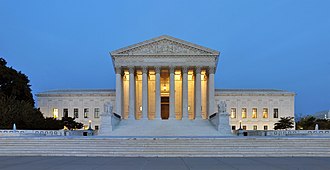
Supreme court
Highest court in a jurisdiction
In most legal jurisdictions, a supreme court, also known as a court of last resort, apex court, high (or final) court of appeal, and court of final appeal, is the highest court within the hierarchy of courts. Broadly speaking, the decisions of a supreme court are binding on all other courts in a nat...

Donald Trump
President of the United States (2017–2021; since 2025)
Donald John Trump (born June 14, 1946) is an American politician, media personality, and businessman who is the 47th president of the United States. A member of the Republican Party, he served as the 45th president from 2017 to 2021. Born into a wealthy New York City family, Trump graduated from the...
Entity Intersection Graph
Connections for Supreme court:
Mentioned Entities
Deep Analysis
Why It Matters
This case challenges the 14th Amendment's guarantee that anyone born in the United States is automatically a citizen, a principle established after the Civil War to ensure equal rights. If overturned, it could affect millions of children born to undocumented immigrants, potentially creating a permanent underclass without citizenship rights. The outcome will shape immigration policy for generations and could trigger legal battles over the status of millions of Americans. This matters to immigrant families, policymakers, and anyone concerned with constitutional interpretation and civil rights.
Context & Background
- The 14th Amendment's Citizenship Clause was ratified in 1868 to guarantee citizenship to formerly enslaved people and their descendants.
- Birthright citizenship has been upheld for over 150 years, including in the 1898 Supreme Court case United States v. Wong Kim Ark.
- Previous attempts to end birthright citizenship through legislation or executive order have failed due to constitutional concerns.
- The current case stems from former President Trump's executive order attempting to reinterpret the 14th Amendment's application.
- Approximately 300,000-400,000 children are born to undocumented immigrants in the U.S. annually who would be affected by this change.
What Happens Next
The Supreme Court will issue its ruling by late June or early July 2024. If they rule against birthright citizenship, Congress may attempt to pass legislation addressing the status of affected children. Either outcome will likely trigger additional lawsuits and political battles over immigration reform. State governments may also pass conflicting laws regarding documentation requirements for birth certificates.
Frequently Asked Questions
The 14th Amendment states: 'All persons born or naturalized in the United States, and subject to the jurisdiction thereof, are citizens of the United States and of the State wherein they reside.' This has been interpreted to grant automatic citizenship to anyone born on U.S. soil, with limited exceptions for children of foreign diplomats.
Most constitutional scholars argue no—changing birthright citizenship would require a constitutional amendment or a Supreme Court reinterpretation of the 14th Amendment. An executive order alone would likely face immediate legal challenges and be struck down as unconstitutional.
The United States is one of approximately 30 countries with unconditional birthright citizenship, including Canada and Mexico. Most developed nations, including European countries, require at least one parent to be a citizen or legal resident for a child to gain citizenship by birth.
If birthright citizenship ended, existing citizens would likely retain their status due to constitutional protections against retroactive laws. However, future children born to undocumented immigrants would not automatically become citizens, potentially creating a two-tier system.
Ending birthright citizenship could reduce 'birth tourism' where people travel to give birth in the U.S., but might also increase undocumented populations as families stay to avoid separation from non-citizen children. Immigration enforcement would become more complex with mixed-status families.