

Supreme Court appears skeptical of Trump's effort to limit birthright citizenship
📖 Full Retelling
📚 Related People & Topics
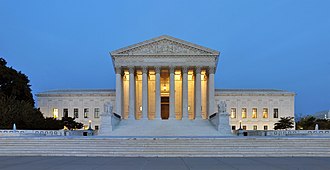
Supreme court
Highest court in a jurisdiction
In most legal jurisdictions, a supreme court, also known as a court of last resort, apex court, high (or final) court of appeal, and court of final appeal, is the highest court within the hierarchy of courts. Broadly speaking, the decisions of a supreme court are binding on all other courts in a nat...

Donald Trump
President of the United States (2017–2021; since 2025)
Donald John Trump (born June 14, 1946) is an American politician, media personality, and businessman who is the 47th president of the United States. A member of the Republican Party, he served as the 45th president from 2017 to 2021. Born into a wealthy New York City family, Trump graduated from the...
Entity Intersection Graph
Connections for Supreme court:
Mentioned Entities
Deep Analysis
Why It Matters
This news matters because it directly challenges the 14th Amendment's guarantee of birthright citizenship, which has been a cornerstone of American immigration policy since 1868. The outcome could affect millions of children born to undocumented immigrants, potentially altering their legal status and rights. It also has significant political implications for immigration debates and could reshape demographic patterns if citizenship rules change.
Context & Background
- The 14th Amendment, ratified in 1868, states that 'all persons born or naturalized in the United States... are citizens of the United States.'
- Birthright citizenship has been consistently upheld by courts for over 150 years, including in the 1898 Supreme Court case United States v. Wong Kim Ark.
- Previous attempts to limit birthright citizenship through legislation or executive action have failed to gain sufficient political or judicial support.
- The current case represents the most serious legal challenge to birthright citizenship in decades, testing the boundaries of presidential authority versus constitutional interpretation.
What Happens Next
The Supreme Court will issue its ruling by late June or early July 2024. If the Court rules against Trump's effort, birthright citizenship will remain intact. If the Court rules in favor, it could trigger immediate legal challenges and congressional responses, potentially leading to further litigation about implementation and enforcement.
Frequently Asked Questions
Birthright citizenship, also called jus soli, is the legal principle that any child born on a country's soil automatically becomes a citizen. In the U.S., this is established by the 14th Amendment's Citizenship Clause, which has been interpreted to apply regardless of parents' immigration status.
The Court's skepticism suggests they may rule against limiting birthright citizenship, which would preserve the current interpretation of the 14th Amendment. This would maintain stability in immigration law and prevent millions from potentially losing citizenship rights they believed were secure.
Approximately 300,000-400,000 children are born to undocumented immigrants in the U.S. annually. Changing birthright citizenship could affect these children plus potentially millions already born under the current system, creating complex legal questions about retroactive application.
Most Western Hemisphere countries practice birthright citizenship, including Canada and Mexico. Most European and Asian countries do not, requiring at least one parent to be a citizen or legal resident. The U.S. has one of the world's most inclusive birthright citizenship policies.
Legal scholars debate this, but most believe Congress cannot override the 14th Amendment's clear language through ordinary legislation. Changing birthright citizenship would likely require a constitutional amendment, which requires two-thirds of both houses of Congress and ratification by three-fourths of states.