

Supreme Court hears arguments in Trump's attempt to limit birthright citizenship
#Supreme Court #birthright citizenship #Trump #14th Amendment #immigration policy #citizenship #legal arguments
📌 Key Takeaways
- The Supreme Court is hearing arguments on a case challenging birthright citizenship.
- The case involves former President Trump's attempt to limit birthright citizenship.
- The outcome could redefine who is automatically granted U.S. citizenship at birth.
- The debate centers on the interpretation of the 14th Amendment's Citizenship Clause.
📖 Full Retelling
🏷️ Themes
Immigration, Constitutional Law
📚 Related People & Topics
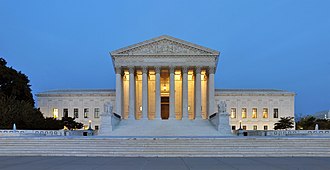
Supreme court
Highest court in a jurisdiction
In most legal jurisdictions, a supreme court, also known as a court of last resort, apex court, high (or final) court of appeal, and court of final appeal, is the highest court within the hierarchy of courts. Broadly speaking, the decisions of a supreme court are binding on all other courts in a nat...

Donald Trump
President of the United States (2017–2021; since 2025)
Donald John Trump (born June 14, 1946) is an American politician, media personality, and businessman who is the 47th president of the United States. A member of the Republican Party, he served as the 45th president from 2017 to 2021. Born into a wealthy New York City family, Trump graduated from the...
Entity Intersection Graph
Connections for Supreme court:
Mentioned Entities
Deep Analysis
Why It Matters
This case challenges the 14th Amendment's guarantee that anyone born in the United States is automatically a citizen, a principle established after the Civil War to ensure freed slaves' citizenship. If the Supreme Court rules in favor of limiting birthright citizenship, it could affect millions of children born to undocumented immigrants, potentially creating a stateless population and altering immigration patterns. The decision would have profound implications for immigration policy, constitutional interpretation, and the rights of future generations, impacting families, employers, and state/federal governments.
Context & Background
- The 14th Amendment, ratified in 1868, states: 'All persons born or naturalized in the United States, and subject to the jurisdiction thereof, are citizens of the United States and of the State wherein they reside.'
- Birthright citizenship has been upheld in Supreme Court cases like United States v. Wong Kim Ark (1898), which affirmed citizenship for children born to non-citizen parents legally residing in the U.S.
- Former President Donald Trump has long advocated restricting birthright citizenship, arguing it encourages 'birth tourism' and illegal immigration, though legal scholars debate his authority to do so via executive order.
- Approximately 300,000–400,000 children are born to undocumented immigrants annually in the U.S., many of whom rely on birthright citizenship for legal status and access to services.
What Happens Next
The Supreme Court will deliberate after oral arguments, with a ruling expected by June 2025. If it upholds birthright citizenship, the status quo remains; if it limits it, Congress may need to pass legislation to address citizenship gaps, and states could face legal battles over documentation and benefits. The decision could influence the 2024 presidential election, as immigration remains a key issue.
Frequently Asked Questions
Birthright citizenship grants automatic U.S. citizenship to anyone born on American soil, regardless of parents' immigration status. It's controversial because critics argue it incentivizes illegal immigration and 'birth tourism,' while supporters view it as a fundamental right ensuring equality and preventing statelessness.
Legal experts are divided; most argue that changing birthright citizenship requires a constitutional amendment or Supreme Court reinterpretation, not just executive action, due to the 14th Amendment's clear language and historical precedent.
Children born to undocumented immigrants could become stateless or face deportation risks, losing access to passports, voting rights, and federal benefits. It might also create a two-tier system of citizenship based on parental status.
Few developed nations have unrestricted birthright citizenship; besides the U.S., Canada and Mexico are notable examples. Most European and Asian countries require at least one parent to be a citizen or legal resident for a child to gain citizenship by birth.
A ruling limiting birthright citizenship could lead to stricter immigration enforcement, reduced migration for childbirth, and congressional debates over citizenship laws. It might also increase pressure on border security and asylum processes.