
Supreme Court to hear arguments in birthright citizenship case today
📖 Full Retelling
📚 Related People & Topics
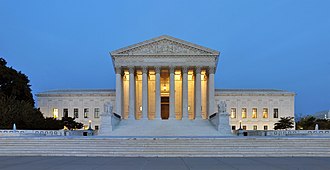
Supreme court
Highest court in a jurisdiction
In most legal jurisdictions, a supreme court, also known as a court of last resort, apex court, high (or final) court of appeal, and court of final appeal, is the highest court within the hierarchy of courts. Broadly speaking, the decisions of a supreme court are binding on all other courts in a nat...
Entity Intersection Graph
Connections for Supreme court:
Mentioned Entities
Deep Analysis
Why It Matters
This case challenges the long-standing interpretation of the 14th Amendment's Citizenship Clause, which could redefine who qualifies as a U.S. citizen at birth. It directly affects children born to undocumented immigrants, potentially altering their legal status and rights. The outcome could impact immigration policy, family reunification, and the legal framework for millions of people living in the U.S. This decision may also influence future debates on immigration reform and constitutional interpretation.
Context & Background
- The 14th Amendment, ratified in 1868, states 'All persons born or naturalized in the United States, and subject to the jurisdiction thereof, are citizens of the United States.'
- Birthright citizenship has been interpreted to apply to nearly all children born on U.S. soil since the 1898 Supreme Court case United States v. Wong Kim Ark.
- The current case challenges whether children born to parents who entered the U.S. illegally are 'subject to the jurisdiction' of the United States as required by the 14th Amendment.
- Previous attempts to restrict birthright citizenship through legislation have failed, making this judicial approach significant.
- The case arrives amid ongoing national debates about immigration policy and border security.
What Happens Next
Following today's oral arguments, the Supreme Court will deliberate privately before issuing a written opinion, likely by June 2024. If the Court rules to restrict birthright citizenship, implementation would require clarification on effective dates and procedures. The decision may trigger legislative responses from Congress and state governments, along with potential legal challenges regarding its application.
Frequently Asked Questions
Birthright citizenship is the legal principle that any child born within a country's territory automatically gains citizenship of that country, regardless of their parents' immigration status. In the U.S., this has been based on the 14th Amendment since 1868.
If the Supreme Court rules against the current interpretation, children born to undocumented immigrants might no longer automatically receive U.S. citizenship. This would represent a fundamental shift in how the 14th Amendment has been applied for over a century.
The United States and Canada are among approximately 30 countries that practice unconditional birthright citizenship. Most European and Asian nations require at least one parent to be a citizen or legal resident for a child to gain citizenship at birth.
The Court's decision would likely address whether any ruling applies prospectively or retroactively. Most constitutional experts believe existing citizenships would be protected, but the opinion will need to clarify this important detail.
The case reached the Supreme Court after conflicting lower court decisions created legal uncertainty. Conservative legal groups have been strategically challenging birthright citizenship for years, and the current Court's composition makes this an opportune moment for reconsideration.