
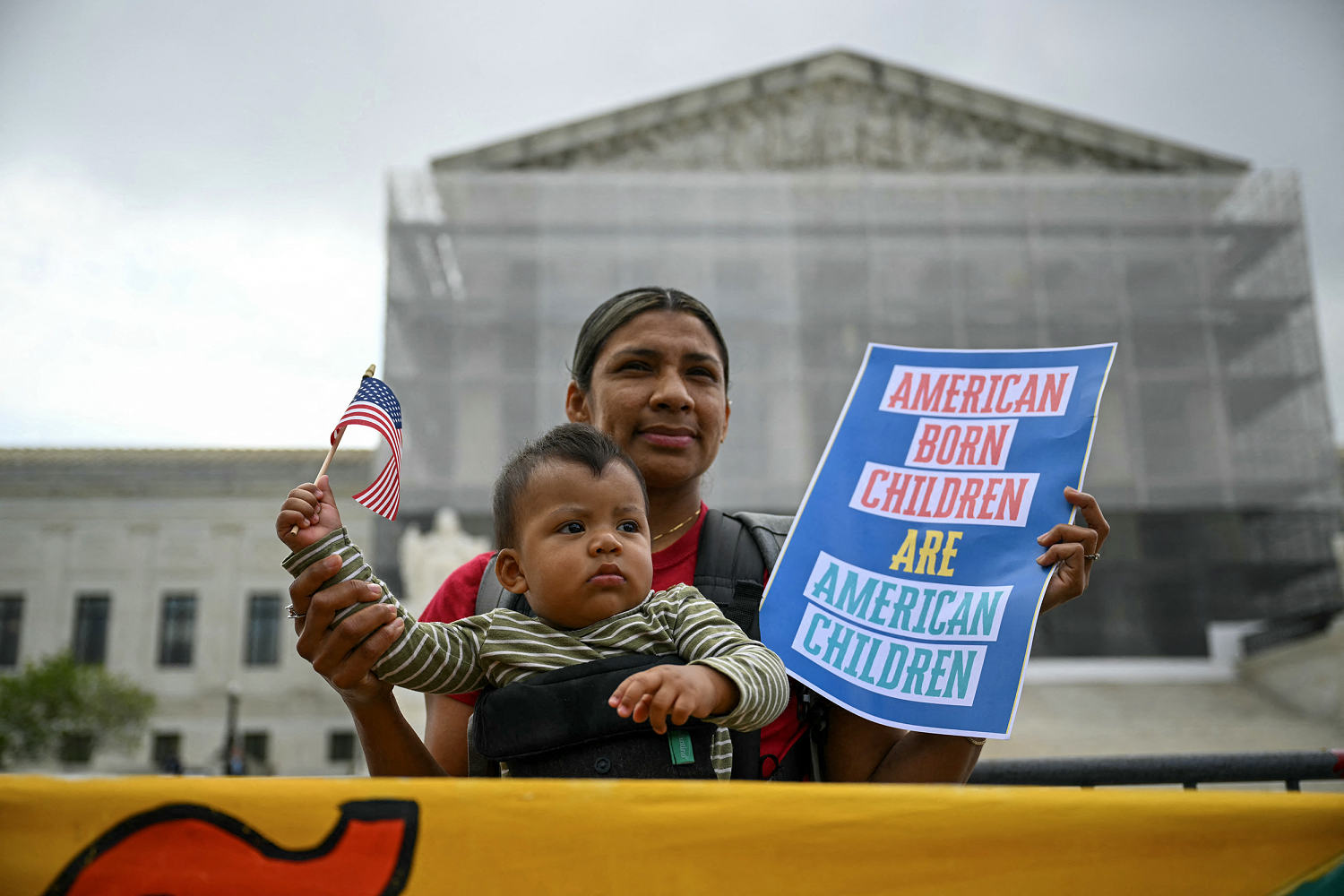
Supreme Court weighs Trump's contentious attempt to limit birthright citizenship
📖 Full Retelling
📚 Related People & Topics
Supreme court
Highest court in a jurisdiction
In most legal jurisdictions, a supreme court, also known as a court of last resort, apex court, high (or final) court of appeal, and court of final appeal, is the highest court within the hierarchy of courts. Broadly speaking, the decisions of a supreme court are binding on all other courts in a nat...

Donald Trump
President of the United States (2017–2021; since 2025)
Donald John Trump (born June 14, 1946) is an American politician, media personality, and businessman who is the 47th president of the United States. A member of the Republican Party, he served as the 45th president from 2017 to 2021. Born into a wealthy New York City family, Trump graduated from the...
Entity Intersection Graph
Connections for Supreme court:
Mentioned Entities
Deep Analysis
Why It Matters
This case challenges the 14th Amendment's guarantee that anyone born in the United States automatically becomes a citizen, a principle established after the Civil War to ensure equal rights. If the Supreme Court upholds Trump's attempt to limit birthright citizenship, it could affect millions of children born to undocumented immigrants, potentially creating a permanent underclass without citizenship rights. The decision would have profound implications for immigration policy, family unity, and constitutional interpretation, affecting both immigrant communities and broader American society.
Context & Background
- The 14th Amendment, ratified in 1868, states 'All persons born or naturalized in the United States, and subject to the jurisdiction thereof, are citizens of the United States.'
- Birthright citizenship has been upheld by the Supreme Court since the 1898 case United States v. Wong Kim Ark, which affirmed citizenship for children born to Chinese immigrants.
- Previous attempts to limit birthright citizenship through legislation or executive action have consistently failed due to constitutional constraints.
- The current debate centers on interpretation of 'subject to the jurisdiction thereof,' with some arguing it excludes children of undocumented immigrants.
- Birthright citizenship exists in approximately 30 countries worldwide, including Canada and Mexico, but most developed nations have abandoned the practice.
What Happens Next
The Supreme Court will hear oral arguments in the coming months, with a decision expected by June 2025. If the Court rules to limit birthright citizenship, Congress would likely need to pass implementing legislation, potentially triggering legal challenges regarding enforcement. Either outcome will influence the 2024 presidential election discourse and could lead to state-level legislation attempting to define citizenship criteria.
Frequently Asked Questions
Trump seeks to reinterpret the 14th Amendment to exclude children of undocumented immigrants from automatic citizenship, arguing they aren't 'subject to the jurisdiction' of the United States. This would require executive action or congressional legislation to implement if the Supreme Court agrees with his interpretation.
Approximately 300,000-400,000 children are born to undocumented immigrants annually in the U.S. A change would affect these children plus potentially millions born since the 1980s when undocumented immigration increased significantly, though retroactive application remains legally uncertain.
Most constitutional scholars argue no—changing birthright citizenship would require a constitutional amendment or Supreme Court reinterpretation of the 14th Amendment. Executive action alone would likely face immediate legal challenges as exceeding presidential authority.
Their status would become legally uncertain. Some proposals suggest only prospective application, but others argue for reviewing existing citizenships. This could create complex legal battles and potentially leave millions in limbo regarding their citizenship status.
Supporters argue it creates an incentive for illegal immigration and allows 'anchor babies' whose citizenship enables family members to remain. They believe it strains social services and contradicts original intent of the 14th Amendment, which they argue applied only to formerly enslaved people.