

Trump arrives at Supreme Court for birthright citizenship argument -- believed to be a first
📖 Full Retelling
📚 Related People & Topics
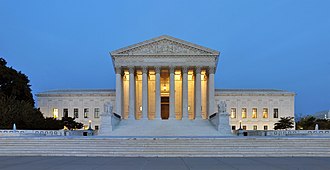
Supreme court
Highest court in a jurisdiction
In most legal jurisdictions, a supreme court, also known as a court of last resort, apex court, high (or final) court of appeal, and court of final appeal, is the highest court within the hierarchy of courts. Broadly speaking, the decisions of a supreme court are binding on all other courts in a nat...

Donald Trump
President of the United States (2017–2021; since 2025)
Donald John Trump (born June 14, 1946) is an American politician, media personality, and businessman who is the 47th president of the United States. A member of the Republican Party, he served as the 45th president from 2017 to 2021. Born into a wealthy New York City family, Trump graduated from the...
Entity Intersection Graph
Connections for Supreme court:
Mentioned Entities
Deep Analysis
Why It Matters
This event matters because it represents a significant intersection of presidential politics and constitutional interpretation. A sitting president personally attending Supreme Court arguments about birthright citizenship signals the administration's prioritization of immigration policy and could influence public perception of the case. The outcome could affect millions of children born to undocumented immigrants in the U.S., potentially altering their citizenship status. This also sets a precedent for future presidents engaging directly with judicial proceedings on controversial policy matters.
Context & Background
- Birthright citizenship is established by the 14th Amendment's Citizenship Clause, ratified in 1868 to guarantee citizenship to formerly enslaved people.
- The current debate centers on whether 'subject to the jurisdiction thereof' excludes children of undocumented immigrants, a legal theory known as the 'subject to the jurisdiction' interpretation.
- Previous presidents have rarely attended Supreme Court arguments in person, making Trump's appearance historically unusual for a sitting president.
- The Trump administration has pursued multiple immigration policy changes including travel bans, family separation, and DACA challenges.
- Birthright citizenship exists in approximately 30 countries worldwide, with most developed nations having abandoned or never adopted the practice.
What Happens Next
The Supreme Court will hear arguments and likely issue a ruling by June 2025. If the Court rules against birthright citizenship, Congress may need to pass legislation addressing the status of affected individuals. The decision will likely become a major issue in the 2024 presidential campaign regardless of timing. Legal challenges to implementation would follow any ruling that changes current interpretation.
Frequently Asked Questions
Birthright citizenship automatically grants U.S. citizenship to anyone born on American soil, regardless of their parents' immigration status. This principle stems from the 14th Amendment and has been federal law since 1868. Approximately 300,000 children annually are born to undocumented immigrants who would be affected by changes.
Sitting presidents almost never attend Supreme Court arguments in person, preferring to send legal representatives. This breaks with tradition and emphasizes the personal importance Trump places on this issue. It may also be intended to signal administration priorities to the justices and public.
Most legal scholars believe changing birthright citizenship would require a constitutional amendment, not just executive action. The president could issue an executive order attempting to reinterpret 'subject to the jurisdiction,' but this would face immediate legal challenges. Ultimately, the Supreme Court would need to rule on any such attempt's constitutionality.
If birthright citizenship were eliminated, it would likely apply prospectively to future births rather than retroactively. Children already born would probably retain citizenship, though their status could become politically contested. The exact implementation would depend on the Court's ruling and subsequent legislation.
Besides the United States, Canada and most Latin American countries practice birthright citizenship. Most European, Asian, and African nations have abandoned or never adopted the practice. Countries like Australia and the UK eliminated birthright citizenship in the 1980s through legislative changes.