
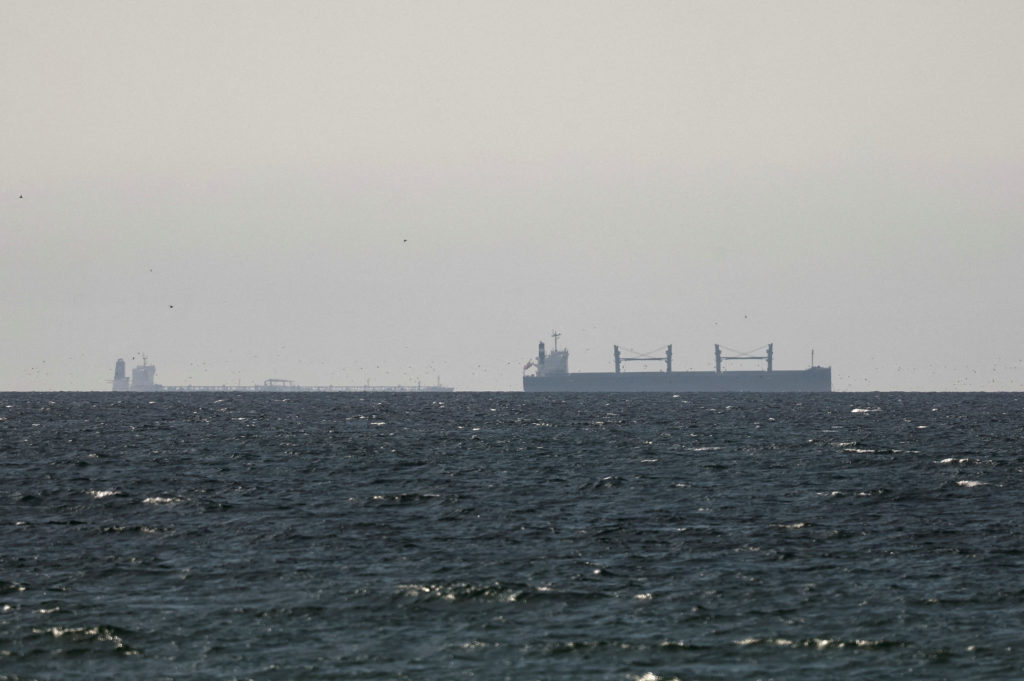
Trump continues to shift course on Strait of Hormuz strategy, raising questions about U.S. war preparedness
#Trump #Strait of Hormuz #strategy #U.S. military #war preparedness #Middle East #security
📌 Key Takeaways
- President Trump's strategy for the Strait of Hormuz is undergoing repeated changes.
- These shifts are causing uncertainty about U.S. military readiness in the region.
- The evolving approach may impact stability and security in the critical waterway.
- Questions are being raised about the coherence and preparedness of U.S. war plans.
📖 Full Retelling
🏷️ Themes
Foreign Policy, Military Strategy
📚 Related People & Topics

Middle East
Transcontinental geopolitical region
The Middle East is a geopolitical region encompassing the Arabian Peninsula, Egypt, Iran, Iraq, the Levant, and Turkey. The term came into widespread usage by Western European nations in the early 20th century as a replacement of the term Near East (both were in contrast to the Far East). The term ...

Strait of Hormuz
Strait between the Gulf of Oman and the Persian Gulf
The Strait of Hormuz ( Persian: تنگهٔ هُرمُز Tangeh-ye Hormoz , Arabic: مَضيق هُرمُز Maḍīq Hurmuz) is a strait between the Persian Gulf and the Gulf of Oman. It provides the only sea passage from the Persian Gulf to the open ocean and is one of the world's most strategically important choke points. ...

Donald Trump
President of the United States (2017–2021; since 2025)
Donald John Trump (born June 14, 1946) is an American politician, media personality, and businessman who is the 47th president of the United States. A member of the Republican Party, he served as the 45th president from 2017 to 2021. Born into a wealthy New York City family, Trump graduated from the...
Entity Intersection Graph
Connections for Middle East:
Mentioned Entities
Deep Analysis
Why It Matters
This news matters because the Strait of Hormuz is a critical global oil chokepoint through which about 20% of the world's petroleum passes. Shifting U.S. strategy creates uncertainty among allies and adversaries alike, potentially destabilizing global energy markets and regional security. The questioning of U.S. war preparedness affects military planning, international relations, and could embolden adversaries while worrying partners who depend on American security guarantees.
Context & Background
- The Strait of Hormuz connects the Persian Gulf with the Gulf of Oman and Arabian Sea, making it essential for oil exports from Saudi Arabia, Iran, UAE, Kuwait, and Iraq
- Tensions in the strait have escalated since 2019 with attacks on oil tankers, drone strikes, and seizures of vessels by Iran's Revolutionary Guard
- The U.S. has maintained a naval presence in the region for decades, with the Fifth Fleet headquartered in Bahrain since 1995
- Previous U.S. administrations have consistently emphasized freedom of navigation in international waters as a core national security interest
What Happens Next
Expect increased scrutiny of U.S. naval deployments and readiness assessments in Congressional hearings. Regional partners like Saudi Arabia and UAE may seek clearer commitments or diversify their security arrangements. Market analysts will monitor oil prices for volatility spikes, and diplomatic efforts may intensify to prevent miscalculation leading to open conflict.
Frequently Asked Questions
The Strait of Hormuz is the world's most important oil transit chokepoint, with approximately 20-21 million barrels of oil passing through daily. This represents about 20% of global petroleum consumption and 30% of all seaborne traded oil. Closure or disruption would cause immediate global energy price shocks and economic disruption.
The Trump administration has shifted between aggressive rhetoric and more restrained military responses, creating policy uncertainty. This contrasts with previous administrations' more consistent emphasis on freedom of navigation and predictable responses to provocations in the waterway.
Major oil exporters like Saudi Arabia, UAE, Iraq, and Iran depend on the strait for their economic survival. Import-dependent nations including China, India, Japan, and South Korea would face immediate energy security crises. Regional stability affects all Persian Gulf nations and global economic health.
The Strait of Hormuz has been a flashpoint in U.S.-Iran relations since the 1979 revolution. Iran has repeatedly threatened to close the strait during crises, while the U.S. has committed to keeping it open. Current tensions follow the U.S. withdrawal from the Iran nuclear deal and subsequent 'maximum pressure' campaign.