

Trump is hastening Britain’s return to the EU
📚 Related People & Topics
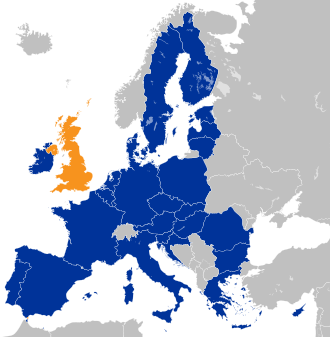
Brexit
Withdrawal of the UK from the EU
Brexit (; a portmanteau of "Britain" and "Exit") was the withdrawal of the United Kingdom (UK) from the European Union (EU). Brexit took place at 23:00 GMT on 31 January 2020 (00:00 1 February 2020 CET). The UK, which joined the EU precursor, the European Communities (EC), on 1 January 1973, is the ...

European Union
Supranational political and economic union
The European Union (EU) is a supranational political and economic union of 27 member states that are located primarily in Europe. The union has a total area of 4,233,255 km2 (1,634,469 sq mi) and an estimated population of more than 450 million as of 2025. The EU is often described as a sui generis ...

Donald Trump
President of the United States (2017–2021; since 2025)
Donald John Trump (born June 14, 1946) is an American politician, media personality, and businessman who is the 47th president of the United States. A member of the Republican Party, he served as the 45th president from 2017 to 2021. Born into a wealthy New York City family, Trump graduated from the...

Politics of the United Kingdom
The United Kingdom is a constitutional monarchy which, by legislation and convention, operates as a unitary parliamentary democracy. A hereditary monarch, currently King Charles III, serves as head of state while the prime minister of the United Kingdom, currently Sir Keir Starmer since 2024, serves...
Entity Intersection Graph
Connections for Brexit:
Mentioned Entities
Deep Analysis
Why It Matters
This news matters because it suggests a potential reversal of one of the most significant geopolitical shifts in recent European history—Brexit. It affects UK citizens who may face renewed debates about sovereignty and economic integration, EU member states who would need to negotiate re-entry terms, and global markets that would react to changing trade dynamics between the UK and Europe. The possibility of a UK return to the EU could reshape European politics, influence transatlantic relations under a potential Trump administration, and alter the balance of power within the EU itself.
Context & Background
- The UK voted to leave the European Union in a 2016 referendum, a process known as Brexit, which was finalized in 2020 after years of negotiations.
- Brexit led to significant economic, political, and social changes, including new trade barriers, regulatory divergence, and debates over issues like Northern Ireland's border.
- Donald Trump, as US president from 2017–2021, openly supported Brexit and advocated for a US-UK trade deal, positioning himself as an ally of Brexit proponents.
- Since Brexit, the UK has faced challenges such as economic stagnation, trade disruptions, and political instability, leading some to reconsider the decision.
- The EU has maintained that the UK could theoretically rejoin, but it would require meeting all membership criteria and likely adopting the euro, which would be politically contentious.
What Happens Next
If Trump's actions or policies indeed hasten a UK return to the EU, we can expect intensified political debates in the UK, with pro-EU factions gaining momentum and potential calls for a new referendum. The EU would likely initiate preliminary discussions on re-entry terms, focusing on issues like budget contributions and regulatory alignment. Over the next 1–2 years, formal negotiations could begin if public and political support in the UK solidifies, though any actual re-entry would take years to finalize.
Frequently Asked Questions
Trump's potential policies, such as imposing trade tariffs or undermining NATO, might push the UK to seek closer ties with the EU for economic and security stability. His divisive stance on international alliances could make EU membership more appealing to UK leaders and citizens. Additionally, his influence on global politics might accelerate existing pro-EU sentiments in the UK.
Key obstacles include political opposition from Brexit supporters, the need for public approval via a referendum, and meeting strict EU membership criteria like adopting the euro. The EU would also require the UK to accept all existing regulations and budget contributions, which could be contentious. Domestic UK politics, including party divisions, would further complicate any re-entry process.
A UK return to the EU could strain the US-UK 'special relationship' if it aligns the UK more closely with EU policies that conflict with US interests. However, it might also stabilize transatlantic ties by reinforcing a united European front. The outcome would depend on broader US foreign policy, especially under a potential Trump administration.
Economically, rejoining the EU could boost UK trade by eliminating barriers with the EU single market, potentially increasing GDP growth and investment. However, it might also require the UK to readopt EU regulations and contribute to the EU budget, imposing costs. Short-term disruptions could occur during the transition, but long-term benefits might include enhanced market access and stability.
Public support for rejoining the EU has fluctuated, with some polls showing a majority in favor, but it remains a deeply divisive issue influenced by factors like the economy and politics. Younger generations and urban areas tend to be more pro-EU, while older and rural voters often oppose it. Any move to rejoin would likely require a new referendum to ensure democratic legitimacy.