
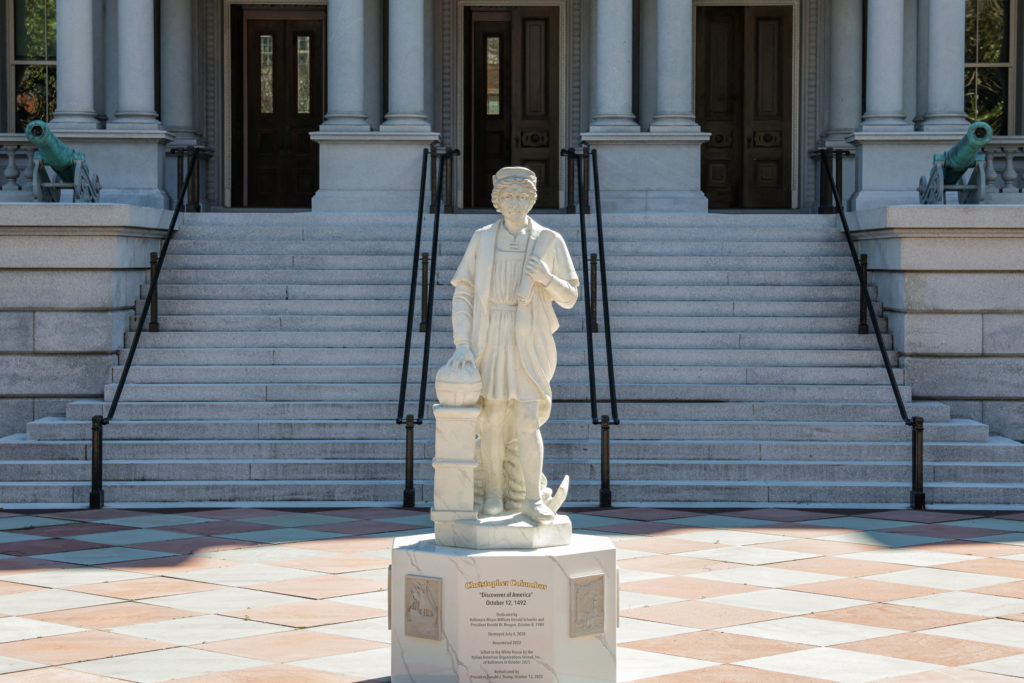
Trump places replica Christopher Columbus statue near the White House
#Trump #Christopher Columbus #statue #White House #monuments #Italian-American #heritage #protests
📌 Key Takeaways
- President Trump installed a replica Christopher Columbus statue near the White House.
- The move is part of a broader effort to honor Columbus and Italian-American heritage.
- It comes amid national debates over historical monuments and racial justice.
- The statue is intended to counter recent removals of Columbus statues in some cities.
📖 Full Retelling
🏷️ Themes
Historical Monuments, Political Symbolism
📚 Related People & Topics

Christopher Columbus
Italian navigator and explorer (1451–1506)
Christopher Columbus (; between 25 August and 31 October 1451 – 20 May 1506) was an Italian explorer and navigator from the Republic of Genoa who completed four Spanish-based voyages across the Atlantic Ocean sponsored by the Catholic Monarchs, opening the way for the widespread European exploration...

White House
Residence and workplace of the US president
# The White House The **White House** is the official residence and principal workplace of the president of the United States. Located at **1600 Pennsylvania Avenue NW** in Washington, D.C., it stands as one of the most recognizable symbols of the American presidency and the United States governmen...

Donald Trump
President of the United States (2017–2021; since 2025)
Donald John Trump (born June 14, 1946) is an American politician, media personality, and businessman who is the 47th president of the United States. A member of the Republican Party, he served as the 45th president from 2017 to 2021. Born into a wealthy New York City family, Trump graduated from the...
Entity Intersection Graph
Connections for Christopher Columbus:
Mentioned Entities
Deep Analysis
Why It Matters
This symbolic act matters because it reinforces Trump's emphasis on traditional American historical narratives during a period of intense national debate about historical monuments. It directly affects Indigenous communities who view Columbus as a symbol of colonization and genocide, while appealing to conservative voters who see such figures as foundational to American identity. The placement near the White House gives this cultural statement official government endorsement, potentially escalating tensions in the ongoing monument controversies.
Context & Background
- Christopher Columbus statues have been targeted for removal or vandalism across the U.S. during 2020 protests, with at least 33 statues removed according to tracking data.
- The original White House Columbus statue was toppled by protesters in June 2020 during demonstrations following George Floyd's death.
- Trump previously signed an executive order in June 2020 promising prosecution for those who damage federal monuments and created a 'National Garden of American Heroes' to honor historical figures.
What Happens Next
Immediate protests or counter-protests are likely near the replica statue location. Legal challenges may emerge regarding the statue's placement on federal property. The Biden administration will face pressure to either maintain or remove the statue after the presidential transition. Additional Columbus statues may be targeted or protected in response to this high-profile placement.
Frequently Asked Questions
Columbus represents European colonization that led to the genocide and displacement of Indigenous populations. While traditionally celebrated for 'discovering America,' modern scholarship emphasizes his role in initiating transatlantic slavery and brutal colonial systems.
Trump positioned this as defending American heritage against what he calls 'radical' attempts to rewrite history. The timing suggests both a cultural statement to his base and a challenge to the monument removal movement that gained momentum in 2020.
Yes, as executive branch head, the president has authority over monuments on federal property like White House grounds. However, removal would likely spark political controversy about historical preservation versus addressing problematic legacies.
Many Indigenous organizations have long advocated for replacing Columbus Day with Indigenous Peoples' Day and removing statues they view as celebrating colonialism. The American Indian Movement and other groups have organized protests at Columbus monuments for decades.
Federal law (18 U.S.C. § 1369) prohibits damaging monuments on federal property with penalties up to 10 years imprisonment. State laws vary, with some recently strengthening monument protections while others have made removal processes easier for local governments.