
Trump says he will attend Supreme Court arguments on birthright citizenship case
📖 Full Retelling
📚 Related People & Topics
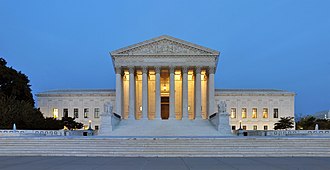
Supreme court
Highest court in a jurisdiction
In most legal jurisdictions, a supreme court, also known as a court of last resort, apex court, high (or final) court of appeal, and court of final appeal, is the highest court within the hierarchy of courts. Broadly speaking, the decisions of a supreme court are binding on all other courts in a nat...

Donald Trump
President of the United States (2017–2021; since 2025)
Donald John Trump (born June 14, 1946) is an American politician, media personality, and businessman who is the 47th president of the United States. A member of the Republican Party, he served as the 45th president from 2017 to 2021. Born into a wealthy New York City family, Trump graduated from the...
Entity Intersection Graph
Connections for Supreme court:
Mentioned Entities
Deep Analysis
Why It Matters
This news matters because it involves a former president directly engaging with a Supreme Court case that could fundamentally alter a constitutional principle dating back to the 14th Amendment. The outcome could affect millions of children born to undocumented immigrants in the U.S., potentially changing their citizenship status and legal rights. Trump's attendance signals the political importance of this issue ahead of the 2024 election and demonstrates how former presidents continue to influence major legal battles.
Context & Background
- Birthright citizenship originates from the 14th Amendment's Citizenship Clause, ratified in 1868, which states 'all persons born or naturalized in the United States... are citizens.'
- The Supreme Court has previously upheld birthright citizenship in cases like United States v. Wong Kim Ark (1898), establishing that children born to non-citizen parents on U.S. soil are citizens.
- Former President Trump has long opposed birthright citizenship, claiming in 2018 he could end it via executive order, though legal scholars widely disputed this authority.
- The current case likely challenges whether children of undocumented immigrants qualify under the 14th Amendment, revisiting a long-settled interpretation.
What Happens Next
The Supreme Court will hear oral arguments on the case, with Trump's attendance potentially drawing heightened media attention. A ruling is expected by June 2025, which could either reaffirm birthright citizenship or create a major constitutional shift. Depending on the outcome, Congress may face pressure to pass clarifying legislation, and states might adjust birth certificate policies.
Frequently Asked Questions
Birthright citizenship is the legal principle that any person born on U.S. soil automatically becomes a U.S. citizen, regardless of their parents' immigration status. It is derived from the 14th Amendment to the Constitution and has been upheld by the Supreme Court for over a century.
Trump argues that birthright citizenship encourages unauthorized immigration and creates 'anchor babies.' He believes it should be restricted to children of citizens or legal residents, though most legal experts say this would require a constitutional amendment, not just a court ruling or executive order.
Yes, the Supreme Court could reinterpret the 14th Amendment, though it would overturn longstanding precedent. Such a ruling would be highly controversial and likely face legal challenges, possibly leading to a constitutional crisis or requiring congressional action to resolve.
Estimates suggest hundreds of thousands of children born annually to undocumented immigrants could lose automatic citizenship. Additionally, millions of existing citizens might face uncertainty about their status, though any ruling would likely apply prospectively, not retroactively.