
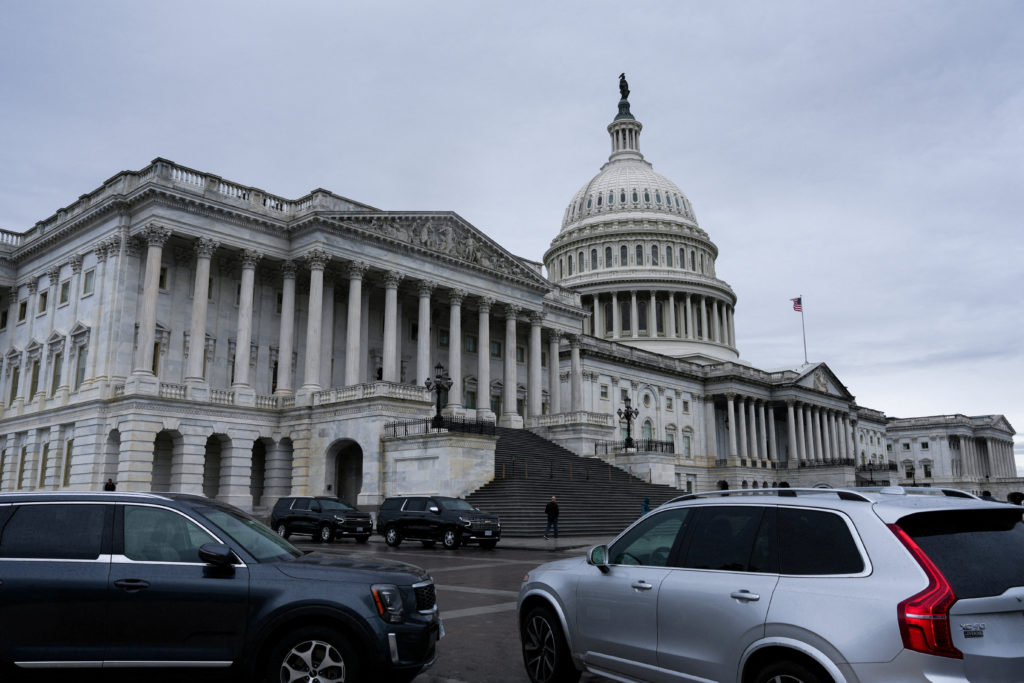
Trump's Iran strategy and rhetoric face scrutiny as Congress returns from recess
#Donald Trump #Iran #war powers #Congress #Qasem Soleimani #military authorization #executive authority
📌 Key Takeaways
- Democratic-led effort to limit President Trump's war powers regarding Iran was blocked by Republicans in Congress.
- The issue is slated for renewed debate when Congress returns from recess, highlighting a constitutional conflict over war authority.
- There is growing bipartisan concern over the president's escalated rhetoric, including a threat about a civilization's destruction.
- The scrutiny encompasses both strategic military decisions and the diplomatic impact of inflammatory public statements.
📖 Full Retelling
🏷️ Themes
U.S. Politics, Foreign Policy, Executive Power
📚 Related People & Topics

Qasem Soleimani
Iranian military officer (1957–2020)
Qasem Soleimani (Persian: قاسم سلیمانی, romanized: Qâsem Soleymâni; 11 March 1957 – 3 January 2020) was an Iranian military officer who served in the Islamic Revolutionary Guard Corps (IRGC). From 1998 until his assassination by the United States in 2020, he was the commander of the Quds Force, an I...

Iran
Country in West Asia
# Iran **Iran**, officially the **Islamic Republic of Iran** and historically known as **Persia**, is a sovereign country situated in West Asia. It is a major regional power, ranking as the 17th-largest country in the world by both land area and population. Combining a rich historical legacy with a...

Congress
Formal meeting of representatives
A congress is a formal meeting of the representatives of different countries, constituent states, organizations, trade unions, political parties, or other groups. The term originated in Late Middle English to denote an encounter (meeting of adversaries) during battle, from the Latin congressus.

Donald Trump
President of the United States (2017–2021; since 2025)
Donald John Trump (born June 14, 1946) is an American politician, media personality, and businessman who is the 47th president of the United States. A member of the Republican Party, he served as the 45th president from 2017 to 2021. Born into a wealthy New York City family, Trump graduated from the...
Entity Intersection Graph
Connections for Qasem Soleimani:
Mentioned Entities
Deep Analysis
Why It Matters
This news is critical because it highlights a fundamental constitutional conflict over who has the authority to declare war, a decision that impacts the lives of service members and global stability. The escalation of rhetoric and military action with Iran poses a significant risk of a broader, unintended conflict in the Middle East. Furthermore, the legislative outcome will set a precedent for how much power future presidents hold to engage in military action without congressional approval, affecting the system of checks and balances.
Context & Background
- The U.S. Constitution grants Congress the power to declare war, but presidents have increasingly engaged in military conflicts without formal declarations since World War II.
- The 1973 War Powers Resolution was passed to check presidential power, requiring withdrawal of forces after 60 days unless Congress authorizes action.
- Tensions between the U.S. and Iran escalated significantly after President Trump withdrew the U.S. from the 2015 Iran nuclear deal in 2018.
- On January 3, 2020, a U.S. drone strike killed Iranian Major General Qasem Soleimani, marking a major escalation in hostilities.
- The article references events occurring around the week of January 6, 2020, placing this analysis in the immediate aftermath of the Soleimani strike.
What Happens Next
Congress is expected to reconvene and move from symbolic votes to substantive legislative efforts, such as amending the National Defense Authorization Act. Lawmakers will likely introduce standalone resolutions to reassert congressional war powers. The coming weeks will see intense debate and voting on these measures as both parties negotiate the extent of presidential authority.
Frequently Asked Questions
The legislation failed because Republican lawmakers opposed the measure, blocking the procedural vote required to advance it.
Lawmakers were alarmed by President Trump's social media post warning that 'a whole civilization will die' if Iran retaliates, viewing it as disproportionate and inflammatory.
Passed in 1973, the War Powers Resolution is a federal law intended to check the president's power to commit the United States to an armed conflict without the consent of the U.S. Congress.
The debate was triggered by the U.S. airstrike that killed Iranian General Qasem Soleimani and the subsequent escalation of tensions with Iran.