
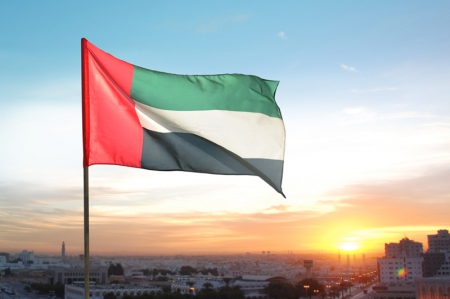
UAE willing to join US in reopening Strait of Hormuz by force- WSJ
📚 Related People & Topics

United Arab Emirates
Country in West Asia
The United Arab Emirates (UAE), also known simply as the Emirates, is a country in West Asia, situated at the eastern end of the Arabian Peninsula. It is a federal semi-constitutional monarchy made up of seven emirates, with Abu Dhabi serving as its national capital. The UAE borders Oman to the east...

Strait of Hormuz
Strait between the Gulf of Oman and the Persian Gulf
The Strait of Hormuz ( Persian: تنگهٔ هُرمُز Tangeh-ye Hormoz , Arabic: مَضيق هُرمُز Maḍīq Hurmuz) is a strait between the Persian Gulf and the Gulf of Oman. It provides the only sea passage from the Persian Gulf to the open ocean and is one of the world's most strategically important choke points. ...

United States
Country primarily in North America
The United States of America (USA), also known as the United States (U.S.) or America, is a country primarily located in North America. It is a federal republic of 50 states and a federal capital district, Washington, D.C. The 48 contiguous states border Canada to the north and Mexico to the south, ...
Entity Intersection Graph
Connections for United Arab Emirates:
Mentioned Entities
Deep Analysis
Why It Matters
This news matters because the Strait of Hormuz is a critical global oil chokepoint through which about 20% of the world's oil passes daily. Any military action to reopen it could escalate regional tensions significantly, potentially disrupting global energy supplies and increasing oil prices worldwide. This affects not only Middle Eastern nations but also global economies dependent on stable energy markets, particularly Europe and Asia.
Context & Background
- The Strait of Hormuz is a narrow waterway between Iran and Oman that connects the Persian Gulf with the Gulf of Oman and Arabian Sea
- Iran has previously threatened to close the strait in response to sanctions or military threats, most notably during the 2019 tanker attacks and seizures
- The UAE has historically maintained close security cooperation with the US, hosting American military bases including Al Dhafra Air Base
- Tensions in the strait have periodically flared since 2019 when Iran seized tankers and was accused of attacking vessels
- The US maintains the Fifth Fleet in Bahrain, which regularly patrols the region to ensure freedom of navigation
What Happens Next
If Iran attempts to close the strait, we can expect immediate US-led naval deployments to the region, potentially including carrier strike groups. Diplomatic efforts through the UN Security Council would likely follow, with possible emergency OPEC meetings to address oil supply concerns. Military confrontation could escalate quickly if either side perceives a direct threat to their naval assets.
Frequently Asked Questions
Iran has threatened to close the strait as leverage against international sanctions or military pressure. It represents their most significant strategic card in regional conflicts, allowing them to threaten global energy markets and exert pressure on Western economies.
The UAE has developed advanced naval capabilities including corvettes and fast attack craft, and hosts significant US military assets. Their participation would provide regional legitimacy and local knowledge to any international coalition operating in the strait.
A closure could immediately spike oil prices by 20-30% or more, potentially triggering global economic repercussions. Strategic petroleum reserves would be tapped, and alternative shipping routes would face severe capacity constraints.
International law recognizes freedom of navigation through strategic waterways. The UN Convention on the Law of the Sea and customary international law provide basis for action if passage is unlawfully obstructed, though specific authorization would likely be sought.
Saudi Arabia and other GCC members typically support freedom of navigation but prefer diplomatic solutions. China and India, as major oil importers through the strait, generally advocate for de-escalation while maintaining their own naval presence in the region.