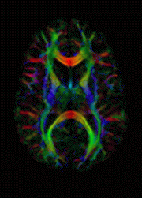
Researchers developed a new method for denoising diffusion-weighted images addressing bias and variance issues
The method accounts for non-Gaussian noise characteristics in dMRI magnitude data
Two alternative loss functions were proposed to correct different types of bias
Experiments showed improved image quality and more reliable diffusion metrics compared to existing methods
📖 Full Retelling
Researchers Jine Xie, Zhicheng Zhang, Yunwei Chen, Yanqiu Feng, and Xinyuan Zhang introduced a novel method for denoising diffusion-weighted images with bias and variance corrected noise modeling in a paper submitted to arXiv on February 22, 2026, addressing the critical issue of low signal-to-noise ratio in diffusion magnetic resonance imaging that significantly degrades image quality and impairs analysis. Diffusion magnetic resonance imaging (dMRI) plays a vital role in both clinical diagnostics and neuroscience research, but its inherently low signal-to-noise ratio, especially under high diffusion weighting, poses significant challenges. Current self-supervised and unsupervised denoising methods offer solutions without requiring clean references, but most fail to account for the non-Gaussian noise characteristics in dMRI magnitude data. This oversight can lead to systematic bias and heteroscedastic variance, particularly under low-SNR conditions, which undermines the reliability of medical diagnoses and research findings. The researchers propose two alternative loss functions derived from the first-order and second-order moments to remove mean bias and correct squared-signal bias, respectively. Both losses include adaptive weighting to account for variance heterogeneity and can be implemented without changing existing network architectures. These objectives are integrated into an image-specific, unsupervised Deep Image Prior framework. Comprehensive experiments on simulated and in-vivo dMRI demonstrate that the proposed losses effectively reduce Rician bias and suppress noise fluctuations, yielding higher image quality and more reliable diffusion metrics than current state-of-the-art denoising baselines.
🏷️ Themes
Medical Imaging, Artificial Intelligence, Image Processing
Method of utilizing water in magnetic resonance imaging
Diffusion-weighted magnetic resonance imaging (DWI or DW-MRI) is the use of specific MRI sequences as well as software that generates images from the resulting data that uses the diffusion of water molecules to generate contrast in MR images. It allows the mapping of the diffusion process of molecul...
Medical diagnosis (abbreviated as Dx, Dx, or Ds) is the process of determining which disease or condition explains a person's symptoms and signs. It is most often referred to as a diagnosis with the medical context being implicit. The information required for a diagnosis is typically collected from ...
Noise reduction is the process of removing noise from a signal. Noise reduction techniques exist for audio and images. Noise reduction algorithms may distort the signal to some degree.
Paradigm in machine learning that uses no classification labels
Unsupervised learning is a framework in machine learning where, in contrast to supervised learning, algorithms learn patterns exclusively from unlabeled data. Other frameworks in the spectrum of supervisions include weak- or semi-supervision, where a small portion of the data is tagged, and self-sup...
--> Quantitative Biology > Quantitative Methods arXiv:2602.22235 (q-bio) [Submitted on 22 Feb 2026] Title: Unsupervised Denoising of Diffusion-Weighted Images with Bias and Variance Corrected Noise Modeling Authors: Jine Xie , Zhicheng Zhang , Yunwei Chen , Yanqiu Feng , Xinyuan Zhang View a PDF of the paper titled Unsupervised Denoising of Diffusion-Weighted Images with Bias and Variance Corrected Noise Modeling, by Jine Xie and 4 other authors View PDF HTML Abstract: Diffusion magnetic resonance imaging plays a vital role in both clinical diagnostics and neuroscience research. However, its inherently low signal-to-noise ratio , especially under high diffusion weighting, significantly degrades image quality and impairs downstream analysis. Recent self-supervised and unsupervised denoising methods offer a practical solution by enhancing image quality without requiring clean references. However, most of these methods do not explicitly account for the non-Gaussian noise characteristics commonly present in dMRI magnitude data during the supervised learning process, potentially leading to systematic bias and heteroscedastic variance, particularly under low-SNR conditions. To overcome this limitation, we introduce noise-corrected training objectives that explicitly model Rician statistics. Specifically, we propose two alternative loss functions: one derived from the first-order moment to remove mean bias, and another from the second-order moment to correct squared-signal bias. Both losses include adaptive weighting to account for variance heterogeneity and can be used without changing the network architecture. These objectives are instantiated in an image-specific, unsupervised Deep Image Prior framework. Comprehensive experiments on simulated and in-vivo dMRI show that the proposed losses effectively reduce Rician bias and suppress noise fluctuations, yielding higher image quality and more reliable diffusion metrics than state-of-the-art denoising baselines. These resul...