
SP
BravenNow
U.S. military airlifts small reactor for the first time as Trump pushes to quickly deploy nuclear power
| USA | world | ✓ Verified - pbs.org

U.S. military airlifts small reactor for the first time as Trump pushes to quickly deploy nuclear power

#Nuclear Reactor #Trump Administration #Microreactor #Energy Security #Pentagon #Energy Department #Utah #AI Energy Demand

📌 Key Takeaways

  • Pentagon and Energy Department successfully airlifted first small nuclear reactor from California to Utah
  • Trump administration prioritizing nuclear energy to meet AI and data center demands
  • Microreactors expected to reach criticality by July 4, 2026, with commercial operations starting in 2028
  • Skeptics raise concerns about safety, feasibility, and waste disposal despite administration enthusiasm

📖 Full Retelling

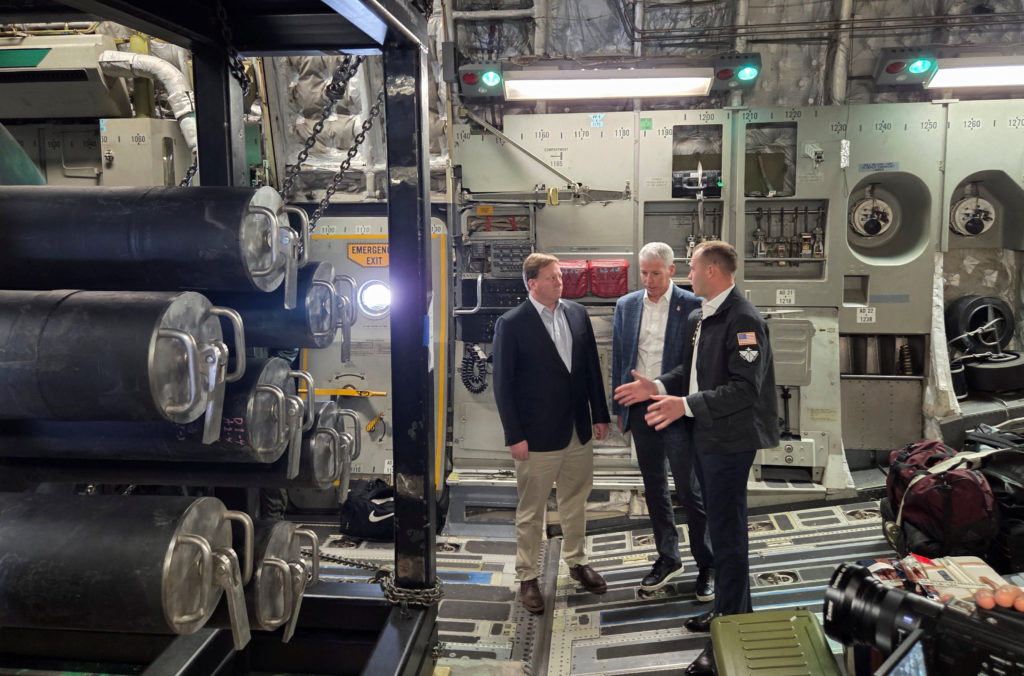
The Pentagon and the Energy Department successfully airlifted a 5-megawatt microreactor from March Air Reserve Base in California to Hill Air Force Base in Utah on February 15, 2026, demonstrating the U.S. potential to quickly deploy nuclear power for military and civilian use under the Trump administration's drive to meet escalating energy demands from artificial intelligence and data centers. The historic flight, which took place over a weekend and covered nearly 700 miles, marked the first time the U.S. military has transported a nuclear reactor in this manner. The reactor, built by California-based startup Valar Atomics and transported without nuclear fuel aboard a C-17 military aircraft, represents a significant milestone in the Trump administration's efforts to fast-track commercial licensing for microreactors. Energy Secretary Chris Wright and Undersecretary of Defense Michael Duffey accompanied the transport, hailing it as a breakthrough that could accelerate the delivery of resilient power to military bases and civilian locations. The Trump administration has prioritized nuclear energy as a carbon-free source of electricity, with President Donald Trump signing a series of executive orders last year that shifted some regulatory authority from the independent Nuclear Regulatory Commission to the Energy Department. Wright emphasized the administration's ambitious timeline, noting that at least three microreactors are expected to reach 'criticality' by July 4, 2026. The transported reactor, roughly the size of a minivan, will be tested at the Utah San Rafael Energy Lab and is designed to generate enough electricity to power 5,000 homes. Valar Atomics aims to begin test power sales in 2027 and achieve full commercialization by 2028. Despite the administration's enthusiasm, skeptics raise concerns about safety, feasibility, and cost-effectiveness. Edwin Lyman, director of nuclear power safety at the Union of Concerned Scientists, criticized the demonstration as a 'dog-and-pony show' that doesn't address critical questions about security, waste disposal, or economic viability. The Trump administration has yet to fully resolve how microreactors will be transported once loaded with nuclear fuel or how nuclear waste will be managed, though Wright mentioned ongoing discussions with states including Utah about potential disposal sites. The administration's push for nuclear expansion comes as part of a broader strategy to reshape America's energy landscape, with Wright stating, 'After four years of restrictions on fossil fuels... Now we're trying to set everything free. And nuclear will be flying soon.'

🏷️ Themes

Energy Policy, Technological Innovation, National Security

📚 Related People & Topics

Nuclear reactor

Nuclear reactor

Device for controlled nuclear reactions

A nuclear reactor is a device used to sustain a controlled fission nuclear chain reaction. They are used for commercial electricity, marine propulsion, weapons production and research. Fissile nuclei (primarily uranium-235 or plutonium-239) absorb single neutrons and split, releasing energy and mult...

View Profile → Wikipedia ↗
Energy security

Energy security

National security considerations of energy availability

Energy security is the association between national security and the availability of natural resources for energy consumption (as opposed to household energy insecurity). Access to cheaper energy has become essential to the functioning of modern economies. However, the uneven distribution of energy ...
View Profile → Wikipedia ↗
Microreactor

Microreactor

Tiny device in which chemical reactions take place

A microreactor or microstructured reactor or microchannel reactor is a device in which chemical reactions take place in a confinement with typical lateral dimensions below 1 mm; the most typical form of such confinement are microchannels. Microreactors are studied in the field of micro process engin...

View Profile → Wikipedia ↗

Presidency of Donald Trump

Index of articles associated with the same name

Presidency of Donald Trump may refer to:

View Profile → Wikipedia ↗
Pentagon

Pentagon

Shape with five sides

In geometry, a pentagon (from Greek πέντε (pente) 'five' and γωνία (gonia) 'angle') is any five-sided polygon or 5-gon. The sum of the internal angles in a simple pentagon is 540°. A pentagon may be simple or self-intersecting.

View Profile → Wikipedia ↗

Entity Intersection Graph

Connections for Nuclear reactor:

🌐 Hill Air Force Base 1 shared
🌐 United States Department of Defense 1 shared
👤 Small modular reactor 1 shared
🌐 Microreactor 1 shared
🌐 Presidency of Donald Trump 1 shared
View full profile

Deep Analysis

Why It Matters

The first airlift of a microreactor demonstrates the U.S. ability to rapidly deploy nuclear power, potentially reshaping energy supply for military and civilian needs amid growing AI data center demand.

Context & Background

  • Microreactors are small, portable nuclear units that can generate up to 5 megawatts.
  • The Trump administration has issued executive orders to fast‑track commercial licensing and remove NRC oversight.
  • Critics raise safety, economic, and waste disposal concerns about deploying nuclear reactors.

What Happens Next

The flown reactor will be tested at the Utah San Rafael Energy Lab, with plans to sell power commercially by 2028. The administration will seek state sites for fuel reprocessing and waste disposal, while the military explores using microreactors to power bases independently of the grid.

Frequently Asked Questions

What is a microreactor?

A microreactor is a small, modular nuclear unit that can produce up to 5 megawatts of electricity and is designed for rapid deployment to remote or mobile sites.

How does the Trump administration plan to address safety and waste concerns?

The Energy Department is in talks with states like Utah to host reprocessing or permanent disposal facilities, and it has issued executive orders to allow the Department to approve advanced reactor designs without NRC review.

Will the microreactor be used only for military purposes?

No, officials say the reactors are intended for both military bases and civilian data centers, aiming to provide resilient power where the grid is unavailable.

Original Source
By — Matthew Daly, Associated Press Matthew Daly, Associated Press Leave your feedback Share Copy URL Email Facebook Twitter LinkedIn Pinterest Tumblr Share on Facebook Share on Twitter U.S. military airlifts small reactor for the first time as Trump pushes to quickly deploy nuclear power Nation Feb 21, 2026 2:47 PM EST HILL AIR FORCE BASE, Utah — The Pentagon and the Energy Department for the first time airlifted a small nuclear reactor from California to Utah, demonstrating what they say is the U.S. potential to quickly deploy nuclear power for military and civilian use. The nearly 700-mile flight last weekend — which transported a 5-megawatt microreactor without nuclear fuel — highlights the Trump administration's drive to promote nuclear energy to help meet skyrocketing demand for power from artificial intelligence and data centers,d as well as for use by the military. WATCH: Trump signs executive orders to speed development of U.S. nuclear power Energy Secretary Chris Wright and Undersecretary of Defense Michael Duffey, who traveled with the privately built reactor, hailed the Feb. 15 trip on a C-17 military aircraft as a breakthrough for U.S. efforts to fast-track commercial licensing for the microreactors, part of a broader effort by the Trump administration to reshape the country's energy landscape. A new emphasis on nuclear energy President Donald Trump supports nuclear power — a carbon-free source of electricity — as a reliable energy source, even as he has been broadly hostile to renewable energy and prioritizes coal and other fossil fuels to produce electricity. Skeptics warn that nuclear energy poses risks and say microreactors may not be safe or feasible and have not proved they can meet demand for a reasonable price. Wright brushed those concerns aside as he touted progress on Trump's push for a quick escalation of nuclear power. Trump signed a series of executive orders last year that allow Wright to approve some advanced reactor designs and projects...
Read full article at source

Source

pbs.org

More from USA

News from Other Countries

🇬🇧 United Kingdom

🇺🇦 Ukraine