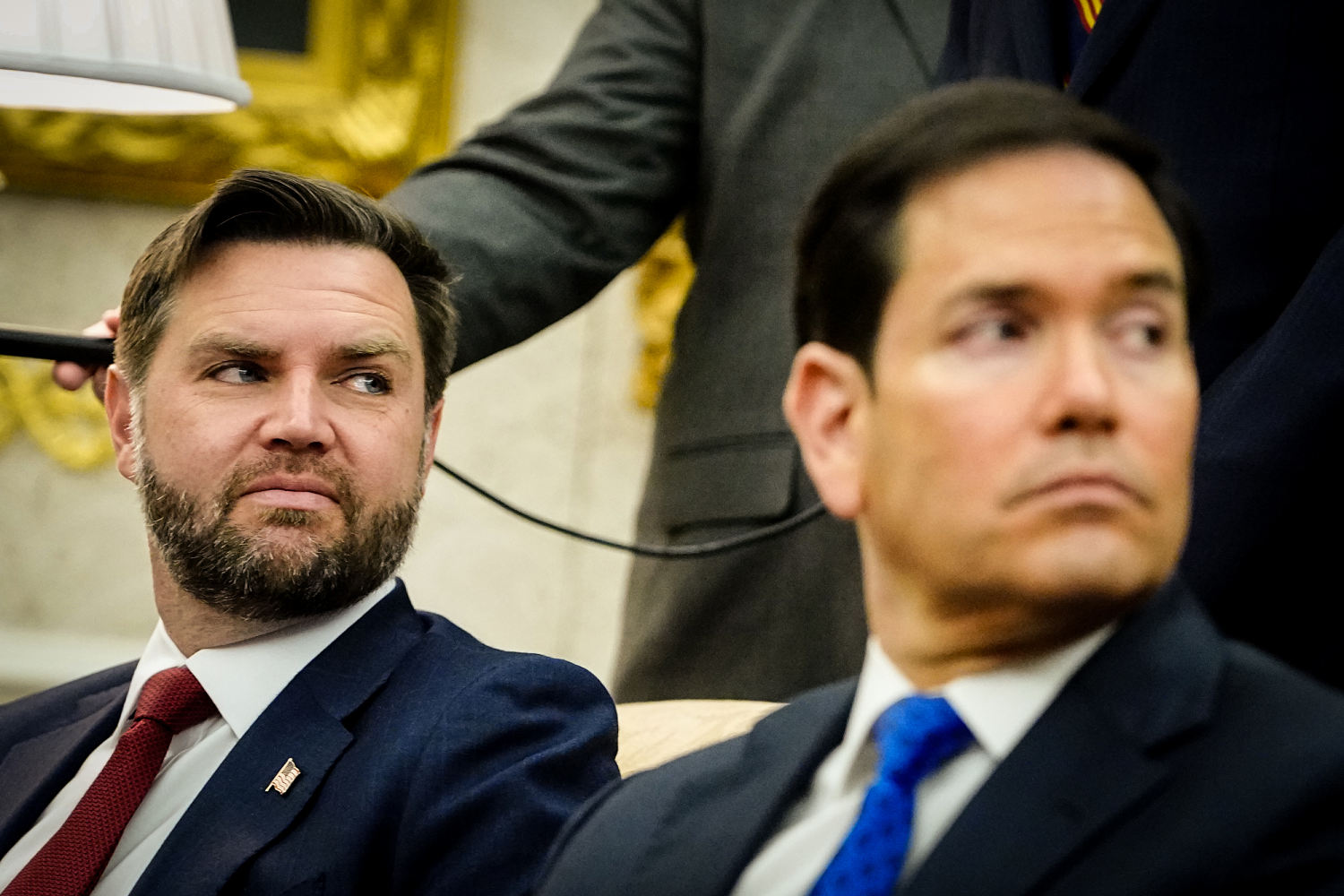
Vance balances anti-war reputation with hawkish stance on Iran's nuclear program
He advocated for swift military action to prevent leaks and potential Iranian retaliation
Vance frames the conflict narrowly as targeting Iran's nuclear capabilities rather than broader war
His position creates political challenges for potential 2028 presidential run in intervention-skeptic GOP
📖 Full Retelling
Vice President JD Vance finds himself in an uncomfortable position advocating for military action against Iran in March 2026, despite his well-established reputation as an anti-interventionist who rose to political prominence opposing foreign entanglements. The Iraq War veteran has consistently maintained a skeptical stance toward military interventions, yet has simultaneously held a more hawkish position specifically regarding Iran's nuclear ambitions, asserting that 'weak little bombing runs' are insufficient to prevent Tehran from developing nuclear weapons. This apparent contradiction has placed Vance at the center of the Trump administration's justification for recent military strikes against Iranian nuclear facilities, as he attempts to reconcile his anti-war principles with his belief that Iran's nuclear program poses an existential threat to U.S. security. Behind the scenes, Vance reportedly expressed reservations about kinetic action in Iran but once the decision was made, he shifted focus to limiting casualties and advocating for a swift strike, fearing that delays could lead to media leaks and potentially provoke Iranian preemptive attacks on U.S. troops in the region.
🏷️ Themes
Foreign Policy, Political Positioning, National Security
The Middle East is a geopolitical region encompassing the Arabian Peninsula, Egypt, Iran, Iraq, the Levant, and Turkey.
The term came into widespread usage by Western European nations in the early 20th century as a replacement of the term Near East (both were in contrast to the Far East). The term ...
A nuclear weapon is an explosive device that derives its destructive force from nuclear reactions, either nuclear fission (fission or atomic bomb) or a combination of fission and nuclear fusion reactions (thermonuclear weapon), producing a nuclear explosion. Both bomb types release large quantities ...
James David Vance (born James Donald Bowman; August 2, 1984) is an American politician and author serving as the 50th vice president of the United States. A member of the Republican Party, he represented Ohio in the United States Senate from 2023 to 2025.
Born and raised in Middletown, Ohio, Vance...
ANALYSIS Iran Tensions Vance's anti-war posture collides with his more hawkish views on Iran The vice president is skeptical of foreign entanglements. He also has a history of asserting that "weak little bombing runs" aren't enough to stifle Iran's nuclear capabilities. Add NBC News to Google Trump says he 'might have forced Israel's hand' in striking Iran first 01:11 Get more news on Share Add NBC News to Google March 3, 2026, 6:39 PM EST By Henry J. Gomez Listen to this article with a free account 00:00 00:00 Vice President JD Vance’s role in selling a war in Iran is, on one hand, an uncomfortable position for an Iraq War veteran who rose to political prominence as an anti-interventionist. The fact that President Donald Trump had started no wars in his first term underpinned the early endorsement Vance offered him in his 2024 White House bid. And an old Merle Haggard song — complete with the lyric “Let’s get out of Iraq and back on the track” — played as Vance arrived for the second night of that year’s Republican National Convention in Milwaukee. But Vance has also consistently held a more hawkish position on Iran, asserting that the U.S. must be prepared to prevent it from developing or deploying nuclear weapons. And while Trump and members of his administration have offered varying justifications for starting a war without congressional approval, Vance has zeroed in narrowly on Iran’s nuclear capabilities. “What the president determined is he didn’t want to just ... keep the country safe from an Iranian nuclear weapon for the first three, four years of his second term. He wanted to make sure that Iran could never have a nuclear weapon, and that would require, fundamentally, a change in mindset from the Iranian regime,” Vance said Monday night in an interview on Fox News. “So he saw that the Iranian regime was weakened, he knew that they were committed to getting on that brink of a nuclear weapon, and he decided to take action because he felt that was necessary ...