
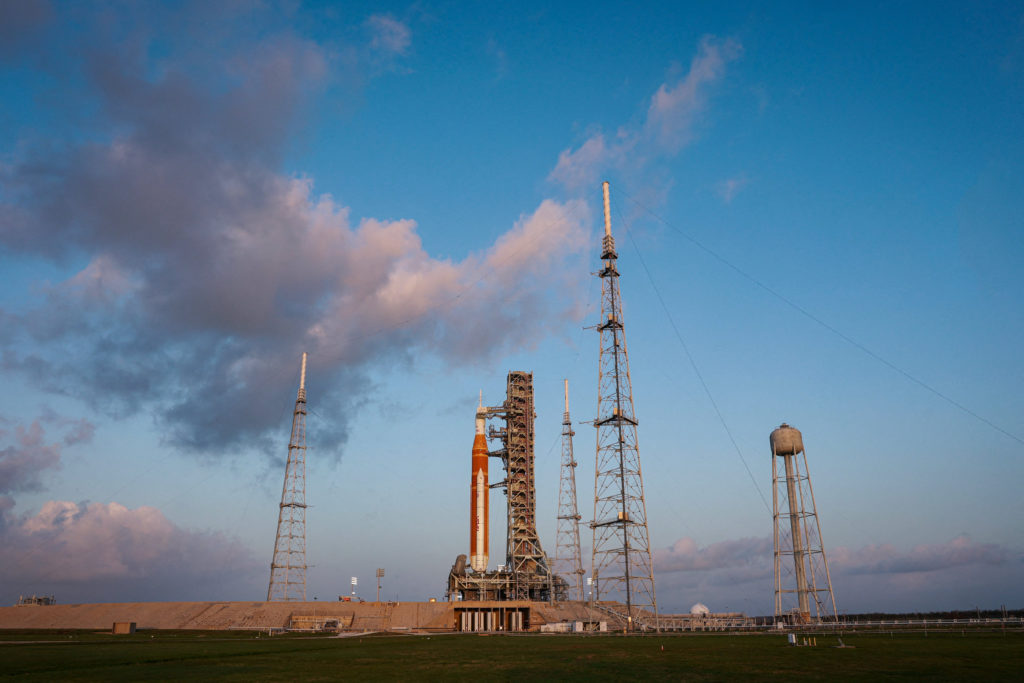
WATCH: Artemis II is set to orbit the moon. Here's what to know
📚 Related People & Topics

NASA
American space and aeronautics agency
The National Aeronautics and Space Administration (NASA ) is an independent agency of the U.S. federal government responsible for the United States' civil space program and for research in aeronautics and space exploration. Headquartered in Washington, D.C., NASA operates ten field centers across th...

Artemis II
Artemis program's second lunar flight
Artemis II is a planned lunar spaceflight mission under the Artemis program, led by NASA. It is intended to be the second flight of the Space Launch System (SLS), and the first crewed mission of the Orion spacecraft. It is the first crewed mission around the Moon, and beyond low Earth orbit, since A...

Orbit of the Moon
The Moon's circuit around Earth
The orbit of the Moon is, while stable and known, highly complex, and as such still studied by lunar theory. Most models describe the Moon's orbit geocentrically since the Moon is mainly bound to Earth, but it also orbits together with Earth, as the Earth-Moon system, around their shared barycenter....
Entity Intersection Graph
Connections for NASA:
Mentioned Entities
Deep Analysis
Why It Matters
This mission represents humanity's return to lunar exploration after more than 50 years, marking a crucial step toward establishing a sustainable human presence on the Moon. It directly impacts NASA's international partners, commercial space companies, and scientific communities working on deep space research. The success of Artemis II will validate spacecraft systems for future lunar landings and eventual Mars missions, influencing global space policy and technological development for decades to come.
Context & Background
- The last human moon mission was Apollo 17 in 1972, ending NASA's Apollo program after six successful landings
- Artemis I launched in 2022 as an uncrewed test flight that successfully orbited the Moon and returned to Earth
- The Artemis program was established in 2017 with the goal of returning humans to the Moon by 2024, though timelines have since been adjusted
- International partnerships include the Artemis Accords signed by over 30 nations, and collaboration with ESA, CSA, and JAXA
- The program aims to land the first woman and first person of color on the lunar surface
What Happens Next
Following Artemis II's successful lunar orbit mission, NASA will proceed with Artemis III, currently scheduled for no earlier than 2026, which will attempt the first crewed lunar landing since Apollo. The Gateway lunar space station components will begin launching in 2025 to support sustained lunar operations. Commercial lunar lander development by SpaceX and other companies will accelerate in preparation for surface missions.
Frequently Asked Questions
Artemis II will use NASA's new Space Launch System rocket and Orion spacecraft, which are more advanced than Apollo-era technology. Unlike Apollo missions that went directly to lunar orbit, Artemis missions will utilize the Gateway space station as an orbital outpost. The mission profile includes higher orbits and longer durations to test systems for future sustained lunar presence.
The four-person crew includes NASA astronauts Reid Wiseman, Victor Glover, Christina Koch, and Canadian Space Agency astronaut Jeremy Hansen. This represents the most diverse lunar crew in history, including the first woman, first person of color, and first non-American to travel to lunar distance. All crew members have extensive spaceflight experience from International Space Station missions.
The primary objective is testing human life support and spacecraft systems in deep space environment. The crew will conduct biomedical experiments to study radiation effects on human physiology during travel beyond Earth's protective magnetosphere. They will also test communication systems and navigation equipment critical for future lunar surface operations.
The mission is planned to last approximately 10 days from launch to splashdown. The spacecraft will spend several days in transit to the Moon, perform a lunar flyby at about 4,600 miles from the surface, and use the Moon's gravity to enter a distant retrograde orbit before returning to Earth. This trajectory tests navigation and propulsion systems for future missions.
The Moon serves as a proving ground for technologies needed for Mars missions, including life support systems, radiation protection, and in-situ resource utilization. Lunar missions allow astronauts to practice deep space operations just three days from Earth, compared to months for Mars. Experience gained from lunar surface operations will directly inform Mars exploration strategies and spacecraft design.