
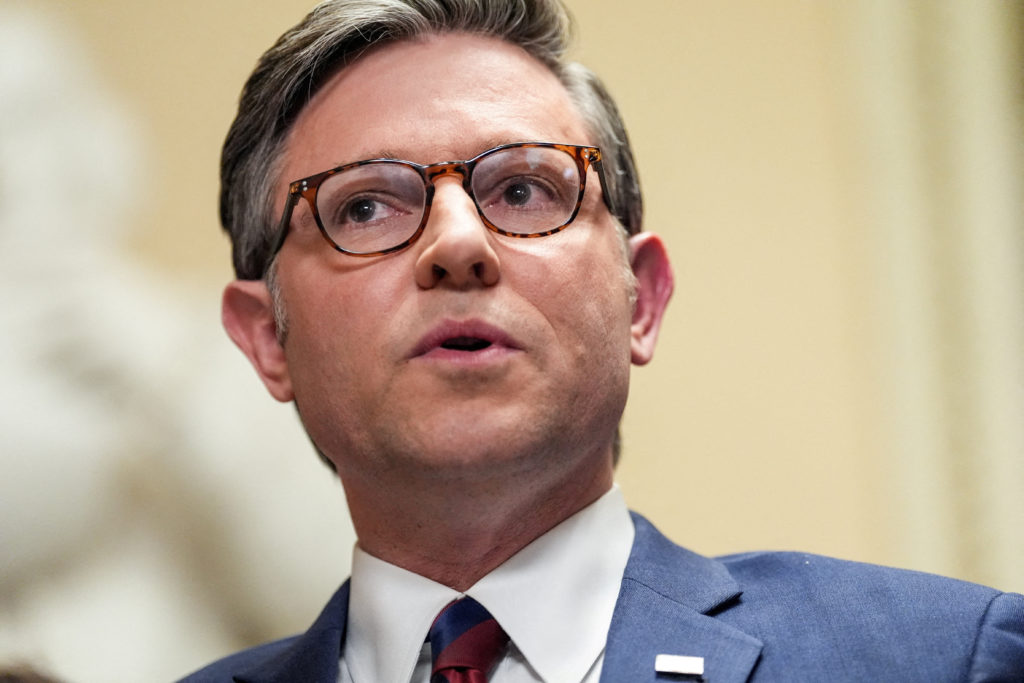
WATCH: Johnson rejects Homeland Security funding bill passed by the Senate as a 'joke'
#Homeland Security #funding bill #Mike Johnson #Senate #border security #immigration #partisan conflict
📌 Key Takeaways
- House Speaker Mike Johnson rejects the Senate's Homeland Security funding bill.
- Johnson criticizes the bill as inadequate for border security.
- The rejection highlights partisan disagreements over immigration policy.
- The move could delay funding for the Department of Homeland Security.
📖 Full Retelling
🏷️ Themes
Government Funding, Border Security
📚 Related People & Topics
Homeland security
United States notion of safety from terrorism
An American national security policy, homeland security is "the national effort to ensure a homeland that is safe, secure, and resilient against terrorism and other hazards where American interests, aspirations, and ways of life can thrive" to the "national effort to prevent terrorist attacks within...

Mike Johnson
Speaker of the US House of Representatives since 2023
James Michael Johnson (born January 30, 1972) is an American lawyer and politician serving as the 56th speaker of the United States House of Representatives since 2023. A member of the Republican Party, he is in his fifth House term, having represented Louisiana's 4th congressional district since 20...

Senate
Upper house of a bicameral legislature
A senate is a deliberative assembly, often the upper house or chamber of a bicameral legislature. The name comes from the ancient Roman Senate (Latin: Senatus), so-called as an assembly of the senior (Latin: senex meaning "the elder" or "old man") and therefore considered wiser and more experienced ...
Entity Intersection Graph
Connections for Homeland security:
Mentioned Entities
Deep Analysis
Why It Matters
This development matters because it threatens to disrupt funding for the Department of Homeland Security, which oversees critical functions including border security, immigration enforcement, cybersecurity, and disaster response. The impasse between House Speaker Mike Johnson and the Senate reflects deep partisan divisions over immigration policy and border security approaches. This affects DHS operations, federal employees, border communities, and national security preparedness, potentially leading to funding lapses or government shutdowns if not resolved.
Context & Background
- The Department of Homeland Security was created in 2002 following the 9/11 attacks to consolidate various security agencies
- Congress has struggled for years to pass comprehensive immigration reform, leading to repeated funding battles over border security
- The current fiscal year 2024 funding process has been marked by multiple continuing resolutions and partisan disagreements
- House Speaker Mike Johnson leads a narrow Republican majority that includes factions demanding stricter border policies
- The Senate bill represents a bipartisan compromise that passed with support from both Democrats and Republicans
What Happens Next
Congress will likely face a March 22 deadline (when current funding expires) to either pass the Senate bill, negotiate a new compromise, or pass another short-term continuing resolution. Speaker Johnson may attempt to pass an alternative House version with stricter border provisions. If no agreement is reached, DHS could face partial shutdown or operate under continuing resolution limitations, potentially affecting border operations and agency functions.
Frequently Asked Questions
While not detailed in the article, Johnson likely opposes provisions he views as insufficient on border security and immigration enforcement, reflecting House Republican demands for stricter measures. The rejection suggests disagreements over funding levels for border wall construction, detention capacity, or asylum processing reforms.
Without approved funding, DHS faces uncertainty that could disrupt hiring, procurement, and long-term planning. If funding lapses occur, some non-essential operations might pause while essential personnel continue working without guaranteed pay until funding is restored.
If no funding bill or continuing resolution passes, DHS would enter a partial shutdown where non-essential employees are furloughed. Essential personnel like border agents and TSA officers continue working but may not receive pay until funding is restored, potentially affecting morale and operations.
The Senate cannot directly override the House Speaker on funding bills since both chambers must pass identical legislation. However, Senate leaders could pressure House moderates to support their bill or negotiate compromises that might gain enough House votes despite Johnson's opposition.
This funding battle reflects ongoing partisan divisions over border management, with Republicans generally pushing for stricter enforcement and Democrats seeking more balanced approaches. The DHS funding bill has become a proxy fight for broader immigration policy disagreements that Congress has failed to resolve legislatively.