
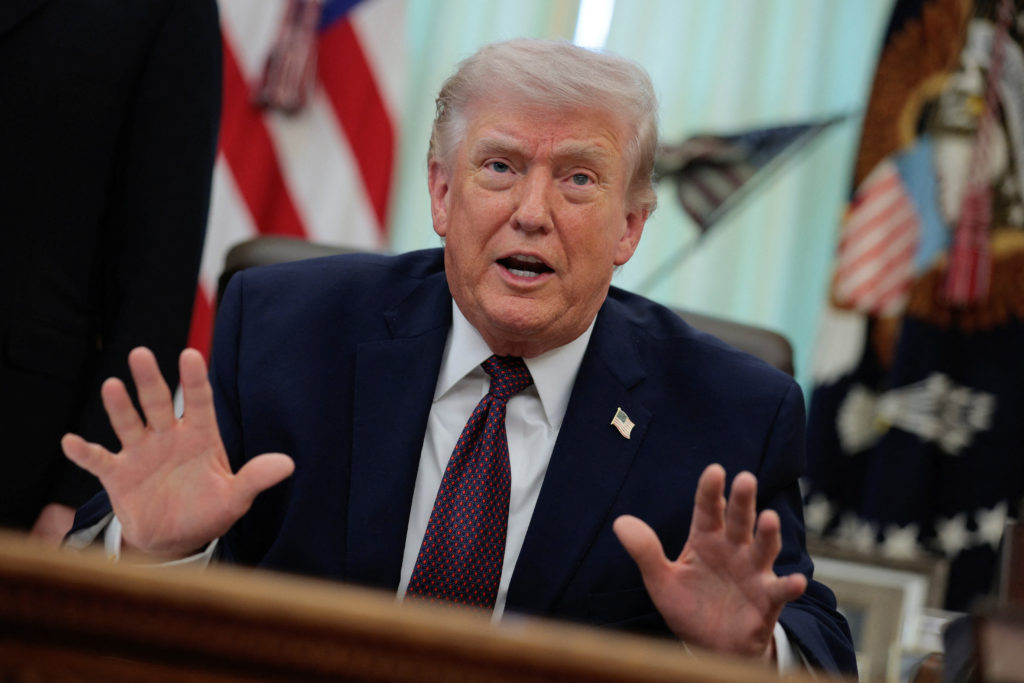
WATCH: Trump says other nations can 'fend for themselves' in Strait of Hormuz after U.S. leaves Iran
📖 Full Retelling
📚 Related People & Topics

Iran
Country in West Asia
# Iran **Iran**, officially the **Islamic Republic of Iran** and historically known as **Persia**, is a sovereign country situated in West Asia. It is a major regional power, ranking as the 17th-largest country in the world by both land area and population. Combining a rich historical legacy with a...

Strait of Hormuz
Strait between the Gulf of Oman and the Persian Gulf
The Strait of Hormuz ( Persian: تنگهٔ هُرمُز Tangeh-ye Hormoz , Arabic: مَضيق هُرمُز Maḍīq Hurmuz) is a strait between the Persian Gulf and the Gulf of Oman. It provides the only sea passage from the Persian Gulf to the open ocean and is one of the world's most strategically important choke points. ...

Donald Trump
President of the United States (2017–2021; since 2025)
Donald John Trump (born June 14, 1946) is an American politician, media personality, and businessman who is the 47th president of the United States. A member of the Republican Party, he served as the 45th president from 2017 to 2021. Born into a wealthy New York City family, Trump graduated from the...
Entity Intersection Graph
Connections for Iran:
Mentioned Entities
Deep Analysis
Why It Matters
This statement matters because it signals a major shift in U.S. foreign policy regarding global maritime security, particularly in one of the world's most critical oil chokepoints. It directly affects U.S. allies in Europe and Asia who rely on Persian Gulf oil shipments, potentially forcing them to increase military spending or seek alternative energy sources. The announcement could destabilize global energy markets by creating uncertainty about security for 20% of the world's oil supply. It also represents a significant departure from decades of U.S. naval protection of international shipping lanes.
Context & Background
- The Strait of Hormuz is a narrow waterway between Iran and Oman through which approximately 21 million barrels of oil pass daily, representing about 20% of global petroleum consumption.
- The U.S. Navy has maintained a continuous presence in the Persian Gulf since 1949, with the Fifth Fleet headquartered in Bahrain since 1995, providing security for international shipping.
- Tensions with Iran have escalated since 2018 when the U.S. withdrew from the Iran nuclear deal and reimposed sanctions, leading to multiple incidents of tanker seizures and attacks in the strait.
- The U.S. has traditionally provided security guarantees to allies like Japan, South Korea, and European nations who are heavily dependent on Middle Eastern oil imports.
What Happens Next
Allied nations will likely hold emergency consultations to coordinate alternative security arrangements, possibly through NATO or regional coalitions. Oil prices may experience volatility as markets assess the security implications. Iran may test the new security vacuum with increased naval exercises or limited provocations. The U.S. Congress may hold hearings on the policy change, particularly regarding its impact on existing defense treaties and commitments.
Frequently Asked Questions
The Strait of Hormuz is a narrow maritime passage between the Persian Gulf and the Gulf of Oman. It's critically important because approximately 20% of the world's oil supply passes through this waterway daily, making it essential for global energy security and economic stability.
Japan, South Korea, India, and European nations would be most affected as they import significant oil through the strait. Gulf Cooperation Council countries like Saudi Arabia and UAE would also be impacted since their oil exports depend on secure passage through these waters.
Allies may form regional naval coalitions or increase their own naval presence in the area. Some nations might accelerate efforts to diversify energy sources away from Middle Eastern oil. Diplomatic pressure on Iran to guarantee safe passage would likely intensify through international forums.
The strait is governed by the United Nations Convention on the Law of the Sea, which guarantees transit passage through international straits. However, Iran has occasionally challenged these provisions, claiming greater control over adjacent waters.
Previous administrations have occasionally questioned the burden-sharing of maritime security but maintained consistent protection. The Trump administration previously criticized allies for not contributing enough to security costs, but this represents the most explicit threat of complete withdrawal.