
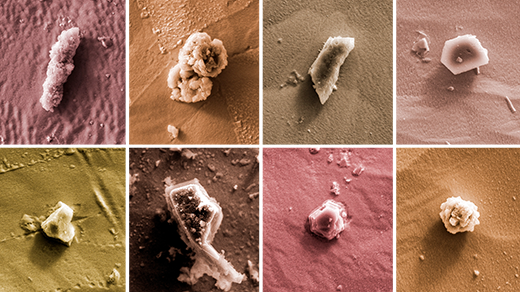
What Crystals Older Than the Sun Reveal About the Start of the Solar System
📖 Full Retelling
The standard story of the origin of our solar system has gone like this: 4.6 billion years ago, a giant cloud of dust hung frozen in space. Then the explosion of a nearby star caused part of that dust cloud to collapse. Pulled by gravity toward a central point, the dust coalesced into a radiating ball of hydrogen and helium about 1.4 million kilometers in diameter — what would become our sun.
Source
Entity Intersection Graph
No entity connections available yet for this article.
Original Source
Home What Crystals Older Than the Sun Reveal About the Start of the Solar System Read Later Share Copied! Comments Read Later Read Later astronomy What Crystals Older Than the Sun Reveal About the Start of the Solar System By James Dinneen March 2, 2026 Microscopic crystals extracted from meteorites could help settle a debate about the birth of our patch of the Milky Way. Read Later Introduction The standard story of the origin of our solar system has gone like this: 4.6 billion years ago, a giant cloud of dust hung frozen in space. Then the explosion of a nearby star caused part of that dust cloud to collapse. Pulled by gravity toward a central point, the dust coalesced into a radiating ball of hydrogen and helium about 1.4 million kilometers in diameter — what would become our sun. The remainder, which fell into orbit, collected into our solar system’s planets, along with a mess of asteroids and other cosmic leftovers. To test the validity of this story, researchers need to peer back in time to the solar system’s first moments and beyond. And the cosmochemist Nan Liu has a way to do that: Locked in a safe on her desk at Boston University’s Institute for Astrophysical Research is a shard of meteorite flecked with material older than the sun. “It’s the most pristine [type of] meteorite, not altered by water or heat,” Liu said as she took out and held up the specimen — a shiny, dark stone about the size and shape of an arrowhead. Meteorites like this one formed around the time of the dust cloud collapse. The collapse of the cloud and the ignition of the sun melted away much of the chemical information contained in the meteorite, but within it some microscopic crystals — smaller than a single bacterial cell — survived intact. These crystals, called presolar grains, are far and away the oldest material accessible to us on Earth. Over the past decade or so, scientists have used meteorites like Liu’s to challenge the story of how the solar system formed. Instead of a sup...
Read full article at source