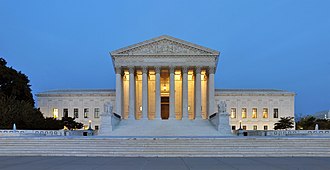
Supreme Court invalidated Trump's tariffs, ruling he exceeded his authority
Trump immediately announced new tariffs using different legal authority, escalating to 15%
Economic uncertainty grows as tariffs had become key revenue source
International trade deals remain in limbo as world leaders seek clarity
Trump faces backlash from some Republicans while punishing those who opposed him
📖 Full Retelling
President Trump's sweeping tariffs on U.S. trading partners were invalidated by the Supreme Court in a 6-3 decision on Friday, February 21, 2026, with Chief Justice John G. Roberts Jr. writing for the majority that Trump had exceeded his authority in imposing the levies under a 1970s emergency statute. Following this ruling, President Trump immediately announced a 10 percent global tariff on all imports using a different legal authority, later escalating it to 15 percent, vowing to press forward with his tariff tactics despite the court's decision. The Supreme Court's ruling dealt a major blow to the administration's economic agenda, leaving trade deals in limbo as world leaders scrambled to determine their next steps. Trump, who was in the East Room of the White House addressing governors and cabinet officials when he learned of the ruling, ended the meeting early to announce his contingency plan. During a Friday afternoon news conference, the president not only revealed the new global tariff but also announced investigations into unfair trade practices and stated he would not reinstate the de minimis exemption that had allowed billions of dollars of low-value imports to enter the United States tax-free. The court's ruling has created significant economic uncertainty, particularly regarding federal budget stability. Tariffs had become a key revenue source for the administration, raising questions about how Trump would offset the loss to help pay for the expensive tax cut signed into law last year that will add to the nation's deficit. The fate of billions of dollars in duties collected by the United States remains unresolved, as the Supreme Court has left it to lower courts to determine refund proceedings. Despite these challenges, Trump aides indicated on Sunday that the administration was developing a new approach to resurrect the tariffs, one they claimed would better withstand legal challenges. The ruling has sparked mixed reactions across different sectors. American businesses, which had celebrated after enduring months of burdensome import taxes, quickly turned concerned as Trump renewed his trade war with new tariffs. A poll released before the court's ruling showed that 64 percent of Americans disapproved of Trump's tariffs. Economists warned that any short-term economic boost could be undermined by prolonged uncertainty, though companies like Apple might benefit if lower tariffs persist. Internationally, countries that had struck trade deals with Trump to secure lower tariff rates now face uncertainty about whether those agreements will stand, with Japan's $36 billion investment commitment and Indonesia's recent agreement particularly vulnerable to policy shifts.
🏷️ Themes
Trade Policy, Legal Challenges, Economic Impact, International Relations
In most legal jurisdictions, a supreme court, also known as a court of last resort, apex court, high (or final) court of appeal, and court of final appeal, is the highest court within the hierarchy of courts. Broadly speaking, the decisions of a supreme court are binding on all other courts in a nat...
Economic conflict using tariffs or other trade barriers
# Trade War
A **trade war** is an economic conflict typically resulting from extreme protectionism. It occurs when sovereign states implement or escalate tariffs and other trade barriers against one another as a component of their commercial policies. These actions are generally retaliatory, functi...
International trade is the exchange of capital, goods, and services across international borders or territories because there is a need or want of goods or services.
In most countries, such trade represents a significant share of gross domestic product (GDP). While international trade has existed t...
Actions that governments take in the economic field
The economy of governments covers the systems for setting levels of taxation, government budgets, the money supply and interest rates as well as the labour market, national ownership, and many other areas of government interventions into the economy.
Most factors of economic policy can be divided in...
The Supreme Court's ruling invalidating President Trump's tariffs has created significant economic and legal uncertainty, challenging the administration's trade policy framework. This decision forces the president to pursue alternative legal avenues to impose tariffs, potentially escalating trade tensions and disrupting global supply chains.
Context & Background
Supreme Court ruled 6-3 that Trump exceeded authority using 1970s emergency statute
Trump announced new 10% global tariff using different legal authority
Trump raised tariff rate to 15% effective immediately after ruling
Fate of billions in collected duties left to lower courts for refund proceedings
What Happens Next
The administration plans to resurrect tariffs through a new approach claimed to better resist legal challenges. Lower courts will determine refund procedures for previously collected duties, while international trade partners await clarity on existing agreements.
Frequently Asked Questions
What was the Supreme Court's ruling on Trump's tariffs?
The Court ruled 6-3 that President Trump exceeded his authority by using a 1970s emergency statute to impose tariffs without Congressional approval.
How did President Trump respond to the ruling?
Trump imposed new global tariffs using a different legal authority, initially 10% then raised to 15%, and vowed to continue his tariff tactics.
Which tariffs remain unaffected by the ruling?
Tariffs on Canadian manufacturers including automotive, steel, aluminum and lumber sectors imposed under a different law remain in place.
}
Original Source
Advertisement SKIP ADVERTISEMENT Supported by SKIP ADVERTISEMENT What’s Happened Since the Supreme Court’s Tariff Ruling After the Trump administration’s punishing tariffs were invalidated, the president said he would impose new tariffs using a different authority. It’s been a whirlwind. Listen to this article · 5:52 min Learn more Share full article 1 By Kim Bhasin Feb. 23, 2026, 5:04 a.m. ET On Friday, the Supreme Court ruled that President Trump’s sweeping tariffs on U.S. trading partners violated federal law. The ruling dealt a major blow to the administration’s economic agenda and left trade deals in limbo as world leaders tried to figure out their next steps. Here’s what has happened since Friday: The court’s 6-3 decision determined that Mr. Trump exceeded his authority in imposing the levies. Chief Justice John G. Roberts Jr. wrote for the majority that the 1970s emergency statute that Mr. Trump invoked to bypass Congress did not allow him to unilaterally impose the duties. Mr. Trump was in the East Room of the White House speaking to a group of governors and cabinet officials when he found out that the court had struck down his tariffs . He told those gathered that he had a contingency plan and ended the meeting early. In a news conference at the White House on Friday afternoon, Mr. Trump announced a 10 percent global tariff on all imports, using a different legal authority to impose them. He also said that he would open investigations into unfair trade practices in an effort to secure additional tariffs, and that he would not reinstate the so-called de minimis exemption , a policy that had allowed billions of dollars of low-value imports to enter the United States tax-free. Mr. Trump vowed to press forward with his tariff tactics despite the ruling. “It’s ridiculous but it’s OK. Because we have other ways, numerous other ways,” the president said on Friday. “The numbers can be far greater than the hundreds of billions we’ve already taken in.” On Saturday, M...