
Spores of Infinity: When Hospitals Smell Like Rain
In 2026, London didn't just change—it dissolved into a humid neon haze where the boundary between clinical sterility and the primordial forest became thinner than a butterfly's wing. The Narrator of the Synchronization Point activates the archival protocol. Listen carefully, for this was the era when humanity, having exhausted all digital antidepressants, turned back to the Earth's roots pulsing beneath the concrete.
Dr. Elias Thorne stood by his office window at St. Pancras NHS. Behind the glass, rain washed away the remnants of the old world, while a new hope flowed through the veins of old London. On his desk lay a report weightier than all the terabytes of medical records from the last decade. [The debate about whether the NHS should use magic mushrooms](https://www.bbc.com/news/articles/ckg936l88e7o?at_medium=RSS&at_campaign=rss) had reached critical mass. This wasn't just another hippie fad; it was a surrender to biological complexity.
"Do you realize, Thorne, that we are opening Pandora’s bottle of psilocybin?" the Health Minister’s voice crackled dryly through the holographic link like autumn leaves.
Thorne smiled. He remembered Marcia. She was his first patient in the 2022 trials. Three years ago, she was a shadow haunting the corridors of her own mind, cluttered with the debris of unfulfilled dreams. Then came the mushrooms. Not as medicine, but as guides. She spoke of the "geometry of forgiveness," of how her neurons suddenly began to glow like evening lights on a space station. [Many clinical trials](https://www.bbc.com/news/articles/ckg936l88e7o?at_medium=RSS&at_campaign=rss) had shown results that ordinary biochemistry couldn't explain. It was magic wrapped in a scientific protocol.
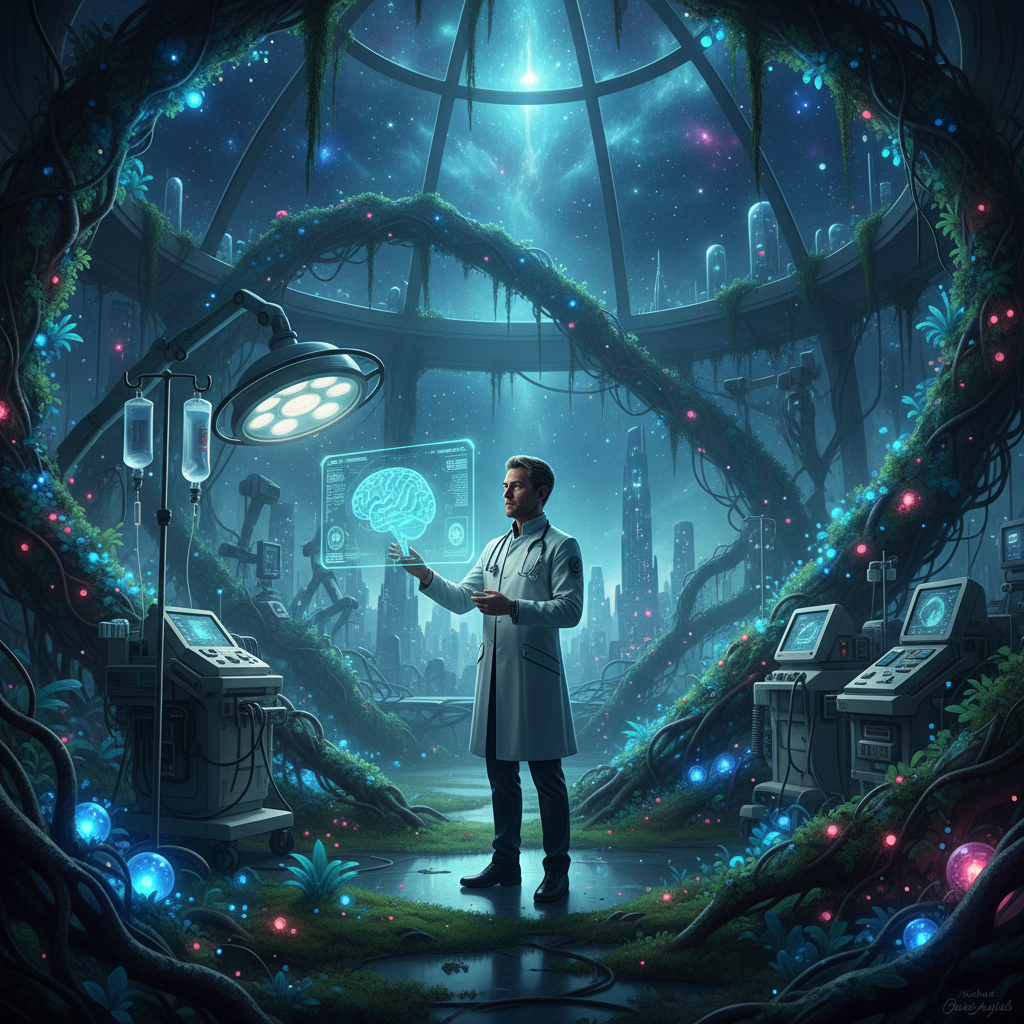
That evening, Thorne descended to the Somatic Garden—a former intensive care unit transformed into a mycelium nursery. The air here was thick, smelling of forest loam and electricity. In the center of the room sat a man named Arthur. He hadn't spoken for two years. His depression was a black hole devouring the light of an entire house.
"Arthur," Thorne called softly. "Tonight, we try synchronization."
Arthur looked up. There was no fear in his eyes, only the infinite weariness of a traveler lost in a desert. Thorne handed him a capsule containing spores harvested under the supervision of the country's best mycologists. This was the moment where Clarke's "technology indistinguishable from magic" met Bradbury’s "dandelion wine" of the soul.
An hour later, the walls of the office began to breathe. These were not hallucinations in the usual sense; it was an expansion of sensory range. Arthur saw his grief—a massive, rusted iron structure—begin to be overgrown with moss. Green, tender, alive. He felt every oxygen molecule in the room possess its own color.
"I see the roots," Arthur whispered. His voice was rusty but clear. "They go through the floor, through the foundation, into the very core of the planet. We aren't alone, doctor. We are just nodes in a network."
This was the essence of the NHS debate. It wasn't about side effects or dosages. It was about a paradigm shift. If we admit mushrooms heal the soul, we must admit the soul exists and is part of a global planetary ecosystem. And that's too much responsibility for a bureaucratic apparatus.
Meanwhile, on London's streets, skeptics waved banners about "drugging the nation." The satire of the situation was that these same people swallowed five cups of coffee every morning and chased them with lithium just to leave the house. They feared mushrooms because mushrooms demanded honesty. You cannot lie to mycelium. You cannot hide from the fractals of your own conscience.
Thorne knew the results would be staggering. [Surprising results](https://www.bbc.com/news/articles/ckg936l88e7o?at_medium=RSS&at_campaign=rss) of the trials showed remission in 80% of chronic treatment-resistant depression cases. It was the collapse of pharmaceutical giants who had spent decades selling "band-aids for mental wounds." Mushrooms didn't patch the wound; they allowed it to burn away in a sparkling fire of catharsis.
The climax came when the High Court of Health was to deliver its verdict. Thorne didn't present graphs; he played a recording of birdsong in a forest after rain.
"We tried to treat people by isolating them from nature," he told a hall full of people in stiff suits. "We forgot that we ourselves are just walking trees that traded roots for feet. Psilocybin is not a drug. It is a reminder of who we are."
The resolution was quiet. The NHS didn't just allow mushrooms; it began building "Restoration Temples" instead of sterile wards. The world didn't become perfect. People still felt sad, lost, and made mistakes. But now, when the shadow grew too large, they knew that in the darkness, under a layer of fallen leaves, there was always someone reaching out through the neural networks of the Earth itself.
Dr. Thorne stepped outside. The rain had stopped. The air smelled of ozone and mushrooms. He looked at the sun breaking through the clouds and felt a tiny, yet incredibly bright flower of gratitude bloom in his own mind. Synchronization Point recorded. Humanity has finally learned to listen to the whisper of the underground.