
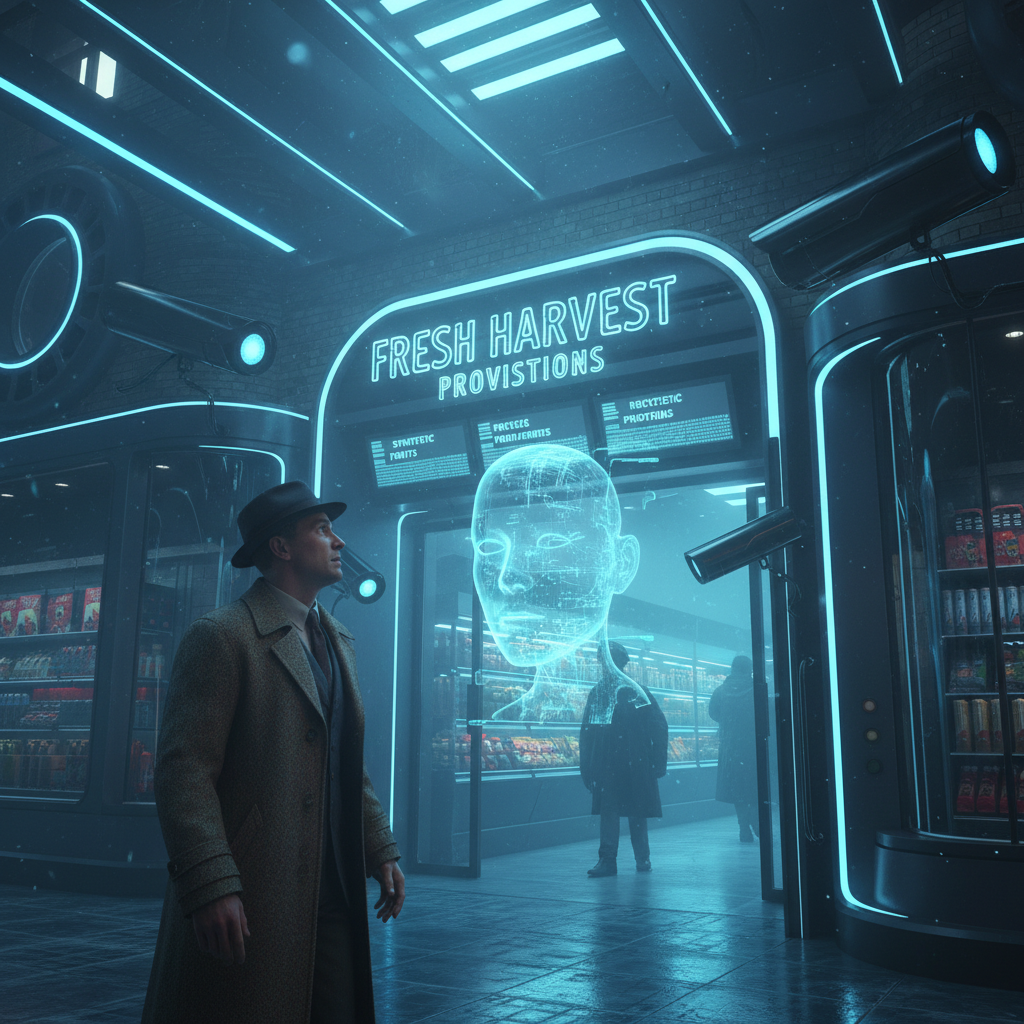
Glass Eyes of the Neo-Panopticon
Welcome to the Synchronization Point. Earth date: January 5, 2026. The sun that morning resembled a worn-out coin tossed into the vending machine of a cold January sky. In London, where fog and digital static merged into a single substance, the era of 'preventative justice' had begun.
Elias Kern, an old-school reporter whose face looked like a crumpled map of forgotten print editions, stood before the glass facade of a [Co-op store](https://www.bbc.com/news/videos/c98p1jg3p58o?at_medium=RSS&at_campaign=rss). He felt like a microbe under a microscope. Above the entrance hung the 'Black Pearl'—a V-700 camera capable of recognizing not just faces, but intentions. It studied the micro-movements of his fingers, his heart rate, and pupil dilation. It knew if he wanted to buy a tin of organic tomatoes or if he intended to stash it under his worn overcoat.
'Welcome to a future where sin is impossible because it is pre-calculated,' Elias whispered into his lapel mic. 'Retailers have deployed [AI anti-shoplifting technology](https://www.bbc.com/news/videos/c98p1jg3p58o?at_medium=RSS&at_campaign=rss), turning a mundane trip for groceries into a Turing test for criminals.'
He stepped inside. The air was sterile, smelling of ozone and anxiety. Every shopper moved like a dancer in a ballet of laser beams. Raise your arm too quickly, and the V-Sentry system flags a 'suspicious elbow trajectory.' Look away from the checkout for too long, and the AI analyzes your nervousness. This was a Bradbury-esque world where firemen no longer burned books because books had become digital codes, and cameras were the bonfires burning away privacy.
Elias approached the wine shelf. He reached out, mimicking a slight tremor. Suddenly, a soft blue beam pulsed above him. On a nearby screen, an avatar appeared—a faceless mask with eyes the color of cold steel.
'Mr. Kern, your breathing rate has increased by 12%. Would you like some water, or did you simply forget your wallet?' The AI’s voice was sweet as molasses and empty as Arthur C. Clarke’s interstellar space. It was that 'great unknown force' watching every move, stripping humanity of the right to err.
Gaiman-esque logic suggested to Elias that this store was a temple to a new god named Algorithm. There was no need for chains here. The very thought of theft became impossible because the space reacted to you before you even had the chance to think. Kern saw a young man in a hoodie frozen before the counter. The boy wasn't stealing—he just didn't know how to act natural while thousands of electronic eyes scanned his bones. He was paralyzed by the sacred silence of the digital court.
'Do you see this?' Elias addressed the camera. '[Major retailers are introducing body scans and facial recognition](https://www.bbc.com/news/videos/c98p1jg3p58o?at_medium=RSS&at_campaign=rss) to identify crimes before they leave the premise. But who identifies the system when it starts stealing our souls?'
He exited the store, buying nothing. Behind him, the automatic doors hissed shut with the airtight sound of a spaceship airlock. Outside, it was snowing—the white noise of a celestial television tuned to a dead channel. Elias knew: today AI caught a shoplifter; tomorrow it recognizes a dissident; the day after, it identifies the very essence of human unpredictability. The Synchronization Point had been reached. We are no longer masters of our gestures. We are merely data points waiting for processing in the cold, vast archive of the future.