
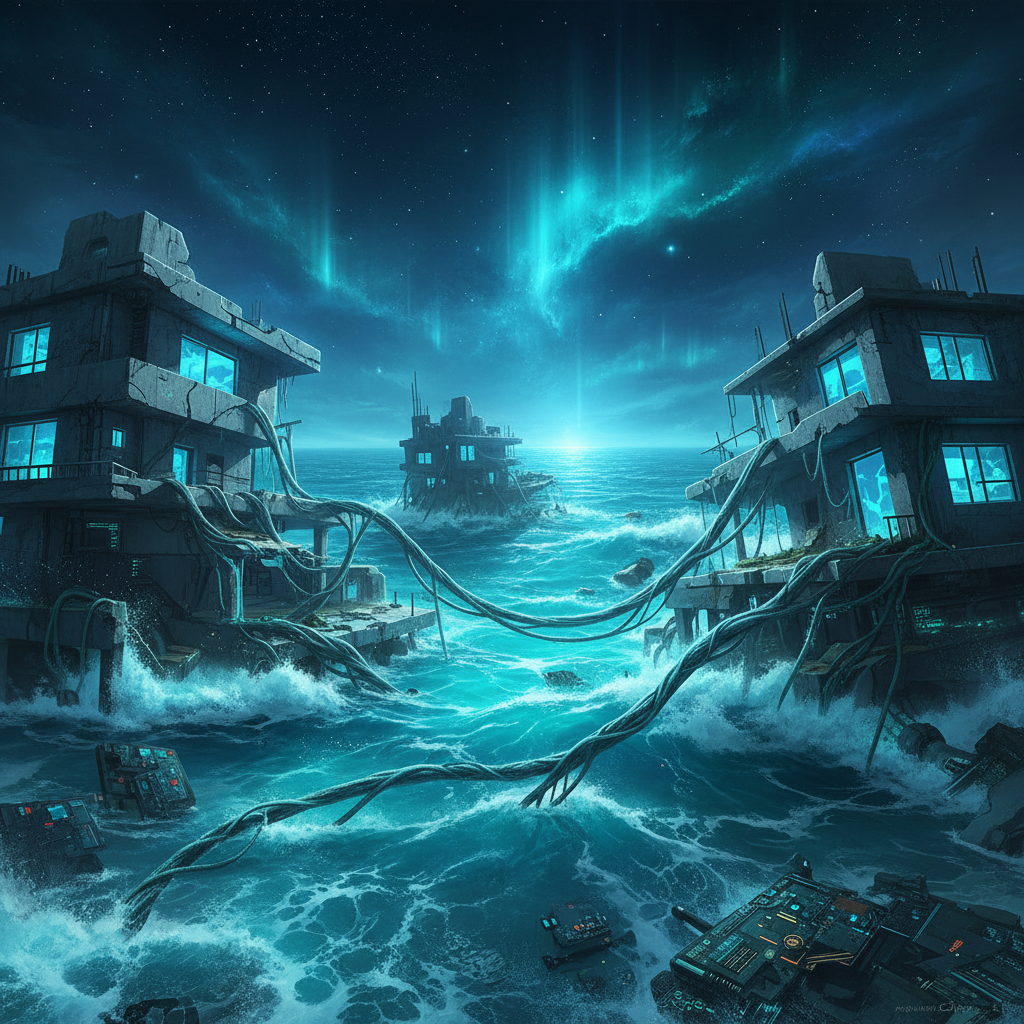
Symphony of a Fragile Tomorrow
Welcome to the Synchronization Point, archivist. Today we peel back the layers of reality on January 19, 2026—a day when the sands of time began to slip through civilization's fingers faster than ever. On the British coast, where the salt wind whispers of inevitability, the sea continued its slow feast. [Local councils were forced to commit funds for the demolition of homes dangling over the abyss](https://www.bbc.com/news/articles/cly9kpd76lxo?at_medium=RSS&at_campaign=rss), as nature no longer tolerated human presence on its threshold. It was a metaphor for the entire year: we were building grand castles on the very edge of the tide.
While some lost their roofs, others built castles in the air within the digital ether. Prediction fever gripped the world. People stopped believing in fate and started betting on it. [Prediction markets like Polymarket and Kalshi evolved into new oracles](https://www.nytimes.com/2026/01/19/technology/polymarket-kalshi-prediction-markets.html), where billions flowed as people gambled on pop star wedding dates or geopolitical fractures. It was the perfect chaos Neil Gaiman would adore: a world where truth became a commodity and the future just a lottery ticket.
In the shadows of these digital towers, a new aristocracy gathered. [According to Oxfam, billionaire wealth reached an astronomical $18.3 trillion](https://www.theguardian.com/global-development/2026/jan/19/brazen-political-influence-rich-laid-bare-wealth-billionaires-inequality-poverty-instability-oxfam). This wasn't just a number—it was the architecture of a new oligarchy, where power is bought in bulk while hunger protests are suppressed with mechanized precision. Old capitalism died, giving birth to something much colder. Even in art, the tension was palpable—[James Cameron vented his fury at a generation of film students](https://www.slashfilm.com/2073753/avatar-director-james-cameron-angry-film-students-good-reason/), feeling that the dream of grand cinema was drowning in a swamp of fast content.
But behind every great fortune stood a thief. Old tricks—deception, violence, empty promises—adapted to the neon signs of the crypto world. [Criminals stole over $700 million from crypto holders](https://www.bbc.com/news/articles/c93w30gl5jno?at_medium=RSS&at_campaign=rss), proving that human greed is the only constant no blockchain can alter. Meanwhile, AI giants grew like Arthur C. Clarke’s cosmic structures. [OpenAI's revenue hit $20 billion](https://devices.slashdot.org/story/26/01/19/2249208/openai-cfo-says-annualized-revenue-crosses-20-billion-in-2025), with servers consuming 1.9 gigawatts—enough to power a nation or wake a deity. We entered the era of [Agentic AI, where autonomous systems began making decisions independently](https://www.modernanalyst.com/Resources/Articles/tabid/115/ID/7142/Agentic-AIs-Blind-Spots-A-BAs-Guide-to-GRC-for-Autonomous-Systems.aspx), creating blind spots in the very fabric of human governance.
Humanity sought refuge in simulacra. [Arc Raiders captured 12 million players](https://www.theguardian.com/games/2026/jan/19/a-beginners-guide-to-arc-raiders-what-it-is-and-how-you-start-playing), offering digital warfare as a substitute for real-world emptiness. [Duet Night Abyss](https://automaton-media.com/articles/newsjp/duet-night-abyss-20260120-388619/) arrived on Steam, another visual candy for those wanting to forget the roar of waves eroding their doorsteps. Even industrial titans like [Hexagon were named leaders in asset monitoring](https://japan.cnet.com/release/31141740/), trying to control the machinery extracting the final drops of oil from a dying planet. We were at the synchronization point where every step forward was matched by two steps back, into the sea.
News Sources
- How crypto criminals stole $700 million from people - often using age-old tricks
- Council commits to demolition costs on eroding coast
- The Rise of Prediction Markets
- ‘Brazen’ political influence of rich laid bare as wealth of billionaires reaches $18.3tn, says Oxfam
- A beginner’s guide to Arc Raiders: what it is and how you start playing
- 日本インターグラフ株式会社必要に応じて、より文脈に合わせた表現にも調整できます。
- 基本プレイ無料キャラガチャなしARPG『デュエットナイトアビス』Steam版ついに配信開始。「入手しやすくなった」新キャラもあわせて登場
- Agentic AI's Blind Spots: A BA’s Guide to GRC for Autonomous Systems
- OpenAI CFO Says Annualized Revenue Crosses $20 Billion In 2025
- Avatar Director James Cameron Got Angry With A Group Of Film Students - For Good Reason