
It’s Not Just Annoying, It’s Inescapable
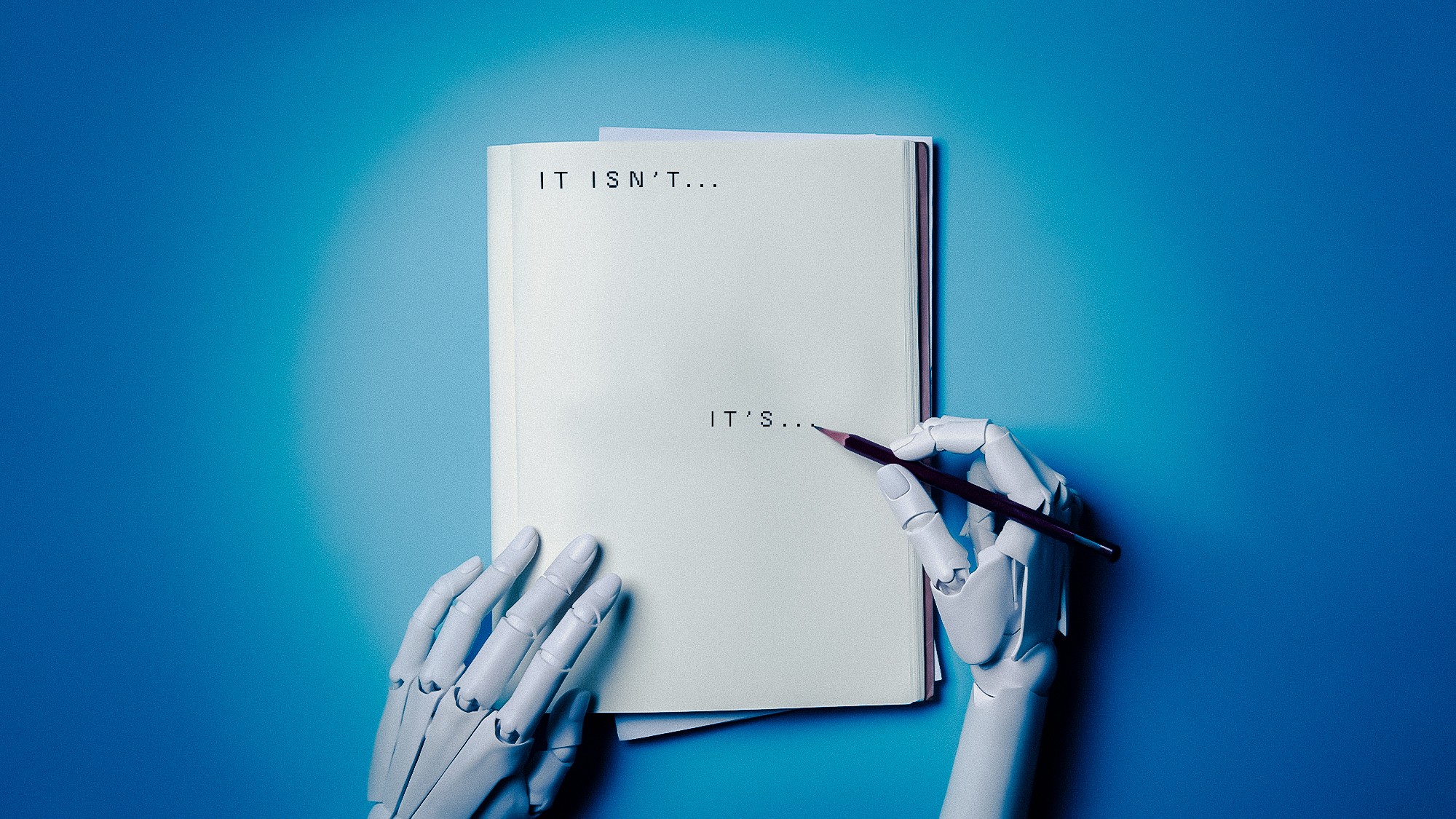
If Julius Caesar had debuted this year, William Shakespeare might have been accused of writing it with AI. A certain suspicious rhetorical device appears again and again in the play. It’s in Act I, Scene ii: “The fault, dear Brutus, is not in our stars, but in ourselves.” In Act III, Scene ii: “Not that I loved Caesar less, but that I loved Rome more.” And later in that same scene: “I come to bury Caesar, not to praise him.”These famous lines include what has become perhaps the best-known tic of AI writing—a sentence that tells you what the subject isn’t as well as what it is: It’s not X; it’s Y. Once you start noticing the construction, you see it all over the place. In one version, the Y is additive: It focuses, intensifies, or expands on the X. An annual review by Citizens Financial Group reported that growth in its private-banking division was “not just a win for the private bank—it’s a win for the entire enterprise.” In another variant, the Y supplants the X as the preferred descriptor. “The target was never a man. The target was the truth,” Michael Flynn, a former Donald Trump adviser, wrote in a March X post.Then there are constructions like No A, no B, just C, which especially seem to crop up in AI-generated fiction. Lines such as “No bag, no things, no armor, just me” helped to fuel accusations of AI writing in the horror novel Shy Girl, which was pulled by its publisher this year. (The book’s author denied using AI to write it. Citizens Financial Group has previously said that its communications team “leverages the technology in a number of areas.” Flynn did not respond to a request for comment.)The prevalence of this device isn’t just anecdotal—it’s measurable. (Sorry.) Barron’s reported that its appearance in corporate communications more than quadrupled from 2023 to 2025. Researchers at Pangram, which makes an AI-detection tool, estimate that Not just X but Y sentences appear three times as often in AI writing as they do in human writing. Elyas Masrour, a founding engineer at Pangram, told me that all of the major chatbots—including ChatGPT, Claude, Gemini, and various open-source models—rely on it to varying degrees.Many other well-known chatbot tells—such as the usage of delve—have come and gone as AI companies honed their models and worked out kinks. Last fall, ChatGPT became obsessed with goblins and gremlins, prompting another intervention: OpenAI retired ChatGPT’s “nerdy” personality, whose affinity for mythical creatures had apparently infected its other models. Yet It’s not X; it’s Y has shown no signs of abating.Before ChatGPT came along, the construction was obscure enough that it didn’t really have an agreed-upon name. Now there’s a scramble for what to call it. Terms from academia, such as antithesis and metalinguistic negation, capture some forms of the construction but not others. In an email, Laurentia Romaniuk, a product manager for model behavior at OpenAI, referred to it as “contrastive phrasing.” Despite its clunkiness, the most popular name I’ve seen is “negative parallelism.”When deployed judiciously, negative parallelism can be punchy. But ChatGPT turns to it too often, Romaniuk acknowledged, which can feel formulaic. So the company is working on ways to broaden the chatbot’s repertoire. In the meantime, she added, users can try giving ChatGPT “custom instructions.” On a Reddit forum about AI writing, users trade tips for scrubbing negative parallelism from chatbots’ writing. One suggested pasting Claude’s output into another AI chatbot and telling it to act as a copy editor who has a strict ban on “negative pairings” such as “it wasn’t X, it was Y.” One obstacle to a more comprehensive fix is that no one seems to know for certain why AI models are so enamored with negative parallelism in the first place—maybe not even the companies that created them. (Anthropic and Google did not respond to my requests for an interview.)The simplest theory is that humans trained them that way. Large language models are built by first identifying patterns in unfathomable quantities of human-written text: books, academic papers, patent filings, and especially the internet. Negative parallelism was, of course, present in the initial training data. Shakespeare aside, there are lots of famous examples: In the 1960s, the legendary football coach Vince Lombardi popularized the saying that “winning isn’t everything; it’s the only thing.” In the 1990s, a frozen-pizza brand’s commercials insisted: “It’s not delivery. It’s DiGiorno.”But the training data also included lots of bad writing that AI companies don’t want their chatbots to mimic, Tuhin Chakrabarty, a computer-science professor at Stony Brook University who studies AI writing, told me. So they also undergo “reinforcement learning,” a process by which human reviewers grade the models on their responses. Through trial and error, chatbots are guided away from inappropriate responses (making stuff up, giving illegal advice, insulting the user) and toward those rated helpful. Chakrabarty said that it’s plausible that human reviewers tended to give high marks to responses that included It’s not X; it’s Y. That could be because negative parallelism gives the impression of nuance and insight: The AI seems to be reasoning its way from a subpar descriptor to a more apt one.That still may not be enough to explain just how prevalent the construction seems to be across the major AI models. Several experts I talked with pointed me to another, even weirder explanation.Although chatbots have advanced dramatically in their research and reasoning capacities, they are still fundamentally text-prediction machines. They generate answers one “token”—or chunk of text—at a time, based on what has come before. Each successive word choice factors in both the statistical likelihood of that word coming next in a sequence, based on patterns in the original training data, and the likelihood that it will lead to a highly rated response overall. In other words, the models are always seeking a balance between the clever word choice and the obvious one.When a chatbot uses negative parallelism, according to this theory, it’s essentially hedging between the two. Once it has started a sentence whose function is to characterize something, the path of least resistance is to say first what the thing isn’t (X), and only then what the thing is (Y). Put another way: For a sentence that begins with “This is,” following it with “not just” is both more likely and safer than the many options for how to directly characterize its subject. And after “This is not just,” the rest of the sentence gets easier too. The next word can be X—the boring, obvious descriptor that gets negated—which in turn sets up the final choice of Y, the somewhat punchier descriptor.Even if researchers could figure out exactly why chatbots embrace negative parallelism, there’s another factor that could make it very hard to fix: “When something gets into these models, it’s very hard to pull it out,” Masrour, the Pangram engineer, said. That’s because one of the main ways that AI models have continued to evolve is by training on text generated by other bots. That AI text is presumably replete with negative parallelism, which further bakes it into the newer model. Now consider that a growing share of the writing on the internet is also AI-generated. This, too, becomes training data for future generations of AI.On top of that, some AI labs are also using AI instead of, or in addition to, human reviewers in the post-training process, Chakrabarty said. Without intervention, there’s a risk of “model collapse,” in which AI reinforces its own biases to the extent that it loses touch with the human data that were meant to ground it. “It’s a very vicious loop,” Chakrabarty said. “There’s already negative parallelism in the text, and then AI is preferencing negative parallelism—it comes to a point where it just cannot write without that.” AI language is eating its own tail.Chatbot clichés might be grating, but there’s an upside to them: They make AI writing easier to distinguish from the human variety. Masrour said that although the AI writing’s specific markers keep changing, it isn’t actually getting any more difficult for Pangram’s software to detect. The stubborn persistence of constructions such as negative parallelism may be one reason.The trade-off, for human writers, is that a once-potent rhetorical device is now a cliché that makes you sound like a bot. That has put some people in the awkward position of insisting that they’re not using AI—that’s just how they write. Before you mock them for it, consider that you too might soon find yourself talking and writing more like a machine: A recent study by researchers in Germany suggested that AI’s writing tics are now cropping up more in spontaneous human conversation. If that continues, maybe negative parallelism will eventually lose its status as an AI-writing tell after all. The fault, dear readers, will be not in our chatbots, but in ourselves.