
#Planetary Science
Latest news articles tagged with "Planetary Science". Follow the timeline of events, related topics, and entities.
Articles (15)
-
🇺🇸 Why Does Jupiter Have More Large Moons than Saturn?
[USA]
The two largest planets in our Solar System, Jupiter and Saturn, have the largest systems of moons. However, Jupiter has more large moons than Saturn, which has only one. Since both planets are gas gi...
Related: #Astrophysics, #Solar System Formation -
🇺🇸 Could We Actually Terraform Mars? A New Scientific Roadmap Lays Out the Blueprint—And the Risks
[USA]
Reading the Mars Trilogy by Kim Stanley Robinson brings the benefits and pitfalls of efforts to terraform the Red Planet into sharp relief. Since the 1970s, when Carl Sagan first suggested the possibi...
Related: #Space Exploration, #Environmental Ethics -
 🇺🇸 Artemis II Astronauts Witnessed 6 Meteorites Colliding With the Moon
[USA]
🇺🇸 Artemis II Astronauts Witnessed 6 Meteorites Colliding With the Moon
[USA]
The moon gets hit by space debris all the time, but some of it is so large that the impact generates light that can be seen thousands of kilometers away.
Related: #Space Exploration, #Risk Assessment -
🇺🇸 A Mercury Rover Could Explore the Planet by Sticking to the Terminator
[USA]
A Mercury lander mission would create opportunities to sample unique geological features. However, extreme temperature fluctuations on Mercury’s surface pose challenges for exploration on the planetar...
Related: #Space Exploration, #Mission Design -
🇺🇸 JUICE is Planning To Do Science On Jupiter's "Minor" Moons Too
[USA]
The European Space Agency’s (ESA’s) Jupiter Icy Moons Explorer (JUICE) probe is on its (very long) way to Jupiter, and will finally arrive at the King of Planets in 2031. Its primary mission is to foc...
Related: #Space Exploration -
🇺🇸 A New Type of Exoplanet Has a Magma Ocean That's Lasted 5 Billion Years
[USA]
A study led by the University of Oxford has identified a new type of planet beyond our Solar System – one that stores large amounts of sulphur deep within a permanent ocean of magma. The magma ocean h...
Related: #Astronomy -
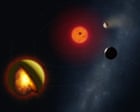 🇬🇧 ‘A molten, mushy state’: scientists may have found a new type of liquid planet
[United Kingdom]
🇬🇧 ‘A molten, mushy state’: scientists may have found a new type of liquid planet
[United Kingdom]
<p>Latest observations of L98-59d, about 35 light years from Earth, suggest it could be different to anything seen before</p><p>Astronomers have identified a planet composed of molten lava, suggesting...
Related: #Exoplanet Discovery -
🇺🇸 Scientists Find Evidence of Worlds Colliding ... 11,000 Light-Years Away
[USA]
Astronomers say unusual readings from a star system 11,000 light-years away suggest that two of the planets circling the star crashed into each other, creating a huge, light-obscuring cloud of rocks a...
Related: #Astronomy -
🇺🇸 ESA's Mars orbiters watch solar superstorm hit the Red Planet
[USA]
What happens when a solar superstorm hits Mars? Thanks to the European Space Agency’s Mars orbiters, we now know: glitching spacecraft and a supercharged upper atmosphere.
Related: #Space Exploration -
🇺🇸 Why Are Interstellar Comets So Weird? Part 3: They SHOULD Be Weird
[USA]
So why should we expect interstellar comets like 3I/ATLAS and 'Oumuamua and even to some extent Borisov to be different-different?
Related: #Astronomy -
🇺🇸 The JWST Reveals Some Puzzling Surprises in Jupiter's Northern Aurora
[USA]
Jupiter's powerful, continuous aurorae dwarf those of Earth. Scientists know that Jupiter's Galilean moons created bright spots on Jupiter's northern aurora. The JWST observed these bright spots and g...
Related: #Space Exploration -
🇺🇸 Mars Express Images Reveal Mars' Pockmarked Surface
[USA]
Craters, craters, and yet more craters: this snapshot from ESA’s Mars Express is packed full of them, each as fascinating as the last.
Related: #Space Exploration -
🇺🇸 Would Earth Still Be Habitable Without Us?
[USA]
Scientists have built a working model of Earth without any life on it and what they found might change how we search for aliens. By simulating 4.5 billion years of our planet's evolution minus every b...
Related: #Astrobiology, #Space Exploration, #Habitability -
🇺🇸 Jupiter Is Smaller and Flatter Than Previously Thought
[USA]
Jupiter is the largest planet in the solar system and has proudly boasted about this since time immemorial, with its scientific confirmation occurring by Galileo Galilei in 1610. It was later found th...
Related: #Jupiter, #Space Exploration, #Astronomy, #Scientific Measurement -
🇺🇸 Interstellar Visitor 3I/ATLAS Finally Wakes Up, Spewing Organics and Water
[USA]
There’s been plenty in the news about 3I/ATLAS over the course of the past 8 months. Our third confirmed interstellar visitor went behind the Sun during its closest approach, but reemerged in December...
Related: #Interstellar Objects, #Cometary Science, #Astronomical Observation
Key Entities (19)
- NASA (2 news)
- Jupiter (2 news)
- Pioneer (1 news)
- Voyager (1 news)
- Juno (1 news)
- Minor (1 news)
- Mars (1 news)
- European Space Agency (1 news)
- Red Planet (1 news)
- Artemis II (1 news)
- Orion (spacecraft) (1 news)
- Moon (1 news)
- Saturn (1 news)
- Martian surface (1 news)
- Mars Express (1 news)
- Exploration of Mars (1 news)
- Exoplanet (1 news)
- Habitability (1 news)
- Atmosphere of Mars (1 news)
About the topic: Planetary Science
The topic "Planetary Science" aggregates 15+ news articles from various countries.