
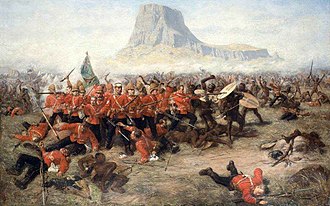
# Battle of Isandlwana
---
Who / What
The **Battle of Isandlwana** was a pivotal military engagement during the Anglo-Zulu War, marking a decisive clash between British forces and the Zulu Kingdom. It occurred as part of the broader conflict between the British Empire and the Zulu nation in Southern Africa.
---
Background & History
The Battle of Isandlwana took place on **22 January 1879** during the Anglo-Zulu War, a conflict initiated by British imperial expansion into Zulu territory. Eleven days prior, British forces under Colonel Sir Garnet Wolseley had invaded Zulu lands, leading to escalating hostilities. The battle unfolded as part of a larger campaign against the Zulu Kingdom, which was led by King Cetshwayo kaMpande.
The Zulus, numbering around 20,000 warriors, engaged British forces consisting of approximately **1,800 soldiers** (including British regulars, colonial troops, and native allies) alongside about **350 civilians**. The battle was a turning point in the war, though it did not immediately determine its outcome.
---
Why Notable
The Battle of Isandlwana remains historically significant as one of the most devastating defeats suffered by the British Empire at the hands of an indigenous force. It exposed critical vulnerabilities in British military tactics and logistics during the conflict, particularly their reliance on superior firepower against disciplined Zulu formations. The battle also underscored the cultural and strategic challenges faced by colonial powers attempting to subdue African kingdoms.
In hindsight, the defeat highlighted the limitations of early 19th-century European warfare when confronted with well-organized African armies armed primarily with traditional weapons. Though the British ultimately prevailed in later engagements (e.g., the Battle of Ulundi), Isandlwana remains a cautionary tale about underestimating indigenous military prowess.
---
In the News
While the Battle of Isandlwana itself is not an active news topic, its historical significance continues to spark scholarly and cultural discussions. Modern analyses often explore its implications for colonial warfare, racial dynamics in 19th-century conflicts, and the broader legacy of imperialism in Southern Africa. The battle’s memory persists in South African history as a symbol of resistance against foreign domination.
---
Key Facts
---

