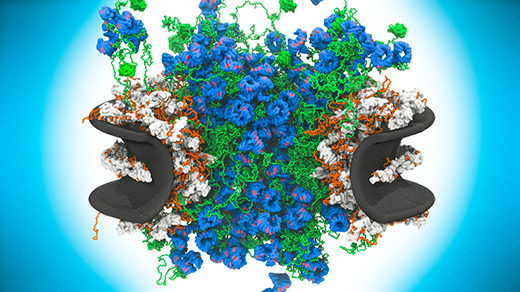
Describe DNA in 3 sentences:
DNA — stands for deoxyribonucleic acid — is a molecule found in cells that carries genetic instructions for the development, functioning, growth and reproduction of all known organisms and many viruses. DNA and ribonucleic acid (RNA) are nucleic acids; alongside proteins, lipids and complex carbohydrates (polysaccharides), nucleic acids are one of the four major types of macromolecules that are essential for all known forms of life. The polymer carries genetic instructions for the development, functioning, growth and reproduction of all known organisms and many viruses.
Create a comprehensive information card for DNA in Markdown:
DNA ([Deoxyribonucleic acid](https://en.wikipedia.org/wiki/DNA))
**Category**: Nucleic acid
### Role/Function
DNA is a molecule found in cells that carries genetic instructions for the development, functioning, growth and reproduction of all known organisms and many viruses.
### Key Facts
**Type**: Macromolecule**Composition**: Made up of nucleotides containing a sugar-phosphate backbone and one of four nitrogenous bases: adenine (A), thymine (T), cytosine (C), and guanine (G).### Structure
The polymer carries genetic instructions in the form of a double helix structure.The two strands are held together by hydrogen bonds between complementary base pairs (A-T and C-G).### Significance
DNA and ribonucleic acid (RNA) are nucleic acids; alongside proteins, lipids and complex carbohydrates (polysaccharides), nucleic acids are one of the four major types of macromolecules that are essential for all known forms of life.### Background & History
**Discovery**: First identified in 1869 by Swiss physician Friedrich Miescher.**Key Milestones**:1953: James Watson and Francis Crick proposed the double helix structure.1962: Watson, Crick, and Maurice Wilkins were awarded the Nobel Prize in Physiology or Medicine.### In the News
**Recent Developments**: Advances in DNA sequencing technologies have revolutionized fields like medicine, forensics, and genealogy.**Why It Matters Now**: DNA analysis is crucial for personalized medicine, ancestry tracing, and solving crimes.### Key Links
[Wikipedia](https://en.wikipedia.org/wiki/DNA)[Genetics Home Reference](https://ghr.nlm.nih.gov/primer/basics/dna)### Notable Achievements
**Role**: DNA is fundamental to genetics and biotechnology.**Impact**: Understanding DNA has led to breakthroughs in medicine, agriculture, and forensic science.### Key Dates
**1869**: Discovery by Friedrich Miescher.**1953**: Proposal of the double helix model by Watson and Crick.**2003**: Completion of the Human Genome Project.### Geography
**Research Centers**: Worldwide, with notable institutions like the Cold Spring Harbor Laboratory (USA) and the European Molecular Biology Laboratory (Germany).This card provides a comprehensive overview of DNA, covering its structure, function, history, and current relevance.