
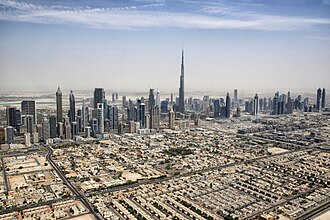
# Economy of the United Arab Emirates
Who / What
The **Economy of the United Arab Emirates (UAE)** refers to the economic system of the country, characterized by a high-income developing market economy that blends open trade with Islamic economic principles. It is driven primarily by hydrocarbon revenues and diversifying into sectors like finance, tourism, and technology.
Background & History
The UAE’s economy emerged from its founding in 1971 as seven emirates united to leverage oil wealth, initially extracted from Abu Dhabi. The country transitioned from a reliance on petrodollars to diversification after the oil boom peaked in the late 20th century. Key milestones include the establishment of free trade zones (e.g., Dubai International Financial Centre) and strategic investments in infrastructure, such as the World Trade Center Dubai.
Why Notable
The UAE’s economy stands out for its rapid growth, ranking among the Middle East’s largest by GDP ($415 billion in 2021–2023), despite hydrocarbon dependence. Its role as a regional financial hub and host to major global events (e.g., Expo 2020) underscores its influence on trade and innovation. The country balances Islamic economic principles with modern market reforms, attracting foreign investment.
In the News
The UAE’s economy remains resilient amid global challenges, driven by diversification into renewable energy, tourism post-pandemic recovery, and strategic investments in tech (e.g., AI, smart cities). Recent developments include plans for a carbon-neutral future and expanding free trade agreements to boost exports beyond hydrocarbons.
