
SP
BravenNow
Gravitational field
🌐 Entity

Gravitational field

Vector field representing a mass's effect on surrounding space

📊 Rating

1 news mentions · 👍 0 likes · 👎 0 dislikes

💡 Information Card

# Gravitational Field


Who / What

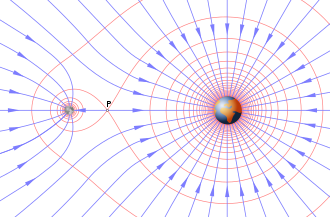
A **gravitational field** is a vector field that describes the gravitational influence exerted by a mass on surrounding space. It quantifies how massive objects affect the spacetime around them, influencing the motion of other bodies through gravitational forces. This field has dimensions of acceleration (L/T²) and is measured in units such as newtons per kilogram (N/kg) or meters per second squared (m/s²).


---


Background & History

The concept of a gravitational field emerged from Newton’s formulation of universal gravitation, which established that every mass attracts other masses with a force proportional to their product and inversely proportional to the square of the distance between them. Isaac Newton described gravity as an action-at-a-distance phenomenon, laying the groundwork for understanding gravitational fields as regions where objects experience acceleration toward a central mass.


Later developments in general relativity by Albert Einstein expanded on this idea, treating gravitational fields not just as forces but as distortions in spacetime itself caused by massive objects. Key milestones include:

  • **1687**: Newton’s *Philosophiæ Naturalis Principia Mathematica* introduced the inverse-square law of gravitation.
  • **1915**: Einstein’s theory of general relativity redefined gravitational fields as geometric properties of curved spacetime.

  • ---


    Why Notable

    The gravitational field is fundamental to modern physics, underpinning celestial mechanics, cosmology, and astrophysics. It explains phenomena like planetary orbits, black hole formation, and the expansion of the universe. Its mathematical description—via equations like Einstein’s field equations or Newtonian potential theory—remains essential for predicting gravitational interactions in both everyday and extreme cosmic scales.


    ---


    In the News

    While not an organization, the study of gravitational fields remains a dynamic area of research with recent breakthroughs:

  • **Gravitational wave astronomy**: The detection of ripples in spacetime (e.g., by LIGO) has revolutionized astrophysics, allowing direct observation of black hole mergers and neutron star collisions.
  • **Planetary science**: Improved models of gravitational fields are critical for missions like NASA’s *DART* (deflection of an asteroid) or ESA’s *Gaia* (stellar mapping).
  • **Theoretical physics**: Ongoing debates about quantum gravity and the nature of spacetime curvature keep the field relevant in fundamental research.

  • ---


    Key Facts

  • **Type**: Conceptual framework (not an organization)
  • **Also known as**:
  • Gravitational acceleration field
  • Newtonian gravitational field (in classical physics)
  • Spacetime curvature (in general relativity)
  • **Key dates**:
  • **1687**: Isaac Newton publishes *Principia*, introducing the inverse-square law.
  • **1915**: Albert Einstein formulates general relativity, redefining gravity as a geometric property of spacetime.
  • **2015**: LIGO detects gravitational waves from merging black holes (first direct observation).
  • **Geography**:
  • Originated in Europe (Newton’s England; Einstein’s Switzerland/Germany).
  • Central to global scientific collaborations (e.g., CERN, NASA, ESA).
  • **Affiliation**:
  • Core discipline of **theoretical physics**, **astrophysics**, and **cosmology**.
  • Foundational for **engineering** (e.g., satellite navigation) and **space exploration**.

  • ---


    Links

  • [Wikipedia](https://en.wikipedia.org/wiki/Gravitational_field)
  • Sources

    📌 Topics

    • Attention Mechanisms (1)
    • Positional Correlation (1)

    🏷️ Keywords

    attention (1) · gravitational field (1) · power-law (1) · positional correlation (1) · neural networks (1) · sequence modeling (1) · long-range dependencies (1)

    📖 Key Information

    In physics, a gravitational field or gravitational acceleration field is a vector field used to explain the influences that a body extends into the space around itself. A gravitational field is used to explain gravitational phenomena, such as the gravitational force field exerted on another massive body. It has dimension of acceleration (L/T2) and it is measured in units of newtons per kilogram (N/kg) or, equivalently, in meters per second squared (m/s2).

    📰 Related News (1)

    🔗 External Links