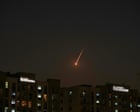
Trump's Iran strikes portrayed as diversionary war to distract from domestic scandals
Administration shows lack of strategic planning similar to 2003 Iraq invasion
Trump's foreign policy driven by spectacle rather than coherent strategy
Approach risks significant long-term consequences with little strategic benefit
📖 Full Retelling
President Donald Trump has initiated military strikes against Iran in recent weeks, a move that according to analyst Christopher S Chivvis represents a deliberate attempt to divert attention from mounting domestic scandals including renewed scrutiny of Epstein files and legal challenges to his tariff policy. The author draws concerning parallels between these actions and the 2003 Iraq invasion, noting that both administrations failed to adequately consider whether the costs and risks justified their military gambits. Trump's approach, however, appears even more narrowly focused on the performative use of power rather than strategic objectives, with military force becoming the strategy itself rather than a tool subordinate to it. The strikes come amid intense domestic pressure over Trump's handling of civil rights issues in Minneapolis and just days after the Supreme Court struck down the legal basis for his global tariff policy, suggesting a calculated effort to shift public focus through international conflict. This 'diversionary war' tactic capitalizes on existing currents of confrontation in Washington, with Trump leveraging Republican hardline positions on Iran while Democratic resistance has been softened by the Iranian regime's own human rights abuses. The author warns that when policy is driven by spectacle rather than strategy, critical questions about long-term consequences become secondary, potentially leading to destabilization that could trigger humanitarian crises, refugee flows, and broader regional conflict while stretching America's strategic bandwidth at a time of critical competition in Asia and Europe.
🏷️ Themes
Foreign Policy, Domestic Politics, National Security, International Relations
# Iran
**Iran**, officially the **Islamic Republic of Iran** and historically known as **Persia**, is a sovereign country situated in West Asia. It is a major regional power, ranking as the 17th-largest country in the world by both land area and population. Combining a rich historical legacy with a...
Use of force or threat of war focused for political purposes
Military strategy is a set of ideas implemented by military organizations to pursue desired strategic goals. Derived from the Greek word strategos, the term strategy, when first used during the 18th century, was seen in its narrow sense as the "art of the general", or "the art of arrangement" of tro...
President of the United States (2017–2021; since 2025)
Donald John Trump (born June 14, 1946) is an American politician, media personality, and businessman who is the 47th president of the United States. A member of the Republican Party, he served as the 45th president from 2017 to 2021.
Born into a wealthy New York City family, Trump graduated from the...
Trump wants to distract Americans from scandals at home with a diversionary war Christopher S Chivvis Iran strikes are attempt to hijack the global narrative and drown out Epstein and tariffs with the thunder of cruise missiles I n 2003, the United States invaded Iraq without deciding whether it should. The George W Bush administration failed to ask whether the costs, risks and likely consequences of regime change justified the gamble. The result was tragedy – for Iraq, for the Middle East and for America. Donald Trump’s attack on Iran now follows the same pattern – but with an even narrower logic of performative power. In the run-up to Iraq, Washington devoted enormous energy to planning the invasion. Almost no attention was given to the more important question: was war necessary, and could it realistically produce a stable political outcome? Now history is repeating itself. Having torn up the Iran nuclear deal and escalated pressure, the president has now initiated a military campaign explicitly aimed at regime collapse. Yet there has been no serious public reckoning with the risks, much less the plausibility of the political end state he claims to seek. By weaponising the military for the sake of the attention economy, Washington has traded grand strategy for the immediate gratification of the news cycle. This is because the outcome of the war is less important to Trump than violent conflict with America’s enemy and the performative use of US power. Trump’s foreign policy is not guided by a coherent theory of order, deterrence or alliance management. It is driven instead by the demonstration of dominance, the creation of spectacle and the command of the news cycle. Military force, in this framework, is not a tool subordinated to strategy. It is the strategy. His escalation against Iran comes as he faces mounting domestic pressure, for attacking the civil rights of US citizens in Minneapolis, amid renewed scrutiny surrounding the Epstein files, and just days after...