
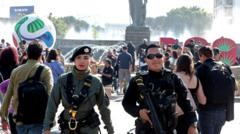
Mexico to deploy 100,000 security personnel for World Cup
#Mexico #World Cup #security personnel #deployment #safety #crowd management #international event
📌 Key Takeaways
- Mexico will deploy 100,000 security personnel for the World Cup.
- The deployment aims to ensure safety and manage large crowds during the event.
- This is a significant security operation for a major international sporting event.
- The move reflects preparations to handle potential security challenges.
📖 Full Retelling
🏷️ Themes
Security, Sports Events
📚 Related People & Topics

World cup
International sports competition where competitors represent their nation
A world cup is a global sporting competition in which the participant entities – usually international teams or individuals representing their countries – compete for the title of world champion. The event most associated with the name is the FIFA World Cup for association football, which dates back...
Mexico
Country in North America
Mexico, officially the United Mexican States, is a country in North America. It is the northernmost country in Latin America and borders the United States to the north, and Guatemala and Belize to the southeast; while having maritime boundaries with the Pacific Ocean to the west, the Caribbean Sea t...
Entity Intersection Graph
Connections for World cup:
View full profileMentioned Entities
Deep Analysis
Why It Matters
This massive security deployment is crucial for ensuring the safety of millions of international visitors and athletes during one of the world's largest sporting events. It affects not only Mexico's tourism industry and global reputation but also neighboring countries concerned about cross-border security coordination. The operation demonstrates Mexico's capacity to handle major international events while addressing ongoing security challenges that could impact the tournament's success.
Context & Background
- Mexico has previously hosted major international events including the 1968 Olympics and 1970 and 1986 FIFA World Cups, each requiring significant security measures
- The country has faced persistent security challenges related to drug cartel violence, with homicide rates remaining high in recent years
- FIFA typically requires host nations to provide comprehensive security plans as part of bidding requirements for World Cup tournaments
- The 2026 World Cup will be jointly hosted by Mexico, the United States, and Canada, marking the first three-nation tournament in history
- Previous World Cups in Brazil (2014) and South Africa (2010) also involved massive security deployments exceeding 100,000 personnel
What Happens Next
Mexico will begin phased security deployments starting 2025, with full implementation by tournament opening in June 2026. Security forces will conduct joint training exercises with U.S. and Canadian counterparts in 2025. Expect detailed security zone announcements and visitor guidelines to be released in late 2025, followed by test events at host stadiums to evaluate security protocols.
Frequently Asked Questions
The 100,000 personnel are needed to protect multiple host cities, secure transportation routes between venues, and manage large crowds at stadiums and fan zones. This scale matches security deployments for previous World Cups in other countries facing security challenges.
The deployment is designed to enhance tourist safety through visible security presence, specialized tourist police units, and secure transportation corridors. However, visitors should still follow standard travel advisories and remain aware of their surroundings in unfamiliar areas.
This deployment is similar in scale to Brazil's 2014 operation (150,000 personnel) and larger than Russia's 2018 security force. The tri-national hosting arrangement requires additional coordination for border security and cross-border movement of teams and fans.
The force will include federal police, military units, specialized tourist police, intelligence agents, and private security contractors. Different units will handle stadium security, transportation protection, crowd control, and anti-terrorism measures.
Authorities claim they will use temporary assignments and additional hiring to avoid draining resources from regular law enforcement. However, some security experts worry it could strain Mexico's security apparatus during the tournament period.