
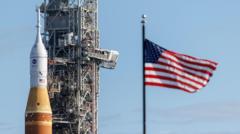
Nasa astronauts' moon mission likely to be delayed due to rocket issue
#Artemis II #NASA moon mission #rocket delay #helium flow issue #lunar mission #Kennedy Space Center #space exploration #moon landing 2028
📌 Key Takeaways
- Artemis II moon mission likely delayed due to helium flow issues
- Mission would mark first human moon journey in 50 years
- Four astronauts (three Americans, one Canadian) prepared for 10-day mission
- Delay impacts timeline for eventual moon landing by 2028
📖 Full Retelling
🏷️ Themes
Space Exploration, Technical Challenges, NASA Missions, Lunar Program
📚 Related People & Topics

Artemis II
Artemis program's second lunar flight
Artemis II is a planned lunar spaceflight mission under the Artemis program, led by NASA. It is intended to be the second flight of the Space Launch System (SLS), and the first crewed mission of the Orion spacecraft. It is the first crewed mission around the Moon, and beyond low Earth orbit, since A...

Kennedy Space Center
U.S. space launch site in Florida
The John F. Kennedy Space Center (KSC, originally known as the NASA Launch Operations Center), located on Merritt Island, Florida, is one of the ten field centers of NASA. Since 1968, KSC has been NASA's primary launch center of American spaceflight, research, and technology. Launch operations for t...
Entity Intersection Graph
Connections for Artemis II:
Deep Analysis
Why It Matters
The delay of Artemis II underscores the technical challenges of returning humans to the Moon after 50 years and highlights the importance of safety in spaceflight. It also pushes back the timeline for the first lunar landing since 1972, affecting NASA's broader Artemis program.
Context & Background
- Helium flow interruption detected during safety checks
- Artemis II scheduled for early March launch
- Crew includes Reid Wiseman, Victor Glover, Christina Koch, and Jeremy Hanse
- Mission aims to fly 10 days around the far side of the Moon
- Delay may push launch to later March or April
What Happens Next
NASA will investigate the helium issue and reschedule the launch window, likely moving it to later March or early April. The agency will continue crew training and system tests while maintaining safety standards for the upcoming lunar mission.
Frequently Asked Questions
Helium pressurises fuel tanks and cools rocket systems, ensuring safe and reliable operation.
NASA has not set a new date yet, but the launch is expected to be later than early March, possibly in April.
The crew consists of Reid Wiseman, Victor Glover, Christina Koch, and Canadian astronaut Jeremy Hanse.
NASA still aims for a 2028 landing, but the delay may affect that timeline.