
SP
BravenNow
Nasa targets early March to send humans back around the Moon
| United Kingdom | world | ✓ Verified - bbc.com

Nasa targets early March to send humans back around the Moon

#NASA Artemis II #Moon mission #Space Launch System #Orion capsule #Lunar exploration #Wet dress rehearsal #Moon landing #Space race

📌 Key Takeaways

  • NASA targets March 6, 2025 for Artemis II mission to send humans around the Moon
  • Four astronauts will spend 10 days traveling around the far side of the Moon in the Orion capsule
  • Mission follows successful 'wet dress rehearsal' after initial technical issues were resolved
  • Artemis II paves the way for future lunar landing with Artemis III targeting 2028
  • US faces competition from China in the race to establish lunar bases

📖 Full Retelling

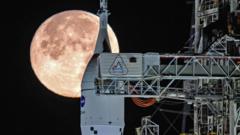
NASA is targeting early March to launch a crew around the Moon for the first time in more than 50 years, in what would be humankind's furthest trip into space. The Artemis II mission will see four astronauts embark on a 10-day journey around the far side of the Moon and back to Earth, paving the way for a future lunar landing. NASA set the earliest launch date of March 6 (early on March 7 in the UK) following a successful 'wet dress rehearsal' - a critical pre-launch test where the rocket is filled with fuel and taken through the countdown sequence at the Kennedy Space Center in Florida. The Artemis team's second attempt at a practice run proved successful after issues from their first rehearsal in February, which ended early due to a hydrogen fuel leak. According to NASA's Lori Glaze, problems including seals and filters have now been remedied. 'Yesterday we were able to fully tank the SLS rocket within the planned time line… we also successfully demonstrated the launch countdown,' she announced during a Friday news conference. The crew consists of three Americans - Reid Wiseman, Victor Glover and Christina Koch - and one Canadian, Jeremy Hansen, who will begin their journey in the 98m-tall Space Launch System rocket with the Orion capsule serving as their home for the 10-day mission.

🏷️ Themes

Space exploration, Lunar missions, International competition

📚 Related People & Topics

Exploration of the Moon

Exploration of the Moon

Missions to the Moon

The physical exploration of the Moon began when Luna 2, a space probe launched by the Soviet Union, made a deliberate impact on the surface of the Moon on 14 September, 1959. Prior to that the only available means of lunar exploration had been observations from Earth. The invention of the optical te...

View Profile → Wikipedia ↗
Orion (spacecraft)

Orion (spacecraft)

American crewed spacecraft for the Artemis program

Orion (Orion Multi-Purpose Crew Vehicle or Orion MPCV) is a partially reusable crewed spacecraft used in NASA's Artemis program. The spacecraft consists of a Crew Module (CM) space capsule designed by Lockheed Martin that is paired with a European Service Module (ESM) manufactured by Airbus Defence ...

View Profile → Wikipedia ↗
Space Launch System

Space Launch System

NASA super heavy-lift expendable launch vehicle

The Space Launch System (SLS) is an American super heavy-lift expendable launch vehicle used by NASA. As the primary launch vehicle of the Artemis Moon landing program, SLS is designed to launch the crewed Orion spacecraft on a trans-lunar trajectory. SLS first launched on 16 November 2022 for the u...

View Profile → Wikipedia ↗

Entity Intersection Graph

No entity connections available yet for this article.

Deep Analysis

Why It Matters

NASA's Artemis II marks the first crewed lunar fly‑by in over 50 years, testing key systems for future landings and re‑establishing human presence beyond Earth orbit. The mission demonstrates the viability of the Space Launch System and Orion capsule, paving the way for a 2028 lunar landing.

Context & Background

  • First crewed lunar mission since Apollo 17 in 1972
  • Artemis II will orbit the far side of the Moon for 10 days
  • Mission uses NASA's SLS rocket and Orion capsule
  • Crew includes three Americans and one Canadian
  • Success is a prerequisite for Artemis III lunar landing

What Happens Next

If Artemis II succeeds, NASA will move forward with Artemis III, aiming to land astronauts on the Moon by 2028. The program will also refine launch schedules and collaborate with SpaceX and Blue Origin to develop lunar landers.

Frequently Asked Questions

When is the Artemis II launch scheduled?

The earliest launch date is March 6, 2025, with a possible early launch on March 7 in the UK.

Who are the astronauts on the Artemis II crew?

The crew consists of Reid Wiseman, Victor Glover, Christina Koch, and Canadian astronaut Jeremy Hansen.

How long will the Artemis II mission last?

The mission will last about 10 days, including a 4‑day lunar fly‑by and a 4‑day return to Earth.

What is the significance of the far side of the Moon?

The far side is the portion of the Moon never visible from Earth, offering a unique scientific and exploration opportunity.

Original Source
Nasa targets early March to send humans back around the Moon 9 hours ago Share Save Rebecca Morelle , Science Editor , Alison Francis , Senior Science Journalist and Greg Brosnan , Senior Science Journalist Share Save Nasa is targeting early March to launch a crew around the Moon for the first time in more than 50 years, in what would be humankind's furthest trip into space. The Artemis II mission will see four astronauts embark on a 10-day journey around the far side of the Moon and back to Earth, paving the way for a future lunar landing. Nasa set the earliest launch date of March 6 (early on March 7 in the UK) following a successful "wet dress rehearsal" - a critical pre-launch test where the rocket is filled with fuel and taken through the countdown sequence. It was the Artemis team's second attempt at a practice run at the Kennedy Space Center in Florida. When does the Nasa Moon mission launch and who are the Artemis II crew? Nasa's mega Moon rocket arrives at launch pad for Artemis II mission "Every night I look up at the Moon and I see it and I get real excited because I can feel she's calling us and we're ready," Nasa's Lori Glaze told a news conference on Friday. "The excitement for Artemis II is really, really starting to build, we can really start to feel it. It's coming." The first rehearsal, which took place at the beginning of February, ended early because of a hydrogen fuel leak at the launch pad. Glaze said issues including with seals and filters had now been remedied. "Yesterday we were able to fully tank the SLS rocket within the planned time line […] we also succesfully demonstrated the launch countdown," she said. Three Americans - Reid Wiseman, Victor Glover and Christina Koch - and one Canadian, Jeremy Hansen, make up the Artemis II crew. Glaze said the crew were excited following the successful rehearsal and would go into quarantine later on Friday. They'll begin their journey on Nasa's mega Moon rocket: the 98m-tall (322ft) Space Launch Syste...
Read full article at source

Source

bbc.com

More from United Kingdom

News from Other Countries

🇺🇸 USA

🇺🇦 Ukraine