
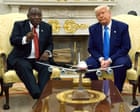
South Africa’s president calls Trump’s policy to offer refuge to white Afrikaners ‘racist’
#South Africa #Donald Trump #Afrikaners #asylum #racist #land reform #Cyril Ramaphosa
📌 Key Takeaways
- South African President Cyril Ramaphosa criticizes Trump's proposal as racist
- Trump's policy would offer asylum to white Afrikaner farmers in South Africa
- The proposal is seen as interfering in South Africa's domestic affairs
- The issue highlights tensions over land reform and racial politics in South Africa
📖 Full Retelling
🏷️ Themes
International Relations, Racial Politics
📚 Related People & Topics
South Africa
Country in Southern Africa
South Africa, officially the Republic of South Africa (RSA), is the southernmost country in Africa. Its nine provinces are bounded to the south by 2,798 kilometres (1,739 miles) of coastline that stretches along the South Atlantic and Indian Ocean; to the north by the neighbouring countries of Namib...

Cyril Ramaphosa
President of South Africa since 2018
Matamela Cyril Ramaphosa ( RAM-ə-FAW-sə or RAH-mə-POH-sə; born 17 November 1952) is a South African businessman and politician serving as the president of South Africa since 2018. A former anti-apartheid activist and trade union leader, Ramaphosa is also the president of the African National Congr...
Afrikaners
Ethnic group in Southern Africa
Afrikaners (Afrikaans: [afriˈkɑːnərs]) are a Southern African ethnic group descended from predominantly Dutch settlers who first arrived at the Cape of Good Hope in 1652. Until 1994, they dominated South Africa's politics as well as the country's commercial and agricultural sector. Afrikaans, a lang...

Donald Trump
President of the United States (2017–2021; since 2025)
Donald John Trump (born June 14, 1946) is an American politician, media personality, and businessman who is the 47th president of the United States. A member of the Republican Party, he served as the 45th president from 2017 to 2021. Born into a wealthy New York City family, Trump graduated from the...
Entity Intersection Graph
Connections for South Africa:
Mentioned Entities
Deep Analysis
Why It Matters
This news matters because it highlights international tensions over racial politics and immigration policies, directly affecting diplomatic relations between the U.S. and South Africa. It impacts white Afrikaners in South Africa, who face debates over land reform and historical inequalities, as well as global audiences observing how leaders address race and refuge. The accusation of racism from a national president against a U.S. policy could influence foreign policy decisions, aid, and trade, while also fueling domestic political debates in both countries about identity and justice.
Context & Background
- White Afrikaners are a South African ethnic group descended from Dutch, German, and French settlers, historically associated with apartheid rule until its end in 1994.
- Land reform in South Africa has been a contentious issue, with policies aiming to address historical dispossession of Black South Africans, sometimes leading to tensions and claims of persecution by some Afrikaner groups.
- The U.S. has a history of offering refugee or asylum status based on persecution, but such policies targeting a specific racial or ethnic group are rare and often politically charged.
- Donald Trump, as U.S. president, previously made controversial statements on race and immigration, including suggesting support for white South African farmers, which aligns with this reported policy.
What Happens Next
If the policy moves forward, expect increased diplomatic friction, potential protests or advocacy from human rights groups, and possible retaliatory measures from South Africa. Upcoming developments may include official U.S. responses, clarification on the policy's details, and heightened media coverage as the 2024 U.S. election approaches, influencing political discourse on race and foreign policy.
Frequently Asked Questions
White Afrikaners are an ethnic group in South Africa primarily descended from European settlers, known for speaking Afrikaans and historically holding power during the apartheid era. They make up a minority of the population and have been central to debates over land, culture, and historical injustices since apartheid ended.
South Africa's president likely views the policy as racist because it singles out white Afrikaners based on race for refuge, potentially ignoring broader racial inequalities and historical context in South Africa. This could be seen as undermining efforts to address apartheid-era injustices and promoting racial division rather than unity.
Land reform in South Africa involves government efforts to redistribute land from white owners to Black South Africans to correct historical dispossession, but it has progressed slowly and sparked controversy. Issues include debates over compensation, property rights, and claims of unfair targeting, contributing to social and political tensions.
This could strain U.S.-South Africa relations by introducing racial and political disagreements into diplomacy, potentially impacting trade, aid, and cooperation on global issues. It may lead to diplomatic protests, reduced trust, and alignment shifts with other international partners, depending on how both sides handle the controversy.