
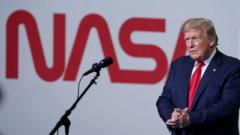
Trump sees 'America First' opportunity in going to the Moon
#Trump #America First #Moon #space exploration #national interests #lunar mission #U.S. leadership
📌 Key Takeaways
- Trump advocates for an 'America First' approach to lunar exploration
- The Moon is framed as a strategic opportunity for national interests
- Space policy is linked to broader economic and political priorities
- The initiative emphasizes U.S. leadership in space over international cooperation
📖 Full Retelling
🏷️ Themes
Space Policy, Nationalism
📚 Related People & Topics

Moon
Natural satellite orbiting Earth
The Moon is the only natural satellite of Earth. It orbits around Earth at an average distance of 384,399 kilometres (238,854 mi), a distance roughly 30 times the width of Earth. It completes an orbit (lunar month) in relation to Earth and the Sun (synodically) every 29.5 days.

America First
American policy prioritizing U.S. interests over other nations
America First denotes a set of policies in the United States that emphasize taking foreign policy and domestic policy decisions which serve the interests of the United States before the interests of all other nations and peoples. This typically manifests itself in policies of American nationalism, a...

Donald Trump
President of the United States (2017–2021; since 2025)
Donald John Trump (born June 14, 1946) is an American politician, media personality, and businessman who is the 47th president of the United States. A member of the Republican Party, he served as the 45th president from 2017 to 2021. Born into a wealthy New York City family, Trump graduated from the...
Entity Intersection Graph
Connections for Moon:
Mentioned Entities
Deep Analysis
Why It Matters
This news matters because it signals a shift in U.S. space policy toward nationalist competition rather than international cooperation, potentially affecting global space governance and scientific collaboration. It impacts NASA's budget priorities, international space partners, and private space companies seeking government contracts. The 'America First' framing could accelerate a new space race with China and Russia while reshaping how space exploration is funded and justified to taxpayers.
Context & Background
- The U.S. last landed humans on the Moon during the Apollo program (1969-1972), with no human lunar missions since.
- NASA's Artemis program aims to return astronauts to the Moon by 2025, involving international partners like ESA, JAXA, and CSA.
- The 1967 Outer Space Treaty establishes space as a province of all humankind, prohibiting national appropriation of celestial bodies.
- China has recently landed robotic missions on the Moon and announced plans for crewed lunar missions in the 2030s.
- Private companies like SpaceX and Blue Origin are developing lunar landers under NASA's Commercial Lunar Payload Services program.
- Previous U.S. administrations have emphasized international cooperation in space, including the International Space Station partnership.
What Happens Next
NASA will likely face pressure to accelerate Artemis timeline and prioritize American contractors over international partners. Congressional budget debates will intensify regarding NASA funding for lunar missions versus other priorities. Expect increased diplomatic tensions with China and Russia over space governance, and potential announcements of new bilateral agreements with select allies. The 2024 presidential election outcome will determine whether this 'America First' approach continues or shifts back toward international cooperation.
Frequently Asked Questions
It means prioritizing U.S. national interests, contractors, and technological advantages over international cooperation and shared scientific goals. This could lead to reduced collaboration with traditional partners like ESA and increased competition with geopolitical rivals in space.
Artemis may be reframed as a demonstration of American technological superiority rather than an international scientific endeavor. Budget priorities may shift toward faster timelines and visible achievements that align with nationalist messaging, potentially at the expense of broader scientific objectives.
They could trigger a destabilizing space race, duplicate expensive infrastructure, and reduce scientific cooperation that benefits all humanity. National competition increases the risk of space militarization and conflicts over lunar resources, potentially violating international space treaties.
American private space companies like SpaceX and Blue Origin would likely receive preferential treatment and contracts, accelerating their lunar capabilities. This creates opportunities for commercial lunar services but may marginalize international aerospace partners and smaller U.S. competitors.
It may accelerate short-term technological achievements but could damage long-term leadership by alienating international partners. While demonstrating American capabilities, it risks creating parallel space programs among allies who feel excluded from U.S.-led initiatives.