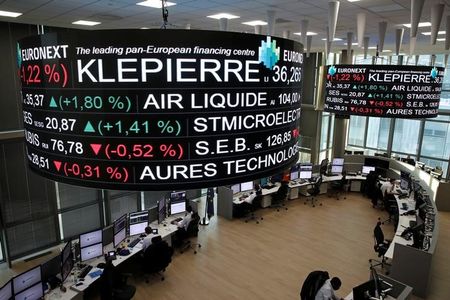
European stocks declined amid renewed U.S. trade uncertainty
Trump's new tariff announcements overshadowed positive court ruling
Gold prices rose while Bitcoin slipped due to tariff volatility
Oil prices fell ahead of US-Iran nuclear talks
📖 Full Retelling
European stock markets declined Monday as renewed uncertainty over U.S. trade policies, particularly President Donald Trump's recent tariff announcements, dampened investor sentiment across the region, with Germany's DAX falling 0.6%, France's CAC 40 slipping 0.2%, and the UK's FTSE 100 dropping 0.1% by early trading. The retreat came despite a brief rally late last week when the U.S. Supreme Court voided most of Trump's previously imposed tariffs, only for the president to respond with new global levies of 10-15% over the weekend. European Central Bank president Christine Lagarde expressed concerns about the unpredictable nature of trade policies, stating that such uncertainty could disrupt established trade equilibriums and investment decisions, comparing it to not knowing the rules of the road before getting in a car. Meanwhile, gold prices extended gains as investors sought safe havens amid tariff-related jitters, while Bitcoin slipped after earlier gains due to the same volatility in trade policy expectations, with some analysts questioning whether digital assets can truly serve as reliable hedges during periods of policy uncertainty. Oil prices fell sharply with Brent futures dropping 1.3% to $70.39 a barrel and U.S. West Texas Intermediate crude futures falling 1.4% to $65.55, as investors weighed the prospect of U.S.-Iran nuclear talks scheduled for Thursday in Geneva against fresh uncertainty from American trade policy, with both contracts having surged nearly 6% the previous week on Middle East tensions. In corporate news, Dutch postal group PostNL cut its annual dividend by 43% and warned free cash flow could turn negative again in 2026, while Barcelona-based dermatology specialist Almirall reported its eczema biologic Ebglyss tripled sales in its second year, pushing the company past €1 billion in annual revenue for the first time. Rolls-Royce urged the British government to commit taxpayer support for the £3 billion development of a new aircraft engine as it seeks to re-enter the short-haul market, with the week's major earnings release expected from chip giant Nvidia on Wednesday.
Bitcoin (abbreviation: BTC; sign: ₿) is the first decentralized cryptocurrency. Based on a free-market ideology, bitcoin was invented in 2008 when an unknown person published a white paper under the pseudonym of Satoshi Nakamoto. Use of bitcoin as a currency began in 2009, with the release of its op...
President of the United States (2017–2021; since 2025)
Donald John Trump (born June 14, 1946) is an American politician, media personality, and businessman who is the 47th president of the United States. A member of the Republican Party, he served as the 45th president from 2017 to 2021.
Born into a wealthy New York City family, Trump graduated from the...
The retreat in European stocks signals that global trade uncertainty remains a major driver of market volatility, impacting investor confidence and economic growth prospects. This matters because unpredictable trade policies can disrupt established supply chains and investment flows, potentially slowing the region's economic recovery.
Context & Background
European stocks declined following new tariff announcements by former U.S. President Donald Trump over the weekend
The U.S. Supreme Court had recently voided most of the tariffs imposed by Trump last year, providing a brief boost to markets
Economic data had shown signs of improvement in the Eurozone, with business activity accelerating and manufacturing returning to growth
What Happens Next
Market attention will turn to the release of Germany's Ifo business climate survey for further clues on economic sentiment. Investors will also closely monitor earnings reports from major European companies and the upcoming Nvidia earnings report for broader market direction.
Frequently Asked Questions
Why did European stocks fall?
European stocks fell due to renewed uncertainty after former President Trump announced new global tariffs, which weighed on risk appetite.
What was the recent Supreme Court ruling about?
The U.S. Supreme Court voided most of the tariffs Trump imposed last year, finding the emergency law he used did not allow their imposition.
What economic data is expected next?
Germany's Ifo business climate survey is due later and is expected to show improved sentiment in the Eurozone's largest economy.
Original Source
try{ var _=i o; . if(!_||_&&typeof _==="object"&&_.expiry Gold prices extend gains on fresh Trump tariff jitters Can gold rise to new highs above $5,600 in 2026? Bitcoin slips after earlier gains amid tariff volatility Bull vs. bear argument on Friday’s Supreme Court tariff ruling (South Africa Philippines Nigeria) European stocks retreat as more trade uncertainty hits risk appetite By Peter Nurse Author Peter Nurse Stock Markets Published 02/23/2026, 03:03 AM European stocks retreat as more trade uncertainty hits risk appetite 0 UK100 -0.12% FCHI -0.35% DE40 -0.66% HSBA 0.08% SCHN -0.71% IBE 0.38% DTEGn 0.00% NVDA 1.02% RR -0.60% CL -0.93% PTNL -0.43% ALM -1.19% STOXX -0.33% Brent Spot US Dollar -0.70% Investing.com - European stocks slipped lower Monday as more uncertainty surrounding U.S. trade tariffs weighed on risk appetite at the start of a new week. At 03:02 ET (08:02 GMT), the DAX index in Germany dropped 0.6%, the CAC 40 in France slipped 0.2% and the FTSE 100 in the U.K. fell 0.1%. Subscribe to InvestingPro for more stock market analysis Trump’s tariffs hit sentiment Global equities, including the main European indices, received a boost late Friday when the U.S. Supreme Court voided most of the tariffs U.S. President Donald Trump imposed last year, finding that the emergency law he relied on did not allow the imposition of tariffs. However, using a different statute, Trump responded over the weekend by announcing first a 10%, then a 15%, global levy that could last five months while the administration searches for more durable workarounds. The uncertainty generated by trade policies seemingly being decided on a whim has weighed on sentiment. "If it shakes the whole equilibrium which people in trade have got used to...it is going to bring about disruptions," European Central Bank president Christine Lagarde said Sunday on CBS’s "Face the Nation". "You want to know the rules of the road before you get in the car. It’s the same with trade. It’s the same with...