
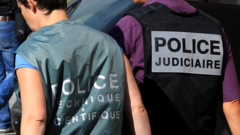
France murder trial complicated by twin brothers with same DNA
#Marseille #identical twins #DNA evidence #murder trial #forensics #French police #genetic profiling
📌 Key Takeaways
- A French murder trial is stalled because DNA on the murder weapon belongs to identical twins.
- Standard forensic testing cannot distinguish between monozygotic twins due to their identical genetic sequences.
- The legal system requires specific identification of the perpetrator, making it difficult to prosecute either brother without further proof.
- Advanced epigenetic testing may be the only scientific way to resolve the case, though it is not yet standard procedure.
📖 Full Retelling
French prosecutors and judicial authorities in Marseille are currently facing a significant legal deadlock in an ongoing murder trial after forensic investigators discovered identical DNA on a recovered weapon belonging to a pair of monozygotic twin brothers. The complication arose during the investigation into a fatal stabbing that occurred in the southern French city, where police identified the two siblings as the primary suspects but found it biologically impossible to distinguish which brother committed the physical act of violence. Because identical twins share the same genetic code, standard profiling techniques have failed to provide the definitive evidence required to charge one individual over the other for the crime.
The case has highlighted a rare but profound vulnerability in the modern criminal justice system, which relies heavily on DNA as the 'gold standard' for identification. While law enforcement successfully recovered the murder weapon and extracted high-quality genetic samples, the laboratory results yielded a 100% match for both men. This genetic indistinguishability has created a paradox for the prosecution, as French law requires the specific identification of a perpetrator to secure a conviction, and charging both men for a single-handed act could lead to a catastrophic miscarriage of justice.
Legal experts suggest that the only way to break the stalemate is through 'ultra-deep sequencing' or epigenetic testing, which looks for chemical modifications on the DNA caused by environmental factors rather than the sequence itself. However, such testing is prohibitively expensive and not yet routine in French criminal laboratories. Without a confession, eyewitness testimony that can distinguish between the two, or advanced forensic breakthroughs, the court faces the possibility of having to release both suspects, as the principle of 'reasonable doubt' protects individuals from being convicted when forensic evidence is shared equally between two potential culprits.
🏷️ Themes
Criminal Justice, Forensics, Legal Ethics
Entity Intersection Graph
No entity connections available yet for this article.