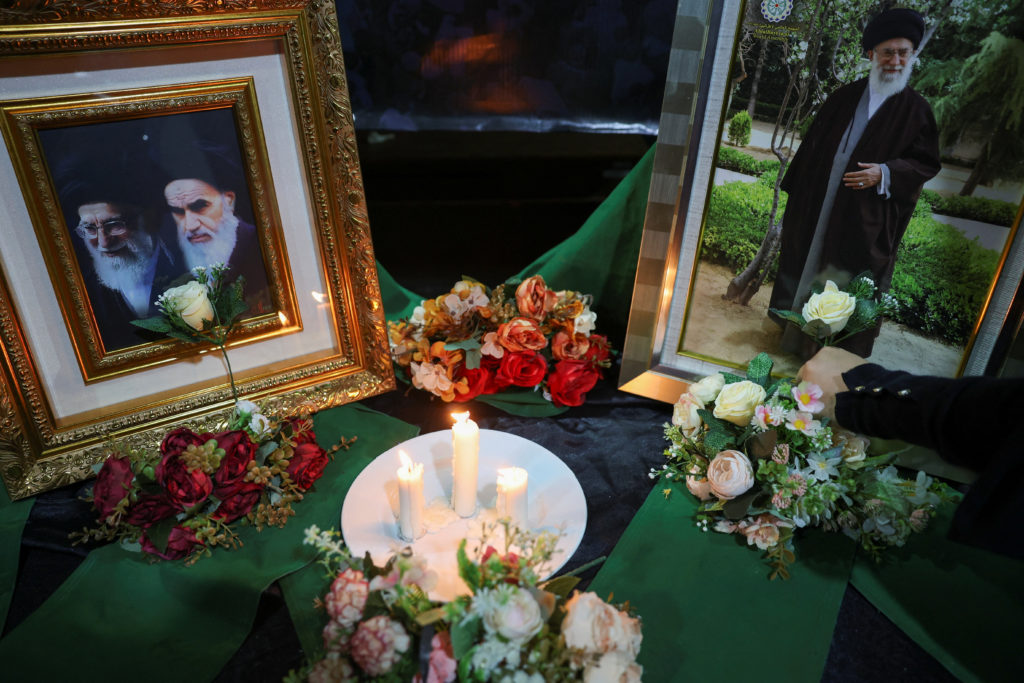
Iran's Supreme Leader Ayatollah Ali Khamenei was killed after 37 years in power
A provisional council is governing Iran during the transition period
The next supreme leader will be chosen by the 88-member Assembly of Experts
Candidates range from hard-liners to reformists with different approaches to foreign relations
📖 Full Retelling
Iran's leaders are scrambling to replace Supreme Leader Ayatollah Ali Khamenei, who ruled the country for 37 years before he was killed in a surprise U.S. and Israeli bombardment on an unspecified date in early 2026. This unprecedented event marks only the second time since the 1979 Islamic Revolution that a new supreme leader is being chosen, creating a critical transition period for the nation. Potential candidates range from hard-liners committed to confrontation with the West to reformists who seek diplomatic engagement, reflecting the ideological divides within Iran's leadership. In the immediate aftermath, a provisional governing council composed of President Masoud Pezeshkian, hard-line judiciary chief Gholamhossein Mohseni Ejei and senior Shiite cleric Ayatollah Ali Reza Arafi is guiding the country through its biggest crisis in decades. Foreign Minister Abbas Araghchi announced that a new supreme leader would be chosen early in the week following the attack, with the selection process overseen by the 88-member Assembly of Experts.
The Assembly of Experts (Persian: مجلس خبرگان رهبری, romanized: Majles-e Khabargan-e Rahbari), also translated as the Assembly of Experts of the Leadership, is the deliberative body empowered to appoint the Supreme Leader of Iran. All directly elected members must first be vetted by the Guardian Cou...
The supreme leader of the Islamic Republic of Iran, also referred to as the supreme leader of the Islamic Revolution, but officially called the supreme leadership authority, is the de facto head of state and the highest political and religious authority of Iran (above the president). The armed force...
Emergency governmental authority created to manage a country during a political transition
A provisional government, also called an interim, emergency, or transitional government, is a temporary government formed to manage a period of transition, often following state collapse, revolution, civil war, or some combination thereof.
Provisional governments generally come to power in connectio...
By — Julia Frankel, Associated Press Julia Frankel, Associated Press Leave your feedback Share Copy URL Email Facebook Twitter LinkedIn Pinterest Tumblr Share on Facebook Share on Twitter Here are some of the contenders to be Iran's supreme leader after the killing of Khamenei World Mar 2, 2026 11:59 AM EST Iran's leaders are scrambling to replace Supreme Leader Ayatollah Ali Khamenei, who ruled the country for 37 years before he was killed in the surprise U.S. and Israeli bombardment. It's only the second time since the 1979 Islamic Revolution that a new supreme leader is being chosen. Potential candidates range from hard-liners committed to confrontation with the West to reformists who seek diplomatic engagement. READ MORE: Inside Iran's succession process and who could be the country's next supreme leader The supreme leader has the final say on all major decisions, including war, peace and the country's disputed nuclear program. In the meantime, a provisional governing council composed of President Masoud Pezeshkian, hard-line judiciary chief Gholamhossein Mohseni Ejei and senior Shiite cleric Ayatollah Ali Reza Arafi is guiding the country through its biggest crisis in decades. Foreign Minister Abbas Araghchi said Sunday that a new supreme leader would be chosen early this week. The supreme leader is appointed by an 88-member panel called the Assembly of Experts, who by law are supposed to quickly name a successor. The panel consists of Shiite clerics who are popularly elected after their candidacies are approved by the Guardian Council, Iran's constitutional watchdog. Khamenei had major influence over both clerical bodies, making it unlikely the next leader will mark a radical departure. Here are the top contenders. Mojtaba Khamenei The son of Khamenei, a mid-level Shiite cleric, is widely considered a potential successor. He has strong ties to Iran's paramilitary Revolutionary Guard but has never held office. His selection could prove awkward, as the Islamic R...