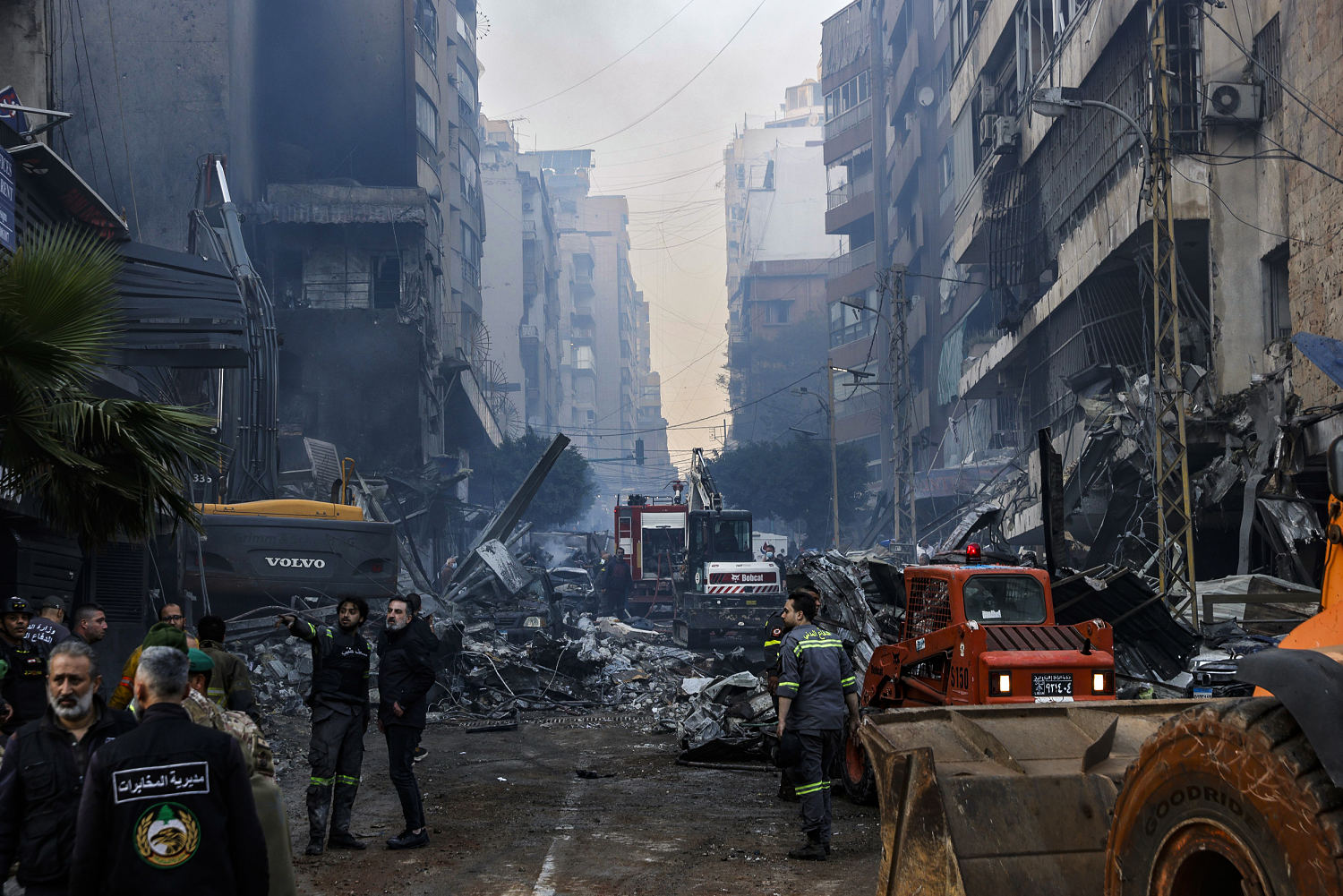
Israeli military strikes in Lebanon killed hundreds of people the day after a US-brokered ceasefire was announced.
The attacks targeted Hezbollah positions, with Israel claiming they were preemptive defensive actions.
The scale of casualties has drawn international condemnation and raised doubts about the ceasefire's stability.
In a separate case, the prime suspect in the Gilgo Beach murders pleaded guilty, resolving a major US cold case.
📖 Full Retelling
Israeli forces conducted a series of military strikes across southern Lebanon on Tuesday, resulting in hundreds of casualties, just one day after the United States, Israel, and Iran jointly announced a temporary ceasefire agreement. The attacks targeted Hezbollah positions and infrastructure, marking a significant escalation in cross-border hostilities despite the diplomatic efforts to de-escalate regional tensions. The timing of the offensive has drawn immediate international condemnation and raised serious questions about the viability of the newly announced truce.
The violence represents one of the deadliest single-day exchanges since the current cycle of conflict between Israel and Hezbollah began. Lebanese officials reported that the strikes hit multiple towns and villages, causing widespread destruction to residential areas and civilian infrastructure. The Israeli military stated the operation was a preemptive response to intelligence indicating an imminent large-scale rocket attack by Hezbollah, which it described as a 'necessary defensive action.' However, the scale of the Lebanese casualties has prompted accusations from Arab nations and human rights groups that the response was disproportionate.
In a separate development in the United States, the man accused of the infamous Gilgo Beach murders entered a guilty plea in a New York courtroom. The suspect, whose name has been withheld pending formal sentencing, confessed to multiple counts of murder in connection with the long-unsolved killings that terrorized Long Island over a decade. This legal resolution brings a measure of closure to one of America's most notorious cold cases, which involved the discovery of several bodies along a remote beach highway, sparking a massive investigation and widespread media attention.
The juxtaposition of these two stories in a single news cycle highlights a world grappling with both international geopolitical instability and domestic criminal justice resolutions. The Lebanon strikes underscore the fragile nature of ceasefire agreements in the Middle East, where longstanding animosities can quickly override diplomatic announcements. Meanwhile, the Gilgo Beach plea represents the culmination of years of forensic work and investigative persistence, demonstrating how justice, though often delayed, can eventually be served for victims and their families.
Islamist movement and militant group based in Lebanon
Hezbollah is a Shia Islamist Lebanese political party and paramilitary group. Hezbollah's paramilitary wing is the Jihad Council, and its political wing is the Loyalty to the Resistance Bloc party in the Lebanese Parliament. Its armed strength was assessed to be equivalent to that of a medium-sized ...
Lebanon, officially the Lebanese Republic, is a country in the Levant region of West Asia. Situated at the crossroads of the Mediterranean Basin and the Arabian Peninsula, it is bordered by Syria to the north and east, Israel to the south, and the Mediterranean Sea to the west; Cyprus lies a short d...
Israel, officially the State of Israel, is a country in the Southern Levant region of West Asia. It is bordered by Lebanon to the north, Syria to the northeast, Jordan to the east, and Egypt to the southwest. Israel occupies the West Bank and the Gaza Strip of the Palestinian territories, as well as...