Supreme Court ruled Trump's tariffs illegal under emergency powers law
Trump vowed to impose new 10% tariff on all imports for 150 days
Businesses face prolonged uncertainty despite the court ruling
Many industries impacted by tariffs, with some facing no relief
Recovery of previously collected tariffs likely to favor larger companies
📖 Full Retelling
President Donald Trump faced a setback on February 21, 2026, when the Supreme Court struck down tariffs he had imposed under an emergency powers law, prompting the president to immediately vow to work around the ruling to maintain his trade restrictions on businesses across the United States. The 6-3 ruling determined that the International Emergency Economic Powers Act did not grant the president authority to tax imports, a power constitutionally reserved for Congress, creating immediate legal and economic repercussions for businesses already struggling with higher costs. Within hours of the decision, Trump pledged to use alternative legal authority to impose a 10% tariff on all imports lasting 150 days, while exploring additional measures against countries he accused of unfair trade practices, leaving many companies in a state of perpetual uncertainty about future trade policies. The Trump administration has consistently maintained that its tariffs help boost American manufacturers and reduce the trade gap, yet numerous businesses have been forced to raise prices and restructure operations to offset the increased costs, with economists warning that any short-term relief from the court's decision will likely be negated by prolonged uncertainty and potential reimposition of similar tariffs through different legal channels.
🏷️ Themes
Trade Policy, Business Uncertainty, Legal Challenges, Economic Impact
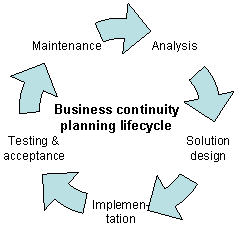
Prevention and recovery from threats that might affect a company
Business continuity may be defined as "the capability of an organization to continue the delivery of products or services at pre-defined acceptable levels following a disruptive incident", and business continuity planning (or business continuity and resiliency planning) is the process of creating sy...
The Supreme Court ruling invalidates Trump’s emergency tariffs, but the president vows to use other powers to maintain them, creating ongoing uncertainty for businesses and affecting supply chains and costs.
Context & Background
Supreme Court struck down tariffs under the International Emergency Economic Powers Act
Trump announced a new 10% tariff using a different legal authority
Businesses across sectors are facing price increases and legal uncertainty
What Happens Next
Trump is likely to pursue alternative legal avenues to impose tariffs, leading to prolonged litigation and potential congressional action to limit executive trade powers. Businesses may need to adjust supply chains and pricing strategies in response to continued tariff uncertainty.
Frequently Asked Questions
Will businesses receive refunds for tariffs already paid?
Unlikely, as the court ruling does not address refunds and Trump has indicated he will not provide refunds.
How will the new 10% tariff affect import timing?
Importers may see tariffs applied to goods arriving within 150 days, but the exact timing depends on customs processing.
Can Congress override Trump's tariff actions?
Congress could pass legislation to limit executive trade powers, but no such law is currently in place.
}
Original Source
Murky outlook for businesses after tariff ruling prompts countermoves by Trump Businesses face a new wave of uncertainty after the Supreme Court struck down tariffs imposed by President Donald Trump under an emergency powers law and Trump vowed to work around the ruling to keep his tariffs in place By MAE ANDERSON AP business writer February 21, 2026, 12:13 AM NEW YORK -- Businesses face a new wave of uncertainty after the Supreme Court struck down tariffs imposed by President Donald Trump under an emergency powers law and Trump vowed to work around the ruling to keep his tariffs in place. The Trump administration says its tariffs help boost American manufacturers and reduce the trade gap. But many U.S. businesses have had to raise prices and adjust in other ways to offset higher costs spurred by the tariffs . It remains to be seen how much relief businesses and consumers will actually get from Friday's ruling. Within hours of the court's decision, Trump pledged to use a different law to impose a 10% tariff on all imports that would last 150 days, and to explore other ways to impose additional tariffs on countries he says engage in unfair trade practices. “Any boost to the economy from lowering tariffs in the near-term is likely to be partly offset by a prolonged period of uncertainty,” said Michael Pearce, an economist at Oxford Economics. “With the administration likely to rebuild tariffs through other, more durable, means, the overall tariffs rate may yet end up settling close to current levels.” Efforts to claw back the estimated $133 billion to $175 billion of previously collected tariffs now deemed illegal are bound to be complicated, and will likely favor larger companies with more resources. Consumers hoping for a refund are unlikely to be compensated. With Trump’s unyielding position on tariffs, many business are braced for years of court battles. Basic Fun, a Florida-based maker of toys such as Lincoln Logs and Tonka trucks, last week joined a slew of othe...