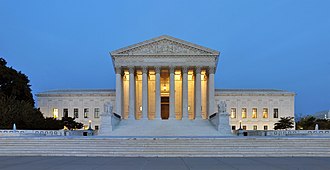
Supreme Court ruled 6-3 that IEEPA does not authorize presidential tariffs
Decision affects Trump's reciprocal tariffs and fentanyl-related import duties
Lower courts had previously found these tariffs illegal
Tariff revenue was a significant component of Trump's economic policy
📖 Full Retelling
The Supreme Court on Friday struck down a significant portion of President Donald Trump's extensive tariff agenda, ruling six to three that the International Emergency Economic Powers Act (IEEPA) does not authorize the President to impose tariffs. Chief Justice John Roberts delivered the majority opinion, while Justices Clarence Thomas, Samuel Alito and Brett Kavanaugh dissented. The decision represents a major rebuke to Trump's aggressive trade policy approach, which has fundamentally reshaped America's trade relationships since his return to the White House. Trump had implemented a sweeping array of import duties affecting nearly every country globally, many of which were justified through an expansive interpretation of IEEPA—a law designed to regulate importation during national emergencies rather than levy tariffs. The administration had argued that the law's language allowing the president to 'regulate importation' empowered Trump to impose tariffs, but critics maintained that this interpretation went beyond the law's intended scope. The ruling comes after federal trade and appeals courts had previously found these tariffs illegal, with IEEPA-based tariffs generating the majority of U.S. tariff revenue last year. The decision affects various tariff initiatives, including Trump's controversial 'reciprocal' tariffs and duties aimed at Mexico, Canada and China related to fentanyl trafficking. Trump has consistently promoted tariffs as both a revenue source and negotiation tool, claiming foreign countries bear the costs while downplaying impacts on American consumers, though his administration has acknowledged duties are paid by U.S. importers.
In most legal jurisdictions, a supreme court, also known as a court of last resort, apex court, high (or final) court of appeal, and court of final appeal, is the highest court within the hierarchy of courts. Broadly speaking, the decisions of a supreme court are binding on all other courts in a nat...
The International Emergency Economic Powers Act (IEEPA), Title II of Pub. L. 95–223, 91 Stat. 1626, enacted December 28, 1977, is a United States federal law authorizing the president to regulate international commerce after declaring a national emergency in response to any unusual and extraordinary...
John Glover Roberts Jr. (born January 27, 1955) is an American jurist who has served since 2005 as the 17th chief justice of the United States. Though primarily an institutionalist, he has been described as having a moderate conservative judicial philosophy.
The Supreme Court on Friday struck down a huge chunk of President Donald Trump's far-reaching tariff agenda. The law that undergirds those import duties "does not authorize the President to impose tariffs," the majority ruled six to three. Chief Justice John Roberts delivered the opinion of the court. Justices Clarence Thomas, Samuel Alito and Brett Kavanaugh dissented. Since retaking the White House, Trump has rapidly reshaped America's longstanding trade relationships by imposing a staggering array of import duties that have touched nearly every country on earth. Many of those tariffs were invoked using a novel reading of the International Emergency Economic Powers Act, or IEEPA. They include Trump's near-global "reciprocal" tariffs, and separate duties related to the alleged trafficking of deadly drugs into the U.S. IEEPA does not explicitly mention tariffs. Instead, it allows the president to "regulate … importation" of foreign property transactions after declaring a national emergency in order to deal with certain "unusual and extraordinary" threats. The Trump administration has argued that that language empowers the president to impose tariffs on foreign goods. Critics charged that the law does not permit the president to unilaterally impose levies of any size on any country at any time. A federal trade court and a federal appeals court both found Trump's IEEPA tariffs illegal before the Supreme Court took up the case. The majority of U.S. tariff revenue generated last year came from the IEEPA duties. Trump last April unveiled his sweeping reciprocal tariff plans at a much-ballyhooed White House event marking what he had dubbed America's "Liberation Day." That announcement stoked a sudden market panic, and the tariffs were quickly put on pause. They have since been repeatedly tweaked, delayed and reimposed, adding confusion and further complexity to the administration's tangled web of trade policies . Other IEEPA-based tariffs include a set aimed at Mexico, Ca...