
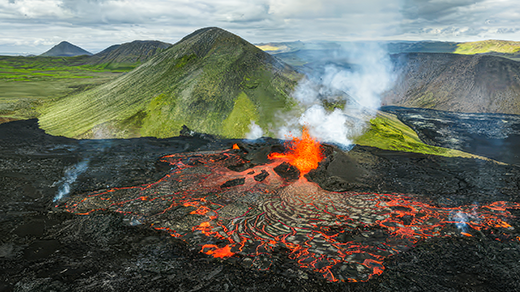
When Coupled Volcanoes Talk, These Researchers Listen
#volcanoes #Kodiak Island #Robert Fiske Griggs #ash #eruption #expedition #Alaska #research
📌 Key Takeaways
- In 1912, Kodiak Island was covered in a foot of ash from a volcanic eruption, alarming residents.
- Botanist Robert Fiske Griggs led expeditions to study the aftermath on Kodiak Island starting in 1913.
- The article highlights research into interconnected volcanic systems and their communication mechanisms.
- Scientists are monitoring volcanic activity to better understand and predict eruptions in coupled systems.
📖 Full Retelling
🏷️ Themes
Volcanology, Scientific Research
📚 Related People & Topics

Kodiak Island
Island off the coast of Alaska, United States
Kodiak Island (Alutiiq: Qikertaq; Russian: Кадьяк, romanized: Kadyak) is a large island on the south coast of the U.S. state of Alaska, separated from the Alaska mainland by the Shelikof Strait. The largest island in the Kodiak Archipelago, Kodiak Island is the second largest island in the United S...

Robert Fiske Griggs
American botanist (1881–1962)
Robert Fiske Griggs (August 22, 1881, in Brooklyn, Connecticut – June 10, 1962), was a botanist who led a 1915 National Geographic Society (NGS) expedition to observe the aftermath of the Katmai volcanic eruption.

Alaska
U.S. state
Alaska ( ə-LASS-kə) is a non-contiguous U.S. state located in the northwestern regions of North America. Part of the Western United States region, it is one of the two non-contiguous U.S. states, alongside Hawaii. Alaska is considered to be the northernmost, westernmost, and, longitudinally, the ea...
Entity Intersection Graph
No entity connections available yet for this article.
Mentioned Entities
Deep Analysis
Why It Matters
This news highlights the importance of monitoring volcanic activity, especially in interconnected systems, to improve eruption forecasting and disaster preparedness. It affects communities living near volcanoes, scientists studying geological hazards, and policymakers responsible for public safety and emergency response. Understanding volcanic communication can lead to better early warning systems, potentially saving lives and reducing economic damage from eruptions.
Context & Background
- The 1912 eruption of Novarupta in Alaska was one of the largest volcanic events of the 20th century, depositing ash across Kodiak Island and beyond.
- Robert Fiske Griggs, a botanist, led expeditions that later contributed to the establishment of Katmai National Monument in 1918, now Katmai National Park and Preserve.
- Volcanoes can influence each other through stress transfer in the Earth's crust, magma plumbing systems, or seismic activity, a phenomenon studied in volcanic fields worldwide.
What Happens Next
Researchers will likely continue analyzing data from coupled volcanoes to develop models predicting eruption sequences, with potential field studies in Alaska and other volcanic regions. Advances in monitoring technology, such as satellite sensors and seismic networks, may enhance detection of volcanic interactions. Findings could be published in scientific journals within the next year, informing hazard assessments and mitigation strategies.
Frequently Asked Questions
Volcanoes 'talk' when they interact through geological processes like shared magma chambers or stress changes, where activity at one volcano can trigger or influence eruptions at another. This communication is studied using seismic data, gas emissions, and ground deformation to understand volcanic hazards.
The 1912 Novarupta eruption was the largest in the 20th century, releasing massive ash clouds that affected global climate and reshaped the Alaskan landscape. It led to scientific explorations that advanced volcanology and conservation efforts in the region.
Researchers use tools like seismometers to detect earthquakes, GPS to measure ground movement, and satellite imagery to track gas plumes and thermal changes. This data helps identify patterns suggesting volcanoes are influencing each other's behavior.
Communities near volcanoes benefit through improved early warning systems, while scientists gain insights into eruption dynamics. Governments and emergency planners use this information to develop evacuation plans and reduce disaster risks.
Source Scoring
Detailed Metrics
Key Claims Verified
The Novarupta-Katmai eruption, one of the largest of the 20th century, began in June 1912, severely impacting Kodiak Island. Robert F. Griggs, a botanist, was indeed informed about the event.
Robert F. Griggs, a botanist, did lead expeditions to the Katmai region starting in 1913. However, his affiliation was with Ohio State University, not 'University of Ohio.' This is a minor inaccuracy in the institution's name.
Historical accounts and scientific studies confirm that Kodiak Island received significant ashfall from the 1912 Novarupta eruption, with depths often exceeding a foot in many areas.
Caveats / Notes
- The snippet refers to 'University of Ohio' instead of the correct 'Ohio State University' for Robert F. Griggs's affiliation, a minor naming error.