
Antonio Tejero obituary
#Antonio Tejero #23-F coup #Spanish Civil Guard #Congress of Deputies #Spanish democracy #Franco dictatorship #political prisoner
📌 Key Takeaways
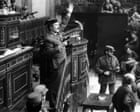
- Antonio Tejero was a former Spanish Civil Guard officer who led the failed 1981 coup attempt in Spain.
- He stormed the Spanish Congress of Deputies with armed Civil Guards in an effort to overthrow the democratic government.
- The coup attempt, known as 23-F, was a pivotal event in Spain's transition to democracy after Franco's dictatorship.
- Tejero was convicted and served 15 years in prison for his role in the coup.
- His death marks the passing of a controversial figure associated with anti-democratic forces in modern Spanish history.
📖 Full Retelling
🏷️ Themes
Spanish history, Political coup, Obituary
📚 Related People & Topics

Francoist Spain
Period of Spanish history (1936–1975)
Francoist Spain (Spanish: España franquista; English: pronounced Franco-ist), also known as the Francoist dictatorship (dictadura franquista), or Nationalist Spain (España nacionalista), and Falangist Spain (España falangista), was the period of Spanish history between 1936 and 1975, when Francisco ...

Civil Guard (Spain)
Gendarmerie branch of Spain's armed forces
The Civil Guard (Spanish: Guardia Civil [ˈɡwaɾðja θiˈβil]) is one of the two national law enforcement agencies of Spain (the other being the National Police). As a national gendarmerie, it is military in nature and is responsible for civil policing under the authority of both the Ministry of the Int...

Congress of Deputies
Lower house of the Cortes Generales
The Congress of Deputies (Spanish: Congreso de los Diputados) is the lower house of the Cortes Generales, Spain's legislative branch, the upper house being the Senate. The Congress meets in the Palace of the Parliament (Palacio de las Cortes) in Madrid. Congress has 350 members elected from fifty-tw...

Antonio Tejero
Spanish Civil Guard colonel and failed coup leader (1932–2026)
Antonio Tejero Molina (30 April 1932 – 25 February 2026) was a Spanish lieutenant colonel of the Guardia Civil. He was the most prominent figure in the failed coup d'état against the newly democratic Spanish government on 23 February 1981 when he stormed the Congress of Deputies with 200 armed Civil...
Entity Intersection Graph
Connections for Francoist Spain:
Mentioned Entities
Deep Analysis
Why It Matters
Antonio Tejero's death marks the passing of a key figure from Spain's turbulent transition to democracy, whose attempted coup in 1981 threatened to derail the entire democratic process. This matters because it represents closure for a controversial chapter in modern Spanish history that still influences political discourse today. The obituary serves as a reminder of the fragility of democratic institutions and the importance of defending them against authoritarian threats. It affects historians, political scientists, and Spanish citizens who lived through or study the post-Franco transition period.
Context & Background
- Antonio Tejero was a Spanish Civil Guard lieutenant colonel who led the failed 1981 coup attempt known as 23-F
- The coup occurred during the parliamentary vote to confirm Leopoldo Calvo Sotelo as Prime Minister, with Tejero famously holding parliament at gunpoint
- Spain was in a fragile transition period following Francisco Franco's death in 1975 after 36 years of dictatorship
- The coup attempt lasted approximately 18 hours before King Juan Carlos I publicly denounced it, helping to ensure its failure
- Tejero was sentenced to 30 years in prison but was released in 1996 after serving 15 years
- The failed coup paradoxically strengthened Spanish democracy by demonstrating public and institutional support for democratic governance
What Happens Next
Historical reassessment of Tejero's legacy will continue among scholars and in Spanish media, with renewed debate about his role in Spanish history. The anniversary of the 23-F coup attempt (February 23) will likely receive increased attention in upcoming commemorations. No immediate political or legal developments are expected, as Tejero had largely faded from public life since his release from prison.
Frequently Asked Questions
The 23-F coup attempt was a critical test for Spain's young democracy that ultimately strengthened it when it failed. It demonstrated that democratic institutions had sufficient support to withstand authoritarian challenges, and King Juan Carlos's decisive opposition to the coup bolstered the monarchy's democratic credentials.
Tejero benefited from Spanish sentencing laws that allowed for conditional release after serving a portion of a prison term. His release in 1996 reflected both legal provisions for early release and the political climate of reconciliation during Spain's democratic consolidation period.
The failed coup paradoxically strengthened Spanish democracy by uniting political parties and the public in defense of democratic institutions. It discredited military intervention in politics and accelerated political reforms, though it also created lasting tensions about how to remember and interpret this turbulent period.
Tejero was a career military officer in the Civil Guard who had previously been involved in anti-democratic activities. He had been arrested and tried for involvement in Operation Galaxia, an earlier coup plot in 1978, which demonstrated his longstanding opposition to Spain's democratic transition.
Tejero remains a deeply controversial figure, viewed by most as a dangerous anti-democratic extremist but by a small minority as a patriot. His legacy is typically discussed in the context of Spain's difficult transition from dictatorship to democracy and serves as a cautionary tale about political extremism.